

Filter by
Product Family
Battery Size
System of Measurement
Voltage

Manufacturer Equivalent Number
Battery Connection

Battery Cell Type
Battery Terminal Configuration

Battery Chemistry
Battery Capacity
Battery Type
Electrical Connection
Application
Thread Size
Performance
DFARS Specialty Metals
Export Control Classification Number (ECCN)
RoHS
Depth
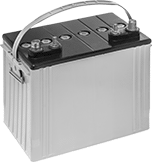
Large-Cell Batteries for Starting and Continuous Use
 |
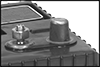 |
Post-and-Stud Terminal Battery Connection |
 |
C |
These dual-purpose batteries provide a surge of power to start automobiles and other vehicles, and they deliver power over a long period of time. They're deep cycle, so they can handle many charge/deep discharge cycles. Because they are wet-cell batteries and contain electrolyte in an unsealed container, they must be mounted upright. They may occasionally need to be filled with distilled water.
Reserve capacity is the number of minutes that a new, fully charged battery can continuously discharge at 25 amps at 80° F. Marine cranking amps is the maximum amps that a new, fully charged battery can continuously deliver for 30 seconds at 32° F.
Warning: Batteries should always be charged and discharged in a ventilated area.
Voltage, V DC | Battery Size | Mfr. Equiv. No. | Battery Cap., A·h | Battery Terminal Configuration | Reserve Cap., min. | Marine Cranking Amps | Thread Size | Ht. | Wd. | Dp. | Each | |||
|---|---|---|---|---|---|---|---|---|---|---|---|---|---|---|
Wet Cell Lead Acid | ||||||||||||||
Post-and-Stud Terminal Battery Connection | ||||||||||||||
| 12 | 24 | 24M | 70 | C | 120 | 625 | 5/16"-18 | 9.4" | 10.3" | 6.8" | 71805K82 | 0000000 | ||
Sealed Large-Cell Batteries for Starting and Continuous Use
 |
|
Post-and-Stud Terminal Battery Connection |
|
C |
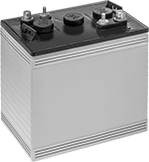
Deliver a surge of power to start automobiles and other vehicles, and provide power over a long time. These batteries are deep cycle, so they can handle many charge/deep discharge cycles. All are dry cell, so they have an absorbed glass mat (AGM) that soaks up the electrolyte and can be used in any position except upside down. They can be recharged hundreds of times.
Reserve capacity is the number of minutes that a new, fully charged battery can continuously discharge at 25 amps at 80° F. Marine cranking amps is the maximum amps that a new, fully charged battery can continuously deliver for 30 seconds at 32° F.
Warning: Batteries should always be charged and discharged in a ventilated area.
Voltage, V DC | Battery Size | Mfr. Equiv. No. | Battery Cap., A·h | Battery Terminal Configuration | Reserve Cap., min. | Marine Cranking Amps | Thread Size | Ht. | Wd. | Dp. | Each | |||
|---|---|---|---|---|---|---|---|---|---|---|---|---|---|---|
Dry-Cell AGM Lead Acid | ||||||||||||||
Post-and-Stud Terminal Battery Connection | ||||||||||||||
| 12 | 24 | 24M | 79 | C | 135 | 800 | 5/16"-18 | 9.9" | 10.9" | 6.8" | 71805K13 | 0000000 | ||
