


Filter by
Product Family
System of Measurement
Distance Measured


Manufacturer
Number of Gauges
Measures
Relative Bore Size
U.S.–Mexico–Canada Agreement (USMCA) Qualifying

Material
DFARS Specialty Metals
Export Control Classification Number (ECCN)
RoHS
REACH
Container Type

Economy Small-Bore Gauge Sets
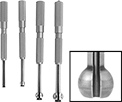 |
Measure the diameter of small holes, grooves, and recesses. These gauges help you find deviations in size or roundness that can cause precision parts, such as engine or valve cylinders, to wear quickly or run poorly. They have a full-ball probe, which has a 360° contact surface that’s easy to center in tight spaces. Compared to gauges with an anvil, spring-loaded contact, or half-ball probe, they’re less likely to tilt inside a bore and skew measurements.
Insert the probe into a bore and turn the knob on the handle to expand the contacts. Measure the distance across the contacts with a micrometer to find the bore diameter.
Distance Measured Range | Material | No. of Gauges | Includes | Each | |||
|---|---|---|---|---|---|---|---|
Full-Ball Small Bore | |||||||
| 0.125" to 0.5" | Steel | 4 | One full-ball gauge with 0.125"-0.200" measuring range and 61/64" max. depth One full-ball gauge with 0.200"-0.300" measuring range and 1 3/64" max. depth One full-ball gauge with 0.300"-0.400" measuring range and 1 5/32" max. depth One full-ball gauge with 0.400"-0.500" measuring range and 1 19/64" max. depth | 6741A47 | 000000 | ||
Starrett Small-Bore Gauges
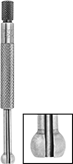 |
Full-Ball Gauge |
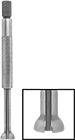 |
Half-Ball Gauge |
Distance Measured Range | Max. Dp. Measured | Material | Mfr. Model No. | Each | |||
|---|---|---|---|---|---|---|---|
Full-Ball Small Bore | |||||||
| 0.125" to 0.2" | 2 1/2" | Steel | 829A | 2100A1 | 000000 | ||
| 0.2" to 0.3" | 2 1/2" | Steel | 829B | 2100A2 | 00000 | ||
| 0.3" to 0.4" | 2.7" | Steel | 829C | 2100A3 | 00000 | ||
| 0.4" to 0.5" | 3" | Steel | 829D | 2100A4 | 00000 | ||
Half-Ball Small Bore | |||||||
| 0.125" to 0.2" | 2" | Steel | 831A | 2205A1 | 00000 | ||
| 0.2" to 0.3" | 3" | Steel | 831B | 2205A2 | 00000 | ||
| 0.3" to 0.4" | 3" | Steel | 831C | 2205A3 | 00000 | ||
| 0.4" to 0.5" | 3" | Steel | 831D | 2205A4 | 00000 | ||
Starrett Small-Bore Gauge Sets
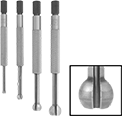 | 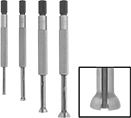 |
Full-Ball Gauge Set | Half-Ball Gauge Set |
Check a variety of hole, groove, and slot diameters. Each gauge in these sets has a different measuring range. The end of these gauges has a 360° contact surface that’s easier to center in tight spaces than anvils or spring-loaded contacts. Use them to measure slots and bores in precision parts, such as electronics, where small size deviations can cause inefficiencies.
Insert the probe into a bore and turn the knob on the handle to expand the contacts. To find the bore diameter, use a micrometer to measure the distance across the contacts.
Full-Ball—Full-ball gauges are best for deep bores. They’re less likely than half-ball gauges to tilt within the bore, which helps to avoid skewed measurements caused by placing the gauge off-center.
Half-Ball—Half-ball gauges are best for measuring near the bottom of flat, shallow bores.
Distance Measured Range | Material | No. of Gauges | Includes | Mfr. Model No. | Each | |||
|---|---|---|---|---|---|---|---|---|
Full-Ball Small Bore | ||||||||
| 0.125" to 0.5" | Steel | 4 | One full-ball gauge with 0.125"-0.200" measuring range and 2 1/2" max. depth One full-ball gauge with 0.200"-0.300" measuring range and 2 1/2" max. depth One full-ball gauge with 0.300"-0.400" measuring range and 2.7" max. depth One full-ball gauge with 0.400"-0.500" measuring range and 3" max. depth | S829EZ | 2100A5 | 0000000 | ||
Half-Ball Small Bore | ||||||||
| 0.125" to 0.5" | Steel | 4 | One half-ball gauge with 0.125"-0.200" measuring range and 2" max. depth One half-ball gauge with 0.200"-0.300" measuring range and 3" max. depth One half-ball gauge with 0.300"-0.400" measuring range and 3" max. depth One half-ball gauge with 0.400"-0.500" measuring range and 3" max. depth | S831EZ | 2205A5 | 000000 | ||
