McMaster-Carr logo
    Enter e-mail addresses in the fields below
    Message
    Cancel
    Comments
    E-mail address (if you would like a response)
    21 Products
    About Wire and Cable
    industrial info icon

    Compare wire vs. cable and choose the right option based on gauge, number of conductors, insulation, and current rating.

    Long-Life Continuous-Flex Lead Wire

    The strands in this wire have better fatigue resistance under repeated flexing than the copper strands in standard continuous-flex wire, so it will last longer. Often used in low-current signaling in automated applications such as robotics, it withstands continuous motion without degrading data or signal transmission.
    Stranded Wire with PVC Outer Jacket
    Image of Product. Front orientation. Carbon Fiber Wire. Long-Life Continuous-Flex Lead Wire.
    Carbon Fiber Wire—Carbon fiber wire has 12,000 strands that are highly flexible and have excellent strength.
    Per Ft.
    AWG
    Current @
    Temp.
    Temp. Range,
    ° F
    OD
    Outer Jacket
    Color
    Performance
    Choose a Length, ft.
    1-99
    100-Up
    Unshielded
     
    Carbon Fiber Wire—300V AC
    38
    0.1 amp @ 86° F0 to 1400.09"GrayLong Life10, 25, 50, 1008692T30000000000
     

    Easy-Print PLA 3D Printer Filaments

    Image of Product. Front orientation. 3D Printer Filaments. Easy-Print PLA 3D Printer Filaments .
    Image of Specification. Black. Front orientation. Contains Border. Black. Easy-Print PLA 3D Printer Filaments .

    Black

    The most commonly used 3D printing material, these PLA filaments make detailed parts at a low melting point, so they won’t warp as they cool, rarely clog nozzles, and don’t require a heated printer bed. They’re also unlikely to drip and produce plastic strings for a clean finished part. In general, they’re best for printing prototypes instead of load-bearing parts since they’re not as strong as ABS or as heat resistant as PEEK. Print them on a fused filament fabrication (FFF) 3D printer.
    Filaments with an annealing temperature can be heat treated to make parts harder, stronger, and better at resisting heat. To anneal, heat your finished part to the listed temperature and then let it cool slowly.
    Maximum exposure temperature is the point at which a printed part will begin to deform. Above this temperature, your part will start to lose structural integrity. Filaments that can be annealed are also rated for maximum temperature after annealing, which is the new maximum exposure temperature once that process completes.
    Carbon Fiber Filled—Carbon fiber-filled PLA filaments make rigid parts that are difficult to bend and break. Their parts can also be threaded and machined more easily than the same non-filled filaments. Because these filaments are abrasive, you should only use them with abrasion-resistant nozzles.
    Tensile Strength—Tensile strength is the best measure of a filament's overall strength. Similar to the stress applied on a rope during a game of tug-of-war, it's the amount of pulling force a material can handle before breaking. A higher rating means a stronger filament. A tensile strength of 5,000 psi and above is considered good; 12,000 psi and above is excellent.
    Spool
    Each
    Dia.,
    mm
    Printing Temp.
    For Printer
    Bed Temp.
    Tensile
    Strength
    Hardness
    Max. Exposure
    Temp.
    Annealing Temp.
    Max. Temp. After
    Annealing
    For Min. Nozzle
    Opening Dia., mm
    Dia.,
    mm
    Dp.,
    mm
    Material
    Wt.,
    g
    1-9
    10-Up
    Carbon Fiber-Filled PLA
     
    Opaque Black
    1.75195° to 225° C
    383° to 437° F
    21° to 60° C
    70° to 140° F
    Not RatedNot Rated 60° C
    140° F
    100° C to 120° C
    212° F to 248° F
    138° C
    280° F
    0.420050Cardboard5001317N22000000000000
    1.75195° to 225° C
    383° to 437° F
    21° to 60° C
    70° to 140° F
    Not RatedNot Rated 60° C
    140° F
    100° C to 120° C
    212° F to 248° F
    138° C
    280° F
    0.4300100Plastic3,0001317N19000000000000
    1.75210° to 230° C
    410° to 446° F
    21° to 60° C
    70° to 140° F
    Not RatedNot Rated 60° C
    140° F
    0.420050Cardboard5001317N130000000000
    1.75210° to 230° C
    410° to 446° F
    21° to 60° C
    70° to 140° F
    Not RatedNot Rated 60° C
    140° F
    0.4300100Plastic3,0001317N11000000000000
    2.85195° to 225° C
    383° to 437° F
    21° to 60° C
    70° to 140° F
    Not RatedNot Rated 60° C
    140° F
    100° C to 120° C
    212° F to 248° F
    138° C
    280° F
    0.420050Cardboard5001317N230000000000
    2.85210° to 230° C
    410° to 446° F
    21° to 60° C
    70° to 140° F
    Not RatedNot Rated 60° C
    140° F
    0.420050Cardboard5001317N140000000000
    2.85210° to 230° C
    410° to 446° F
    21° to 60° C
    70° to 140° F
    Not RatedNot Rated 60° C
    140° F
    0.4300100Plastic3,0001317N12000000000000
     

    Wear-Resistant Nylon 3D Printer Filaments

    Image of Product. Front orientation. 3D Printer Filaments. Wear-Resistant Nylon 3D Printer Filaments .
    Image of Specification. Front orientation. Contains Border. Black. Wear-Resistant Nylon 3D Printer Filaments .

    Black

    Print tough, long-lasting parts that won’t scratch or wear out from constant motion and friction, such as gears and washers. You can even tap or drill the parts without them cracking or shattering.
    Use these filaments with fused filament fabrication (FFF) printers. Because of their relatively high melting point, a heated printer bed is recommended. These filaments also emit fumes when printing, so it’s best to use them in an enclosed printer or to remove the fumes with a fume exhauster. Store them in a sealed container with a desiccant so they don’t absorb moisture in the air, which can make them unusable.
    Maximum exposure temperature is the point at which a printed part will begin to deform. Above this temperature, your printed parts will start to lose structural integrity.
    Carbon Fiber Filled—Carbon-fiber-filled nylon filaments make rigid parts that are difficult to bend and break. Their parts can also be threaded and machined more easily than the same filaments without any filler. However, they’re abrasive, so only use them with abrasion-resistant nozzles.
    Tensile Strength—Tensile strength is the best measure of a filament's overall strength. Similar to the stress applied on a rope during a game of tug-of-war, it's the amount of pulling force a material can handle before breaking. A higher rating means a stronger filament. A tensile strength of 5,000 psi and above is considered good; 12,000 psi and above is excellent.
    Spool
    Dia.,
    mm
    Printing Temp.
    For Printer
    Bed Temp.
    Tensile Strength,
    psi
    Hardness
    Max. Exposure
    Temp.
    For Min. Nozzle
    Opening Dia., mm
    Dia.,
    mm
    Dp.,
    mm
    Material
    Wt.,
    g
    Each
    Carbon Fiber-Filled Nylon—Extreme Strength, High Strength, Impact Resistant, Wear Resistant
     
    Opaque Black
    1.75280° to 300° C
    535° to 570° F
    50° C
    122° F
    15,225Not Rated 215° C
    419° F
    0.420065Cardboard5003483N6000000
     

    High-Strength Expandable Wire Sleeving
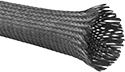
    Image of Product. Front orientation. Wire Sleeving. High-Strength Expandable Wire Sleeving.
    With excellent torsional strength, this sleeving withstands the extreme twisting found in robotics. Made of carbon fiber, it has impact strength similar to steel yet is lighter than plastic and rubber. Resistant to corrosion and chemicals, it’s often used to protect brake lines and hydraulic lines. It’s expandable, so it stretches to fit over items for easy installation, then tightens around its contents for a secure fit. The braided construction permits heat and moisture to dissipate. Cut with scissors or a hot-blade knife.
    Carbon Fiber
    10 ft. Long
    ID
    Expanded
    ID
    Wall
    Thk.
    Temp. Range,
    ° F
    Color
    Each
    1/4"5/16"1/16"-40 to 415Black5726N11000000
    1/2"5/8"1/16"-40 to 415Black5726N1200000
    3/4"7/8"1/16"-40 to 415Black5726N1300000
    1"1 1/16"1/16"-40 to 415Black5726N1400000
    1 1/2"1 3/4"1/16"-40 to 415Black5726N1500000
     

    High-Strength Impact-Resistant Polycarbonate 3D Printer Filaments

    Image of Product. Front orientation. 3D Printer Filaments. High-Strength Impact-Resistant Polycarbonate 3D Printer Filaments .
    Create strong, durable parts that carry heavy loads and absorb blows and other impact without cracking or breaking. Made of polycarbonate, these filaments are stronger and resist heat better than other impact-resistant filaments, such as those made from ABS or ASA.
    Use with a fused filament fabrication (FFF) 3D printer. These filaments have a high melting point and must be printed onto a heated bed. Without it, parts will cool too quickly and warp. These filaments also release fumes as they are printed, so use an enclosed printer or a fume exhauster to ventilate them.
    Maximum exposure temperature is the point at which a printed part will begin to deform. Above this temperature, your printed parts will start to lose structural integrity.
    Carbon Fiber Filled—Carbon-fiber-filled polycarbonate filaments make rigid parts that are difficult to bend and break. Parts made from these filaments can also be threaded and machined more easily than parts made from polycarbonate filaments without a filler. Carbon-fiber-filled filaments are abrasive, so you should use them with an abrasion-resistant nozzle.
    Tensile Strength—Tensile strength is the best measure of a filament's overall strength. Similar to the stress applied on a rope during a game of tug-of-war, it's the amount of pulling force a material can handle before breaking. A higher rating means a stronger filament. A tensile strength of 5,000 psi and above is considered good; 12,000 psi and above is excellent.
    Spool
    Dia.,
    mm
    Printing Temp.
    For Printer
    Bed Temp.
    Tensile Strength,
    psi
    Hardness
    Max. Exposure
    Temp.
    For Min. Nozzle
    Opening Dia., mm
    Dia.,
    mm
    Dp.,
    mm
    Material
    Wt.,
    g
    Each
    Carbon Fiber-Filled Polycarbonate—Extra High Strength, High Strength, Highly Absorbent, Impact Resistant
     
    Opaque Black
    1.75260° to 280° C
    500° to 535° F
    80° to 100° C
    175° to 210° F
    10,580Not Rated 115° C
    245° F
    0.419555Plastic7501317N353000000
    2.85260° to 280° C
    500° to 535° F
    80° to 100° C
    175° to 210° F
    10,580Not Rated 115° C
    245° F
    0.419555Plastic7501317N35400000
     

    Impact-Resistant ABS 3D Printer Filaments

    Image of Product. Front orientation. 3D Printer Filaments. Impact-Resistant ABS 3D Printer Filaments.
    Image of Specification. Front orientation. Contains Border. Black. Impact-Resistant ABS 3D Printer Filaments.

    Black

    Bumps, scrapes, and falls won’t damage these tough ABS filaments. Known for their durability, they absorb impact without cracking or breaking, and won’t degrade when heated. Use them to print tool handles, storage cases, and other parts that are handled or dropped frequently. These filaments are a good place to start if you’re experimenting with printing impact-resistant parts.
    Use with a fused filament fabrication (FFF) 3D printer. These filaments have a high melting point and must be printed onto a heated bed. Without it, parts will cool too quickly and warp. These filaments also release fumes as they are printed, so use an enclosed printer or a fume exhauster to ventilate them.
    Maximum exposure temperature is the point at which a printed part will begin to deform. Above this temperature, your printed parts will start to lose structural integrity.
    Carbon Fiber Filled—Carbon-fiber-filled ABS filaments make rigid parts that are difficult to bend and break. Their parts can also be threaded and machined more easily than ABS filaments without a filler. Carbon-fiber-filled filaments are abrasive, so you should use them with an abrasion-resistant nozzle. They will wear out other nozzles.
    Tensile Strength—Tensile strength is the best measure of a filament's overall strength. Similar to the stress applied on a rope during a game of tug-of-war, it's the amount of pulling force a material can handle before breaking. A higher rating means a stronger filament. A tensile strength of 5,000 psi and above is considered good; 12,000 psi and above is excellent.
    Spool,
    mm
    Dia.,
    mm
    Printing Temp.
    For Printer
    Bed Temp.
    Tensile Strength,
    psi
    Max. Exposure
    Temp.
    For Min. Nozzle
    Opening Dia., mm
    Dia.
    Dp.
    Wt.,
    g
    Color
    Each
    Carbon Fiber-Filled ABS—Extra High Strength, High Strength, Highly Absorbent, Impact Resistant
    1.75220° to 240° C
    428° to 464° F
    100° to 110° C
    212° to 230° F
    6,67076° C
    169° F
    0.419555750Black1317N311000000
    2.85220° to 240° C
    428° to 464° F
    100° to 110° C
    212° to 230° F
    6,67076° C
    169° F
    0.419555750Black1317N31200000
     

    Moisture-Resistant Polyester 3D Printer Filaments

    Image of Product. Front orientation. 3D Printer Filaments. Moisture-Resistant Polyester 3D Printer Filaments .
    Image of Specification. Front orientation. Contains Border. Black. Moisture-Resistant Polyester 3D Printer Filaments .

    Black

    Parts printed with these polyester filaments absorb less moisture than other types of plastic, making them ideal for use in wet or humid environments. They are more durable and flexible than PLA, and easier to print than ABS. Use these filaments with fused filament fabrication (FFF) 3D printers, and print onto a heated print bed. Printing onto a cool surface causes the molten filament to change temperature rapidly, which can warp your designs. Although finished parts are moisture-resistant, these filaments are sensitive to humidity, and should be stored in a dehumidifying cabinet or a sealed container with desiccant for the best printing quality.
    Maximum exposure temperature is the point at which a printed part will begin to deform. Above this temperature, your printed parts will start to lose structural integrity.
    Carbon Fiber Filled—Carbon-fiber-filled PETG is often used to make rigid parts that are difficult to bend and break. Finished parts are easier to thread and machine than unfilled parts. Because these filaments are abrasive, use them only with abrasion-resistant nozzles.
    PETG—PETG contains glycol, so it is less brittle and easier to print than PETT and PCTG.
    Antistatic—Antistatic filaments make parts that prevent the buildup of static electricity. This helps prevent the buildup of dust or fibers on the surface of your finished part. However, they are not as effective at preventing electrostatic discharge as static-dissipative filaments.
    Tensile Strength—Tensile strength is the best measure of a filament's overall strength. Similar to the stress applied on a rope during a game of tug-of-war, it's the amount of pulling force a material can handle before breaking. A higher rating means a stronger filament. A tensile strength of 5,000 psi and above is considered good; 12,000 psi and above is excellent.
    Spool
    Dia.,
    mm
    Printing Temp.
    For Printer
    Bed Temp.
    Tensile Strength,
    psi
    Surface Resistivity,
    ohm/sq.
    Hardness
    Max. Exposure
    Temp.
    For Min. Nozzle
    Opening Dia., mm
    Dia.,
    mm
    Dp.,
    mm
    Material
    Wt.,
    g
    Each
    Carbon Fiber-Filled PETG—Antistatic, Extra High Strength, High Strength, Moisture Resistant, Spark Resistant
     
    Opaque Black
    1.75230° to 260° C
    446° to 500° F
    60° C
    140° F
    8,1201× 10^9 to 1× 10^12Not Rated 77° C
    170° F
    0.420060Plastic7503462N1000000
    2.85230° to 260° C
    446° to 500° F
    60° C
    140° F
    8,1201× 10^9 to 1× 10^12Not Rated 77° C
    170° F
    0.420060Plastic7503462N1100000
     

    Coaxial and Fiber-Optic Cable Cutters
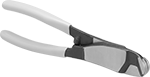
    Image of Product. Front orientation. Cable Cutters. Coaxial and Fiber-Optic Cable Cutters.
    Produce clean, distortion-free cuts in cable with one-handed operation.
    For Data
    Cable
    For Use On
    Max.
    Dia.
    Max. Wire
    Ga.
    Overall
    Lg.
    Jaw
    Material
    Handle
    Material
    Grip
    Material
    Opening
    Style
    Each
    Carbon Fiber, Copper, Fiberglass, Kevlar3/4"500 MCM8 1/4"SteelSteelPlasticManual4938A31000000
    back to top