

Filter by
System of Measurement
Grip Range
Collet Size

For Holding
Material

Approximate Diameter Compression
Face Type

DFARS Specialty Metals
RoHS
U.S.–Mexico–Canada Agreement (USMCA) Qualifying
Specifications Met
Export Control Classification Number (ECCN)
ER Collets
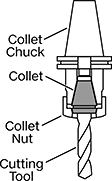 | 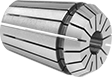 |
The most widely used type of collet, these collets hold cutting tools in ER collet chucks for milling, drilling, and routing. Spring slots clamp evenly around the shank to minimize runout for clean, accurate cuts and long tool life. The slots flex to grip slightly undersized shanks too, so you don't need an exact match for each cutting tool in your lineup. You can also use these collets in ER collet fixtures and custom setups to keep small round parts centered.
Chrome-Moly Steel—Hardened chrome-moly steel collets are more wear-resistant than hardened 52100 alloy steel collets. They hold their shape better over time and have lower runout, even with frequent bit changes. Often used for high-volume production runs, they stand up to high-speed, high-force machining in any material.
Collet Size | Grip Range | Total Indicated Runout (TIR) Accuracy | ID Tolerance | Max. Body Dia. | Overall Lg. | Specs. Met | Each | |||
|---|---|---|---|---|---|---|---|---|---|---|
ER-11 | ||||||||||
Hardened Chrome-Moly Steel | ||||||||||
| 1/32" | 0.024" to 0.031" | 0.0002" | -0.0001" to 0.0001" | 0.46" | 0.71" | DIN 6499-B, ISO 15488 Form B | 4560N101 | 000000 | ||
ER-16 | ||||||||||
Hardened Chrome-Moly Steel | ||||||||||
| 1/32" | 0.024" to 0.031" | 0.0002" | -0.0001" to 0.0001" | 0.68" | 1.06" | DIN 6499-B, ISO 15488 Form B | 3215A301 | 00000 | ||
DA Collets
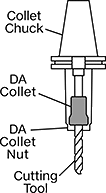 | 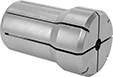 |
Also known as double-angle and Erickson collets, these collets are used for drilling, reaming, and light milling. They grip cutting tools in DA collet chucks but are less accurate and have a weaker grip than ER and TG collets. This can lead to a shorter life for these collets and cutting tools. You can also use them with die grinders to hold bits and burs.
