


Filter by


For Robot Arm Manufacturer


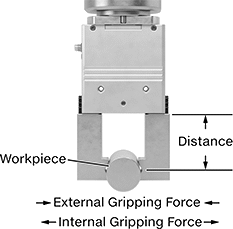
External Gripping Force
Compatible with Manufacturer

Manufacturer Series
Component


Weight
Environment

Manufacturer Model Number
U.S.–Mexico–Canada Agreement (USMCA) Qualifying
DFARS Specialty Metals
Export Control Classification Number (ECCN)
Electrical Connection


Finger Spacing

Electric Pick-and-Place Grippers
 |
Gripper Fingers Not Included |
Lift and move items with electricity—no need for an air supply or complicated control valves. These grippers have a servomotor that opens and closes the jaws in a parallel motion, like elevator doors, with a consistent gripping force in either direction. This lets you grab parts from the outside or open the jaws inside hollow parts to grab them when the outside is hard to grip. Adjust the gripping force with the switch on the side. Open and close these grippers with digital signals from your controller. You’ll also need gripper fingers—choose ready-to-use fingers (sold separately) or machine your own to grip complex shapes.
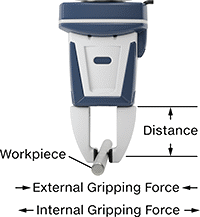
External force and internal force describe how hard the gripper can squeeze your part at the fingertips, also called the gripping distance. The less friction there is between the part and fingers, the more force you’ll need to lift a part. Typically, you’ll need a force that’s about 10 times the part’s weight, but an oily part might need a force about 20 times its weight. However, air pressure and finger length also affect the ideal force. Click on a part number and select "Product Detail" to view a chart that shows how external or internal force changes as the gripping distance changes.
Double Acting%20--%3e%3csvg%20version='1.1'%20id='Layer_1'%20xmlns='http://www.w3.org/2000/svg'%20xmlns:xlink='http://www.w3.org/1999/xlink'%20x='0px'%20y='0px'%20viewBox='0%200%20400%20400'%20style='enable-background:new%200%200%20400%20400;'%20xml:space='preserve'%3e%3cstyle%20type='text/css'%3e%20.st0{fill:%231A70A0;}%20.st1{opacity:0.5;}%20%3c/style%3e%3cg%3e%3cg%3e%3cpath%20class='st0'%20d='M200,56.9c38.35,0,74.4,14.93,101.51,42.05c27.11,27.11,42.05,63.17,42.05,101.51s-14.93,74.4-42.05,101.51%20S238.35,344.02,200,344.02s-74.4-14.93-101.51-42.05c-27.11-27.11-42.05-63.17-42.05-101.51s14.93-74.4,42.05-101.51%20S161.65,56.9,200,56.9%20M200,12.9C96.41,12.9,12.44,96.88,12.44,200.46c0,103.59,83.97,187.56,187.56,187.56%20c103.59,0,187.56-83.97,187.56-187.56C387.56,96.88,303.59,12.9,200,12.9L200,12.9z'/%3e%3c/g%3e%3cg%3e%3cg%20class='st1'%3e%3cpath%20class='st0'%20d='M235.49,152.24h16.15l-27.46,111.87c-1.94,7.8-2.91,12.5-2.91,14.1c0,1.82,0.58,3.29,1.73,4.41%20c1.16,1.12,2.69,1.68,4.61,1.68c5.23,0,11.78-3.85,19.63-11.55l17.22,21.34c-16.95,17.33-34.87,26-53.78,26%20c-8.37,0-15.45-1.47-21.23-4.41c-5.79-2.94-10.44-7.25-13.95-12.92c-3.51-5.67-5.27-11.18-5.27-16.53c0-1.93,0.35-5.24,1.05-9.94%20c1-6.94,2.05-12.54,3.15-16.82l15.22-62.15h-32.69l7.65-30.97C190.89,163.58,214.53,158.88,235.49,152.24z%20M230.44,80.84%20c8.24,0,14.66,2.62,19.26,7.86c4.6,5.24,6.9,11.55,6.9,18.94c0,5.46-1.42,10.7-4.25,15.73c-2.83,5.03-6.88,9.07-12.12,12.12%20c-5.24,3.05-10.33,4.57-15.24,4.57c-4.6,0-9.17-1.23-13.72-3.69c-4.55-2.46-8.02-5.78-10.43-9.95%20c-2.41-4.17-3.61-8.67-3.61-13.48c0-5.35,1.52-10.64,4.57-15.89c3.05-5.24,7.03-9.25,11.96-12.04%20C218.68,82.23,224.24,80.84,230.44,80.84z'/%3e%3c/g%3e%3cg%3e%3cpath%20class='st0'%20d='M214.08,152.24h16.15l-27.46,111.87c-1.94,7.8-2.91,12.5-2.91,14.1c0,1.82,0.58,3.29,1.73,4.41%20c1.16,1.12,2.69,1.68,4.61,1.68c5.23,0,11.78-3.85,19.63-11.55l17.22,21.34c-16.95,17.33-34.87,26-53.78,26%20c-8.37,0-15.45-1.47-21.23-4.41c-5.79-2.94-10.44-7.25-13.95-12.92c-3.51-5.67-5.27-11.18-5.27-16.53c0-1.93,0.35-5.24,1.05-9.94%20c1-6.94,2.05-12.54,3.15-16.82l15.22-62.15h-32.69l7.65-30.97C169.48,163.58,193.11,158.88,214.08,152.24z%20M209.03,80.84%20c8.24,0,14.66,2.62,19.26,7.86c4.6,5.24,6.9,11.55,6.9,18.94c0,5.46-1.42,10.7-4.25,15.73c-2.83,5.03-6.88,9.07-12.12,12.12%20c-5.24,3.05-10.33,4.57-15.24,4.57c-4.6,0-9.17-1.23-13.72-3.69c-4.55-2.46-8.02-5.78-10.43-9.95%20c-2.41-4.17-3.61-8.67-3.61-13.48c0-5.35,1.52-10.64,4.57-15.89c3.05-5.24,7.03-9.25,11.96-12.04%20C197.26,82.23,202.83,80.84,209.03,80.84z'/%3e%3c/g%3e%3c/g%3e%3c/g%3e%3c/svg%3e)
 |
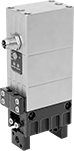 | 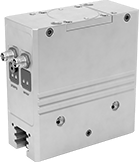 |
Schunk EGP Series | Schunk PGN-Plus-E |
 |
M8 Connection |
EGP Series—EGP grippers use one connector for both power and control. If you want to signal your control program whether the jaws are open or closed, add a sensor (sold separately).
PGN-Plus E Series—PGN-Plus E grippers include a built-in sensor to signal your control program whether the jaws are open or closed. For more detailed feedback about jaw positions, add a sensor (sold separately).
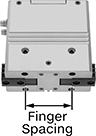
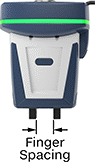
Finger Spacing—Finger spacing describes the distance between the fingers when fully closed and fully open. It’s measured from the inside surface of the fingers.
Overall, mm | Electrical | ||||||||||||||||||
|---|---|---|---|---|---|---|---|---|---|---|---|---|---|---|---|---|---|---|---|
External Gripping Force @ Distance | Internal Gripping Force @ Distance | Stroke per Jaw, mm | Finger Spacing, mm | Cycles per sec. | Lg. | Wd. | Dp. | Connection | No. of Poles | Connection Coding | No. of Connections | Connection Location | Voltage, V DC | Mounting Hardware Included | Manufacturer (Series/Model Number) | Each | |||
| 8.9 lbf @ 0 mm, 4.4 lbf @ 32 mm | 8.9 lbf @ 0 mm, 4.4 lbf @ 32 mm | 3 | 11 to 17 | 5 | 72.7 | 26.5 | 18 | M8 | 4 | A | 1 | Gripper | 24 | No | Schunk (EGP 25) | 9604N11 | 000000000 | ||
| 31 lbf @ 0 mm, 7.8 lbf @ 50 mm | 31 lbf @ 0 mm, 7.8 lbf @ 50 mm | 6 | 16 to 28 | 2 | 88.4 | 40 | 26 | M8 | 4 | A | 1 | Gripper | 24 | No | Schunk (EGP 40) | 9604N12 | 00000000 | ||
| 47 lbf @ 0 mm, 12.1 lbf @ 64 mm | 47 lbf @ 0 mm, 12.1 lbf @ 64 mm | 8 | 18 to 34 | 2 | 104.4 | 50 | 30 | M8 | 4 | A | 1 | Gripper | 24 | No | Schunk (EGP 50) | 9604N13 | 00000000 | ||
| 67 lbf @ 0 mm, 16.8 lbf @ 64 mm | 67 lbf @ 0 mm, 16.8 lbf @ 64 mm | 10 | 24 to 44 | 1 | 114.7 | 64 | 35 | M8 | 4 | A | 1 | Gripper | 24 | No | Schunk (EGP 64) | 9604N14 | 00000000 | ||
| 120 lbf @ 0 mm, 24.2 lbf @ 125 mm | 120 lbf @ 0 mm, 24.2 lbf @ 125 mm | 8 | 11 to 27 | 1 | 103 | 96 | 42 | M8 | 4 | A | 2 | Gripper | 24 | No | Schunk (PGN-Plus E 80) | 9604N15 | 00000000 | ||
| 185 lbf @ 0 mm, 44 lbf @ 160 mm | 185 lbf @ 0 mm, 44 lbf @ 160 mm | 10 | 10.5 to 34.5 | 1 | 123 | 120 | 50 | M8 | 4 | A | 2 | Gripper | 24 | No | Schunk (PGN-Plus E 100) | 9604N16 | 00000000 | ||
 | 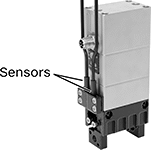 |
These sensors detect when the jaws reach positions—such as fully open—so your system can trigger actions such as a new pick cycle. These sensors slide into the grooves on the gripper body. Schunk EGP series sensors are inductive, so they’re not the best choice for machining because metallic debris can trigger them. Sensors with two sensing positions let you check more than one condition in a cycle for more reliable feedback. For example, if the sensor detects the jaws have moved past a certain position but aren’t fully closed, it may indicate the gripper missed picking up a part and signal the robot to try the pick again.
Electrical | |||||||||||||
|---|---|---|---|---|---|---|---|---|---|---|---|---|---|
For Mfr. Series | Connection | No. of Poles | No. of Wire Leads | No. of Sensing Positions | Switch Starting Position | Voltage, V DC | Current, mA | Cord Lg., ft. | Manufacturer (Model Number) | Each | |||
For Schunk | |||||||||||||
NPN Output Signal | |||||||||||||
| JGP, JGP-P, JGZ, PGN-Plus E, PWG-Plus | Wire Leads | — | 3 | 1 | 1 Off | 24 | 50 | 6 1/2 | Schunk (MMSK 22-S-NPN) | 7705N143 | 0000000 | ||
| JGP, JGP-P, JGZ, PGN-Plus E, PWG-Plus | M8 | 3 | — | 1 | 1 Off | 24 | 50 | 1 | Schunk (MMS 22‐S‐M8‐NPN) | 7705N141 | 000000 | ||
PNP Output Signal | |||||||||||||
| JGP, JGP-P, JGZ, PGN-Plus E, PWG-Plus | Wire Leads | — | 3 | 1 | 1 Off | 24 | 50 | 6 1/2 | Schunk (MMS-P 22-S-M8-PNP) | 7705N142 | 00000 | ||
| JGP, JGP-P, JGZ, PGN-Plus E, PWG-Plus | Wire Leads | — | 4 | 2 | 1 Off and 1 On | 24 | 100 | 2 | Schunk (MMS-P 22-S-M8-PNP) | 7705N148 | 000000 | ||
| JGP, JGP-P, JGZ, PGN-Plus E, PWG-Plus | M8 | 3 | — | 1 | 1 Off | 24 | 50 | 1 | Schunk (MMS 22-S-M8-PNP) | 7705N14 | 00000 | ||
| JGP, JGP-P, JGZ, PGN-Plus E, PWG-Plus | M12 | 4 | — | 2 | 1 Off and 1 On | 24 | 100 | 6 1/2 | Schunk (MMSK-P 22-S-PNP) | 7705N149 | 000000 | ||
| EGP | Wire Leads | — | 3 | 1 | 1 Off | 24 | 200 | 6 1/2 | Schunk (INK 40-S) | 7705N145 | 000000 | ||
| EGP | Wire Leads | — | 3 | 1 | 1 On | 24 | 200 | 6 1/2 | Schunk (IN 40-O) | 7705N147 | 000000 | ||
| EGP | M8 | 3 | — | 1 | 1 Off | 24 | 200 | 1 | Schunk (IN 40-S-M8) | 7705N144 | 000000 | ||
| EGP | M8 | 3 | — | 1 | 1 On | 24 | 200 | 1 | Schunk (IN 40-O-M8) | 7705N146 | 000000 | ||
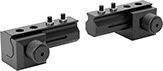 | 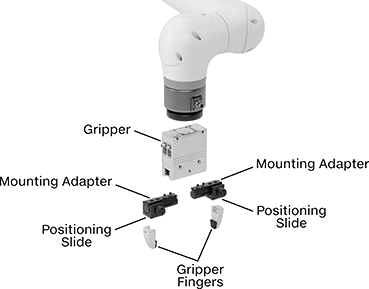 | 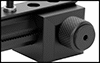 |
For Manufacturer (Series/Model Number) | Positioning Slide Adjustment Wd., mm | Lg. Adjustment Increments, mm | Lg., mm | Wd., mm | Ht., mm | Mounting Hardware Included | Manufacturer (Series/Model Number) | Weight | Pair | ||
|---|---|---|---|---|---|---|---|---|---|---|---|
| Schunk (PGN-Plus E 80) | 44 | 2 | 79 | 42 | 40 | Yes | Schunk (UZB 80) | 0.74 lb. / 0.34 kg | 9604N21 | 0000000 | |
| Schunk (PGN-Plus E 100) | 55 | 2.5 | 97 | 47 | 46 | Yes | Schunk (UZB 100) | 1.14 lb. / 0.52 kg | 9604N22 | 000000 |
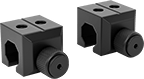
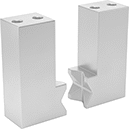 | 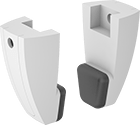 |
Aluminum Fingers | Nylon Fingers |
| |
Finger, mm | ||||||||||
|---|---|---|---|---|---|---|---|---|---|---|
For Manufacturer (Series/Model Number) | For Part Wd., mm | Lg. | Wd. | Dp. | Finger Material | Mounting Hardware Included | Features | Pair | ||
| Schunk (Co-act EGP-C 40, EGP 40) | 0 to 12 | 50 | 25.5 | 30 | Nylon | Yes | Rubber Gripping Pad | 9799N13 | 0000000 | |
| Schunk (Co-act EGP-C 40, EGP 40) | 12 to 24 | 50 | 19.5 | 30 | Nylon | Yes | Rubber Gripping Pad | 9799N14 | 000000 | |
| Schunk (Co-act EGP-C 64, EGP 64) | 0 to 20 | 80 | 39 | 36.9 | Nylon | Yes | Rubber Gripping Pad | 9799N7 | 000000 | |
| Schunk (Co-act EGP-C 64, EGP 64) | 20 to 40 | 80 | 29 | 34 | Nylon | Yes | Rubber Gripping Pad | 9799N18 | 000000 | |
| Schunk (JGP-P 80, PGN-Plus E 80) | 9.5 to 25.5 | 77.5 | 36 | 25 | Aluminum | Yes | — | 9799N22 | 000000 | |
| Schunk (JGP-P 100, PGN-Plus E 100) | 12.5 to 32.5 | 95 | 44 | 30 | Aluminum | Yes | — | 9799N23 | 000000 | |
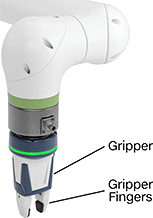
Robot-Ready Collaborative Electric Pick-and-Place Grippers
 |
Gripper Fingers Not Included |
 |  | 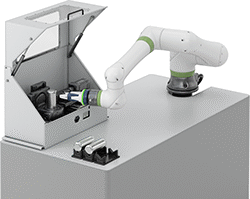 |
Machine-Tending Application |
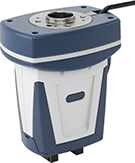 | 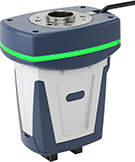 |
Pick-and-Place Grippers | Pick-and-Place Grippers with LED Status Ring |
Overall, mm | Pick-and-Place Grippers | Pick-and-Place Grippers with LED Status Ring | |||||||||||
|---|---|---|---|---|---|---|---|---|---|---|---|---|---|
For Robot Arm Manufacturer (Series/Model Number) | External Gripping Force @ Distance | Internal Gripping Force @ Distance | Stroke per Jaw, mm | Finger Spacing, mm | Cycles per sec. | Lg. | Wd. | Dp. | Each | Each | |||
| FANUC (CRX 5iA, 10iA, 10iA/L, 20iA/L, 25iA, 30iA) | 30 lbf @ 0 mm, 8.1 lbf @ 50 mm | 30 lbf @ 0 mm, 8.1 lbf @ 50 mm | 6 | 16 to 28 | 1 | 118 | 93 | 90 | 3767N33 | 000000000 | 9599N11 | 000000000 | |
| FANUC (CRX 5iA, 10iA, 10iA/L, 20iA/L, 25iA, 30iA) | 51 lbf @ 0 mm, 12.3 lbf @ 80 mm | 51 lbf @ 0 mm, 12.3 lbf @ 80 mm | 10 | 24 to 44 | 1 | 144 | 125 | 86 | 3767N34 | 00000000 | 9599N12 | 00000000 | |
| Universal Robots (UR3e, UR5e, UR7e, UR10e, UR12e, UR16e) | 30 lbf @ 0 mm, 8.1 lbf @ 50 mm | 30 lbf @ 0 mm, 8.1 lbf @ 50 mm | 6 | 16 to 28 | 1 | 118 | 93 | 90 | 3767N11 | 00000000 | 3767N18 | 00000000 | |
| Universal Robots (UR3e, UR5e, UR7e, UR10e, UR12e, UR16e) | 51 lbf @ 0 mm, 12.3 lbf @ 80 mm | 51 lbf @ 0 mm, 12.3 lbf @ 80 mm | 10 | 24 to 44 | 1 | 144 | 125 | 86 | 9599N13 | 00000000 | 3767N21 | 00000000 | |
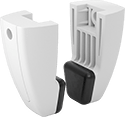 |
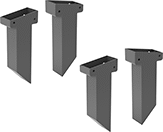
No need to machine your own fingers—connect these fingers to your gripper and start moving items. They’re best for parts with basic shapes—think flat edges and simple curves. Rubber gripping pads protect your parts from damage.
Robot-Ready Electric Soft Pick-and-Place Grippers
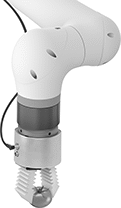 |
Shown with Robot Arm (Not Included) |
Mimicking a human hand, these grippers have soft, flexible silicone fingers that curl around items to pick them up. Unlike standard grippers with rigid fingers, these grippers can grasp fruit, bagged items, and other delicate objects without crushing them. They are powered and actuated entirely by your robot, so there's no need for an air supply or control valves. Connect them to terminals on your robot controller with the included 9 1/2 ft. electrical cord. A simple toggle on your controller’s digital outputs opens and closes the fingers. Mount them to most robot arms, like FANUC CRX and Universal Robots arms, thanks to their mounting slots that match a variety of ISO mounting patterns.
To program their range of motion and position, you’ll have access to a simple web-based interface from any smartphone or laptop. You don’t have to worry about hooking these up to your network. They generate their own wireless network like a hotspot, so you can connect your device to the setup interface to program them. If you are using these grippers with a Universal Robots arm, you can download a URCap plugin from the manufacturer's website for user-friendly control through your teach pendant software.
The fingers are made of FDA-compliant silicone for direct contact with food.
With Fixed Grip Force
 |  |  |
2-Finger | 4-Finger |
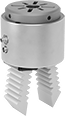
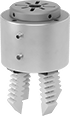
Grippers with fixed grip force apply the same amount of force every time. This helps them pick up most items successfully.
2 Finger—2-finger grippers are good at picking up objects with uniform shapes, such as bottles and boxes.
4 Finger—4-finger grippers are a good choice if you plan to pick up irregularly shaped objects and need additional points of contact for a secure hold. They work well with fruits and vegetables, fabrics, and flexible packaging.
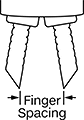
Finger Spacing Range—Finger spacing range describes the distance between the fingers across their full range of motion, from pressed together to stretched open. It’s measured from the inside surface of the fingers.
Overall, mm | |||||||||||
|---|---|---|---|---|---|---|---|---|---|---|---|
Finger Configuration | External Gripping Force, lb. | Max. Gripping Cap. | Cycles per sec. | Finger Spacing Range, mm | Mounting Pattern Compatibility | Dia. | Lg. | Each | |||
Aluminum Housing and Silicone Rubber Finger | |||||||||||
| 2 Finger | 1.1 | 3.3 lb./1.5 kg | 1 | 0 to 175 | ISO 31.5 ISO 40 ISO 50 ISO 63 | 105 | 172 | 7149N101 | 000000000 | ||
| 4 Finger | 1.1 | 3.3 lb./1.5 kg | 1 | 0 to 190 | ISO 31.5 ISO 40 ISO 50 ISO 63 | 119 | 187 | 7149N103 | 00000000 | ||
With Adjustable Grip Force and Part Confirmation
|
2-Finger |
|
4-Finger |
|
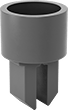
Grippers with adjustable grip force are the best choice to grip extremely sensitive items, such as baked goods or fragile glassware, because you can fine-tune the gripping force. These grippers also have part confirmation, which means they can send a signal to one of your robot controller's digital inputs to tell it whether a part has been successfully picked up. If the pickup fails, you can program your robot to try the pickup again.
2 Finger—2-finger grippers are good at picking up objects with uniform shapes, such as bottles and boxes.
4 Finger—4-finger grippers are a good choice if you plan to pick up irregularly shaped objects and need additional points of contact for a secure hold. They work well with fruits and vegetables, fabrics, and flexible packaging.
Finger Spacing Range—Finger spacing range describes the distance between the fingers across their full range of motion, from pressed together to stretched open. It’s measured from the inside surface of the fingers.
Overall, mm | |||||||||||
|---|---|---|---|---|---|---|---|---|---|---|---|
Finger Configuration | External Gripping Force, lb. | Max. Gripping Cap. | Cycles per sec. | Finger Spacing Range, mm | Mounting Pattern Compatibility | Dia. | Lg. | Each | |||
Aluminum Housing and Silicone Rubber Finger | |||||||||||
| 2 Finger | 0.23 to 1.1 | 3.3 lb./1.5 kg | 1 | 0 to 175 | ISO 31.5 ISO 40 ISO 50 ISO 63 | 105 | 172 | 7149N102 | 000000000 | ||
| 4 Finger | 0.23 to 1.1 | 3.3 lb./1.5 kg | 1 | 0 to 190 | ISO 31.5 ISO 40 ISO 50 ISO 63 | 119 | 187 | 7149N104 | 00000000 | ||
Robot-Ready Electric Pick-and-Place Grippers
 |
 |  |
 |  |
Grippers | Dual Grippers |
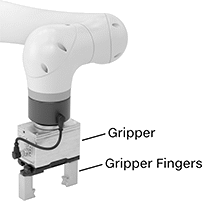
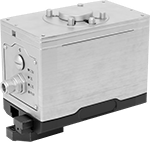
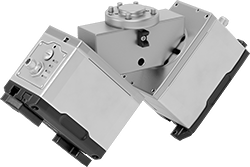
Equip your robot arm with all it needs to lift and move items using electricity—no air supply or complicated control valves needed. These grippers have a servomotor that opens and closes the jaws in a parallel motion, like elevator doors, with a consistent gripping force in either direction. This lets you grab parts from the outside or open the jaws inside hollow parts to grab them when the outside is hard to grip. These grippers open and close wider and with more force than our collaborative robot-ready electric grippers to handle heavier and larger items. This makes them a good match for packaging, assembly, and machine-tending jobs. Use your robot’s control program to set the gripping force and jaw position. A built-in sensor detects when the part is picked up, so your arm knows it can move to the next location.
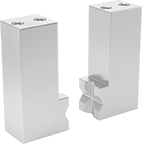
These grippers include a robot mount, electrical connections, and software plug-ins tailored to FANUC CRX and Universal Robots (UR) arms. You’ll also need gripper fingers—choose ready-to-use fingers (sold separately) or machine your own to grip complex shapes.
Unlike collaborative robot-ready grippers, these grippers can operate at high forces. They may require additional safety precautions when working near your collaborative robot.
Grippers connect to your robot’s teach pendant using the software plug-in. Then you can use your teach pendant to open and close the grippers.
The IP67-rated control box of these grippers shields the electrical components from coolant. Plus, their jaws are rated IP40, so solid objects, such as chips produced during machining, won’t obstruct their motion.
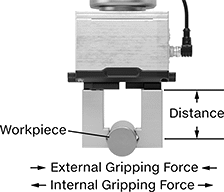
External force and internal force describe how hard the gripper can squeeze your part at the fingertips, also called the gripping distance. The less friction there is between the part and fingers, the more force you’ll need to lift a part. Typically, you’ll need a force that’s about 10 times the part’s weight, but an oily part might need a force about 20 times its weight. However, air pressure and finger length also affect the ideal force. Click on a part number and select "Product Detail" to view a chart that shows how external or internal force changes as the gripping distance changes.
Grippers—Choose a gripper for simple pick-and-place operations. It holds one part at a time.
Dual Grippers—Dual grippers can help reduce cycle times by handling two parts at once. For example, you might use one gripper to unload a part from your machine, then rotate the robot arm and use the second gripper to load a new part.
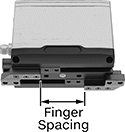
Finger Spacing—Finger spacing describes the distance between the fingers when fully closed and fully open. It’s measured from the inside surface of the fingers.
Overall, mm | ||||||||||||
|---|---|---|---|---|---|---|---|---|---|---|---|---|
For Robot Arm Manufacturer (Series/Model Number) | External Gripping Force @ Distance | Internal Gripping Force @ Distance | Stroke per Jaw, mm | Finger Spacing, mm | Cycles per sec. | Lg. | Wd. | Dp. | Each | |||
Grippers | ||||||||||||
| FANUC (CRX 5iA, 10iA, 10iA/L, 20iA, 20iA/L, 25iA, 30iA) Universal Robots (UR5e, UR7e, UR10e, UR12e, UR16e) | 146 lbf @ 0 mm, 33 lbf @ 80 mm | 146 lbf @ 0 mm, 33 lbf @ 80 mm | 51 | 1 to 103 | 0.6 | 103 | 149 | 72 | 9495N21 | 000000000 | ||
Dual Grippers | ||||||||||||
| FANUC (CRX 5iA, 10iA, 10iA/L, 20iA, 20iA/L, 25iA, 30iA) Universal Robots (UR5e, UR7e, UR10e, UR12e, UR16e) | 146 lbf @ 0 mm, 33 lbf @ 80 mm | 146 lbf @ 0 mm, 33 lbf @ 80 mm | 51 | 1 to 103 | 0.6 | 176 | 347 | 72 | 9495N22 | 00000000 | ||
 |
Finger, mm | ||||||||
|---|---|---|---|---|---|---|---|---|
For Part Wd., mm | Lg. | Wd. | Dp. | Finger Material | Mounting Hardware Included | Pair | ||
| 0 to 88 | 59 | 30.5 | 20 | Aluminum | Yes | 9495N17 | 0000000 | |
