


Filter by


Electrical Connection


Transmission Speed
Certification

Maximum Temperature
U.S.–Mexico–Canada Agreement (USMCA) Qualifying
DFARS Specialty Metals
Export Control Classification Number (ECCN)


REACH
Wire Connection

DIN-Rail-Mount Ethernet Switches
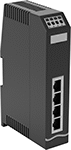 | 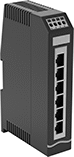 |
4 Ports | 6 Ports |
Mount these Ethernet switches onto a standard 35 mm DIN rail alongside PLCs, relays, and power supplies—they snap in place and stay secure. They connect computers, sensors, and other devices to the same network so they can talk to each other, access the Internet, and provide you with real-time diagnostics. Switches do not require set up—just plug in a device and it will be connected to your network. These switches are backward compatible, so they'll work in networks below their rated transmission speed. For example, a 100 Mbit/s switch will work in a 10 Mbit/s network, but it will only run at 10 Mbit/s.
Ethernet | |||||||||||||||
|---|---|---|---|---|---|---|---|---|---|---|---|---|---|---|---|
No. of Ports | Connection | Transmission Speed | Ht. | Wd. | Dp. | Housing Material | Voltage, V DC | Wire Connection | No. of Terminals | Temp. Range, ° F | Certification | Each | |||
| 4 | RJ45 | 10 Mbit/s, 100 Mbit/s | 5 1/2" | 1 3/16" | 3 3/8" | Plastic | 10 to 32 | Screw Terminal | 4 | -10 to 140 | UL Listed, C-UL Listed, CE Marked | 8653T31 | 0000000 | ||
| 4 | RJ45 | 10 Mbit/s, 100 Mbit/s, 1 Gbit/s | 5 1/2" | 1 3/16" | 3 3/8" | Plastic | 10 to 30 | Screw Terminal | 4 | -40 to 165 | UL Listed, C-UL Listed, CE Marked | 8653T33 | 000000 | ||
| 6 | RJ45 | 10 Mbit/s, 100 Mbit/s | 5 1/2" | 1 3/16" | 3 3/8" | Plastic | 10 to 32 | Screw Terminal | 4 | -10 to 140 | UL Listed, C-UL Listed, CE Marked | 8653T32 | 000000 | ||
| 6 | RJ45 | 10 Mbit/s, 100 Mbit/s, 1 Gbit/s | 5 1/2" | 1 3/16" | 3 3/8" | Plastic | 10 to 30 | Screw Terminal | 4 | -40 to 165 | UL Listed, C-UL Listed, CE Marked | 8653T34 | 000000 | ||
Low-Profile DIN-Rail-Mount Ethernet Switches
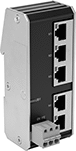 | 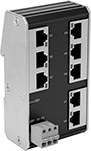 | 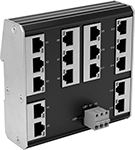 |
5 Sockets | 8 Sockets | 16 Sockets |
These switches do the same job as full-sized DIN-rail mount Ethernet switches but take up less space, so they'll fit in shallow cabinets. No setup required—just plug in a device and it will connect to your network. Mount these Ethernet switches onto a standard 35 mm DIN rail alongside PLCs, relays, and power supplies. They snap in place and stay secure. They connect computers, sensors, and other devices to the same network, so they can talk to each other, access the Internet, and provide you with real-time diagnostics. These switches are backward compatible, so they'll work in networks below their rated transmission speed. For example, a 100 Mbit/s switch will work in a 10 Mbit/s network, but it will only run at 10 Mbit/s.
Ethernet | 100 Mbit/s Transmission Speed | 1 Gbit/s Transmission Speed | |||||||||||||
|---|---|---|---|---|---|---|---|---|---|---|---|---|---|---|---|
No. of Sockets | Connection | Ht. | Wd. | Dp. | Housing Material | Voltage, V DC | Wire Connection | No. of Terminals | Temp. Range, ° F | Certification | Each | Each | |||
| 5 | RJ45 | 4 1/8" | 1 5/8" | 1 1/2" | Metal | 9 to 36 | Screw Terminal | 3 | -40 to 155 | UL Listed, C-UL Listed, CE Marked | 6339N11 | 0000000 | 6339N21 | 0000000 | |
| 8 | RJ45 | 4 1/8" | 2 5/16" | 1 1/2" | Metal | 9 to 36 | Screw Terminal | 3 | -40 to 155 | UL Listed, C-UL Listed, CE Marked | 6339N12 | 000000 | 6339N22 | 000000 | |
| 16 | RJ45 | 4 1/8" | 4 5/16" | 1 1/2" | Metal | 9 to 36 | Screw Terminal | 3 | -40 to 155 | UL Listed, C-UL Listed, CE Marked | 6339N13 | 000000 | ——— | 0 | |
Low-Profile Ethernet Switches
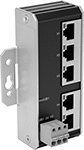 | 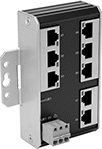 | 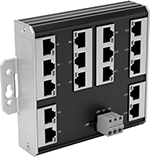 |
5 Sockets | 8 Sockets | 16 Sockets |
These compact switches work just like regular Ethernet switches but are small enough to fit in shallow cabinets. They connect computers, sensors, and other devices to the same network, so they can talk to each other, access the Internet, and provide you with real-time diagnostics. These switches do not require setup—just plug in a device and it will connect to your network. They are backward compatible, so they'll work in networks below their rated transmission speed. For example, a 100 Mbit/s switch will work in a 10 Mbit/s network, but it will only run at 10 Mbit/s.
Ethernet | Mounting | 100 Mbit/s Transmission Speed | 1 Gbit/s Transmission Speed | ||||||||||||||
|---|---|---|---|---|---|---|---|---|---|---|---|---|---|---|---|---|---|
No. of Sockets | Connection | Ht. | Wd. | Dp. | Housing Material | Voltage, V DC | Fasteners Included | Hole Dia., mm | Temp. Range, ° F | Wire Connection | No. of Terminals | Certification | Each | Each | |||
| 5 | RJ45 | 4 1/8" | 2 11/16" | 1 1/8" | Metal | 9 to 36 | No | 4.5 | -40 to 155 | Screw Terminal | 3 | UL Listed, C-UL Listed, CE Marked | 6078N11 | 0000000 | 6078N21 | 0000000 | |
| 8 | RJ45 | 4 1/8" | 3 1/2" | 1 1/8" | Metal | 9 to 36 | No | 4.5 | -40 to 155 | Screw Terminal | 3 | UL Listed, C-UL Listed, CE Marked | 6078N12 | 000000 | 6078N22 | 000000 | |
| 16 | RJ45 | 4 1/8" | 5 3/8" | 1 1/8" | Metal | 9 to 36 | No | 4.5 | -40 to 155 | Screw Terminal | 3 | UL Listed, C-UL Listed, CE Marked | 6078N13 | 000000 | ——— | 0 | |
Device-Prioritizing DIN-Rail-Mount Ethernet Switches
Ethernet Switches with Port Mirroring
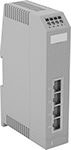 | 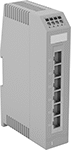 | 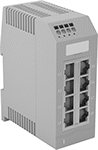 |
4 Sockets | 6 Sockets | 8 Sockets |
Ethernet switches with port mirroring allow any port on the switch to duplicate the output of another port. This is useful for troubleshooting network and performance issues.
IEEE 802.1q—Ethernet switches that meet IEEE 802.1q standard for VLAN (Virtual Local Area Network) increase security, reliability, and efficiency by clustering devices on the network into groups. They also limit when and how devices can communicate outside of their group.
Ethernet | ||||||||||||||||
|---|---|---|---|---|---|---|---|---|---|---|---|---|---|---|---|---|
No. of Sockets | Connection | Control Communication Protocol | Transmission Speed, Gbit/s | Ht. | Wd. | Dp. | Housing Material | Voltage, V DC | Wire Connection | No. of Terminals | Temp. Range, ° F | Certification | Specs. Met | Each | ||
| 4 | RJ45 | PROFINET | 1 | 5 1/2" | 1 3/16" | 3 3/8" | Plastic | 9 to 30 | Screw Terminal | 4 | -40 to 155 | UL Listed, C-UL Listed | IEEE 802.1q | 6631N11 | 0000000 | |
| 6 | RJ45 | PROFINET | 1 | 5 1/2" | 1 3/16" | 3 3/8" | Plastic | 9 to 30 | Screw Terminal | 4 | -40 to 155 | UL Listed, C-UL Listed | IEEE 802.1q | 6631N12 | 00000000 | |
| 8 | RJ45 | PROFINET | 1 | 4 1/8" | 1 5/8" | 3 3/8" | Plastic | 9 to 30 | Screw Terminal | 4 | -40 to 145 | UL Listed, C-UL Listed | IEEE 802.1q | 6631N13 | 00000000 | |
Device-Prioritizing Micro M12 Ethernet Switches
 |
 |  |
4-Pole M12 Plug | 5-Pole M12 Plug |
 |  |
4-Pole M12 Socket | 5-Pole M12 Socket |
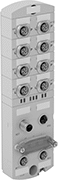
Device-prioritizing Ethernet switches, also known as managed Ethernet switches, let you control which devices get priority speed on your network. For example, you can set it so that safety systems get all of the bandwidth they need while they are running, and all other devices on the network share what's left over. Easily set up these switches over the web or via command line interface. No software required.
Ethernet switches connect computers, sensors, and other devices to the same network so they can talk to each other, access the Internet, and provide you with real-time diagnostics. These switches have port mirroring, which duplicates data from one network port to another—this lets you keep an eye on network traffic and troubleshoot performance issues. They are backward compatible, so they'll work in networks below their rated transmission speed. For example, a 100 Mbit/s switch will work in a 10 Mbit/s network, but it will only run at 10 Mbit/s.
M12 connections instead of typical RJ45 keep out contaminants and won’t come loose from vibration.
D—D-coded connectors are used for Ethernet rated up to Category 5 or 100 Mbps.
X—X-coded connectors are used for high-speed Ethernet with data transfer rates up to 1 Gb/s.
5-Pole M12—Switches with a 5-pole power plug have a ground pin.
IEEE 802.1q—These switches use the IEEE 802.1q standard for VLAN (Virtual Local Area Network). VLAN increases security, reliability, and efficiency by clustering devices on the network into groups and limiting when and how devices can communicate outside of their group.
Ethernet | Mounting | Power Connections | |||||||||||||||||||
|---|---|---|---|---|---|---|---|---|---|---|---|---|---|---|---|---|---|---|---|---|---|
No. of Sockets | Coding | Connection | Transmission Speed | Ht. | Wd. | Dp. | Housing Material | Voltage, V DC | Fasteners Included | Hole Dia., mm | Temp. Range, ° F | Plug Type | Socket Type | Coding | Certification | Specs. Met | Enclosure Rating | Each | |||
EtherNet/IP Communication Protocol | |||||||||||||||||||||
| 10 | D | M12 | 10 Mbit/s, 100 Mbit/s | 8 7/8" | 2 1/2" | 1 7/16" | Metal | 9 to 30 | No | 7.5 | -10 to 130 | 4-Pole M12 | 4-Pole M12 | L | UL Listed, C-UL Listed, CE Marked | IEEE 802.1q | IP67 | 6655N11 | 000000000 | ||
| 10 | D | M12 | 10 Mbit/s, 100 Mbit/s | 8 7/8" | 2 1/2" | 1 7/16" | Metal | 9 to 30 | No | 7.5 | -10 to 130 | 5-Pole M12 | 5-Pole M12 | L | UL Listed, C-UL Listed, CE Marked | IEEE 802.1q | IP67 | 6655N21 | 00000000 | ||
| 10 | X | M12 | 10 Mbit/s, 100 Mbit/s, 1 Gbit/s | 8 7/8" | 2 1/2" | 1 7/16" | Metal | 9 to 30 | No | 7.5 | -10 to 110 | 4-Pole M12 | 4-Pole M12 | L | UL Listed, C-UL Listed, CE Marked | IEEE 802.1q | IP67 | 6655N15 | 00000000 | ||
| 10 | X | M12 | 10 Mbit/s, 100 Mbit/s, 1 Gbit/s | 8 7/8" | 2 1/2" | 1 7/16" | Metal | 9 to 30 | No | 7.5 | -10 to 110 | 5-Pole M12 | 5-Pole M12 | L | UL Listed, C-UL Listed, CE Marked | IEEE 802.1q | IP67 | 6655N25 | 00000000 | ||
| 8 2 | D X | M12 | 10 Mbit/s, 100 Mbit/s 10 Mbit/s, 100 Mbit/s, 1 Gbit/s | 8 7/8" | 2 1/2" | 1 7/16" | Metal | 9 to 30 | No | 7.5 | -10 to 130 | 4-Pole M12 | 4-Pole M12 | L | UL Listed, C-UL Listed, CE Marked | IEEE 802.1q | IP67 | 6655N13 | 00000000 | ||
| 8 2 | D X | M12 | 10 Mbit/s, 100 Mbit/s 10 Mbit/s, 100 Mbit/s, 1 Gbit/s | 8 7/8" | 2 1/2" | 1 7/16" | Metal | 9 to 30 | No | 7.5 | -10 to 130 | 5-Pole M12 | 5-Pole M12 | L | UL Listed, C-UL Listed, CE Marked | IEEE 802.1q | IP67 | 6655N23 | 00000000 | ||
PROFINET Communication Protocol | |||||||||||||||||||||
| 10 | D | M12 | 10 Mbit/s, 100 Mbit/s | 8 7/8" | 2 1/2" | 1 7/16" | Metal | 9 to 30 | No | 7.5 | -10 to 130 | 4-Pole M12 | 4-Pole M12 | L | UL Listed, C-UL Listed, CE Marked | IEEE 802.1q | IP67 | 6655N12 | 00000000 | ||
| 10 | D | M12 | 10 Mbit/s, 100 Mbit/s | 8 7/8" | 2 1/2" | 1 7/16" | Metal | 9 to 30 | No | 7.5 | -10 to 130 | 5-Pole M12 | 5-Pole M12 | L | UL Listed, C-UL Listed, CE Marked | IEEE 802.1q | IP67 | 6655N22 | 00000000 | ||
| 10 | X | M12 | 10 Mbit/s, 100 Mbit/s, 1 Gbit/s | 8 7/8" | 2 1/2" | 1 7/16" | Metal | 9 to 30 | No | 7.5 | -10 to 110 | 4-Pole M12 | 4-Pole M12 | L | UL Listed, C-UL Listed, CE Marked | IEEE 802.1q | IP67 | 6655N16 | 00000000 | ||
| 10 | X | M12 | 10 Mbit/s, 100 Mbit/s, 1 Gbit/s | 8 7/8" | 2 1/2" | 1 7/16" | Metal | 9 to 30 | No | 7.5 | -10 to 110 | 5-Pole M12 | 5-Pole M12 | L | UL Listed, C-UL Listed, CE Marked | IEEE 802.1q | IP67 | 6655N26 | 00000000 | ||
| 8 2 | D X | M12 | 10 Mbit/s, 100 Mbit/s 10 Mbit/s, 100 Mbit/s, 1 Gbit/s | 8 7/8" | 2 1/2" | 1 7/16" | Metal | 9 to 30 | No | 7.5 | -10 to 130 | 4-Pole M12 | 4-Pole M12 | L | UL Listed, C-UL Listed, CE Marked | IEEE 802.1q | IP67 | 6655N14 | 00000000 | ||
| 8 2 | D X | M12 | 10 Mbit/s, 100 Mbit/s 10 Mbit/s, 100 Mbit/s, 1 Gbit/s | 8 7/8" | 2 1/2" | 1 7/16" | Metal | 9 to 30 | No | 7.5 | -10 to 130 | 5-Pole M12 | 5-Pole M12 | L | UL Listed, C-UL Listed, CE Marked | IEEE 802.1q | IP67 | 6655N24 | 00000000 | ||
