

Filter by


Jaw Opening Style
Grip Style


U.S.–Mexico–Canada Agreement (USMCA) Qualifying

DFARS Specialty Metals
Export Control Classification Number (ECCN)
REACH
Surface Resistivity
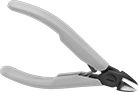
Lindstrom Static-Control Wire Cutters
 |
 |  |
Angled Head | Standard Head Thickness |
 | |
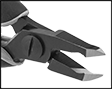
Wire with Flush Cut Profile |
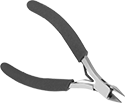
The grips on these tools divert static electricity faster than our other static-control wire cutters, preventing buildup from electrostatic discharge (ESD) that can damage sensitive equipment. Cutters have spring-assisted jaws that open automatically when you release the handles and an adjustable jaw pivot that keeps the jaws aligned. Also known as diagonal-cutting pliers.
Angled Head—Angled-head cutters are also known as oblique-head cutters.
Ultra Grip—Cutters with an ultra grip have the most comfortable hold because their grip is made of hard and soft materials.
Flush—Flush cutters produce a cut with virtually no pinch, creating clean connections for easy soldering. Flush-cut tools don’t last as long as semi-flush.
Cut Profile—Cut profile refers to the amount of pinch left on the tip of the wire after it has been cut.
Jaw | For Wire | ||||||||||||||||
|---|---|---|---|---|---|---|---|---|---|---|---|---|---|---|---|---|---|
Overall Lg. | Cut Profile | Cutting Edge Location | Relative Head Thk. | Lg. | Opening Style | Max. Dia. | Max. Ga. | Type | Features | Performance | Surface Resistivity | Material | Mfr. Model No. | Each | |||
Angled Head and Ultra Grip | |||||||||||||||||
| 5 3/4" | Flush | Side | Standard | 11/16" | Spring Assisted | 0.039" | 18 | Soft | Adjustable Jaw Pivot | Static Control, Static Dissipative | 1× 10^6Ω⋅m to 1× 10^8Ω⋅m | Steel | RX8247 | 5445A38 | 0000000 | ||
Corrosion-Resistant Wire Cutters
 |
 |
 | |
Tapered Head | Wire with Flush Cut Profile |
These cutters are stainless steel, which provides excellent corrosion resistance. Also known as diagonal-cutting pliers.
Tapered Head—Tapered-head cutters fit more easily in tight spaces than oval-head cutters, but they’re less durable.
Ultra Grip—Ultra-grip cutters are the most comfortable for repeated cuts. The grips are rubber and plastic, so they won't slip.
Flush—Flush cutters produce a cut with virtually no pinch, creating clean connections for easy soldering. Flush-cut tools don’t last as long as pointed and semi-flush.
Spring-Assisted Jaws—Spring-assisted jaws open automatically when you release the handles.
Wire Catch—Cutters with a wire catch grip the wire after it has been cut, so it doesn’t fall off or fly into your workspace.
Cut Profile—Cut profile refers to the amount of pinch left on the tip of the wire after it has been cut.
Head Offset Angle—Cutters with an offset head are also known as oblique-head cutters.
Jaw | For Wire | ||||||||||||||
|---|---|---|---|---|---|---|---|---|---|---|---|---|---|---|---|
Overall Lg. | Cut Profile | Cutting Edge Location | Head Offset Angle | Lg. | Opening Style | Max. Dia. | Max. Ga. | Type | Features | Performance | Material | Each | |||
Tapered Head and Ultra Grip | |||||||||||||||
| 5" | Flush | Side | 15° | 11/32" | Spring Assisted | 0.062" | 15 | Soft | Wire Catch | Corrosion Resistant | Stainless Steel | 5520A32 | 000000 | ||
Static-Control Wire Cutters
 | |
 | | |
Tapered Head | Standard Head Thickness | Wire with Flush Cut Profile |
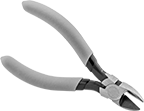
The grips drain static from your application, preventing buildup from electrostatic discharge (ESD) that can damage sensitive equipment. Also known as diagonal-cutting pliers.
Tapered Head—Tapered-head cutters fit more easily in tight spaces than oval-head cutters, but they’re less durable.
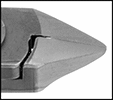
Flush—Flush cutters produce a cut with virtually no pinch, creating clean connections for easy soldering. Flush-cut tools don’t last as long as pointed and semi-flush.
29° Head Offset Angle and 30° Head Offset Angle—Cutters with a 29° or 30° head offset angle are also known as oblique-head cutters.
Spring-Assisted Jaws—Spring-assisted jaws open automatically when you release the handles.
Cut Profile—Cut profile refers to the amount of pinch left on the tip of the wire after it has been cut.
Jaw | For Wire | ||||||||||||||
|---|---|---|---|---|---|---|---|---|---|---|---|---|---|---|---|
Overall Lg. | Cut Profile | Cutting Edge Location | Head Offset Angle | Relative Head Thk. | Lg. | Opening Style | Max. Dia. | Max. Ga. | Type | Performance | Material | Each | |||
Tapered Head and Cushion Grip | |||||||||||||||
| 4" | Flush | Side | 29° | Standard | 7/16" | Spring Assisted | 0.032" | 20 | Soft | Antistatic, Static Control | Steel | 3817A15 | 000000 | ||
| 4 1/2" | Flush | Side | 30° | Standard | 15/16" | Spring Assisted | 0.032" | 20 | Soft | Antistatic, Static Control | Steel | 3817A16 | 00000 | ||
Static-Control Wire Cutters with Carbide Blades
 | |
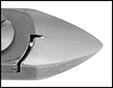 | | |
Oval Head | Tapered Head | Wire with Flush Cut Profile |
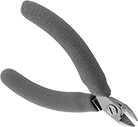
Tungsten carbide cutting edges are bonded to the jaws for long life. The grips drain static from your application, preventing buildup from electrostatic discharge (ESD) that can damage sensitive equipment. These cutters have spring-assisted jaws that open automatically when you release the handles. Also known as diagonal-cutting pliers.
Oval Head—Oval-head cutters are more durable than tapered-head cutters.
Tapered Head—Tapered-head cutters fit more easily in tight spaces but are less durable than oval-head cutters.
Flush—Flush cutters produce a cut with virtually no pinch, creating clean connections for easy soldering. Flush-cut tools don’t last as long as pointed and semi-flush.
Static Dissipative—Static-dissipative tools divert static faster than antistatic tools.
Cut Profile—Cut profile refers to the amount of pinch left on the tip of the wire after it has been cut.
Jaw | For Wire | |||||||||||||
|---|---|---|---|---|---|---|---|---|---|---|---|---|---|---|
Overall Lg. | Cut Profile | Cutting Edge Location | Lg. | Opening Style | Max. Dia. | Max. Ga. | Type | Performance | Surface Resistivity, ohm/sq. | Material | Each | |||
Oval Head and Cushion Grip | ||||||||||||||
| 4 1/2" | Flush | Side | 1/2" | Manual | 0.059" | 16 | Soft, Hardened | Static Control, Static Dissipative | 1× 10^9 | Steel | 5760A12 | 0000000 | ||
Tapered Head and Cushion Grip | ||||||||||||||
| 4 1/2" | Flush | Side | 1/2" | Manual | 0.059" | 16 | Soft, Hardened | Static Control, Static Dissipative | 1× 10^9 | Steel | 5760A13 | 000000 | ||
