


Filter by
Weight Capacity
Measures


Load Sensor Connection

Data Connection
Electrical Connection
Performance
Export Control Classification Number (ECCN)

DFARS Specialty Metals
U.S.–Mexico–Canada Agreement (USMCA) Qualifying
REACH
RoHS
Ready-to-Use Tension and Compression Force Sensor Kits
Round
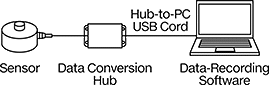 |
PC Connection Kit |
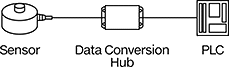 |
PLC Connection Kit |
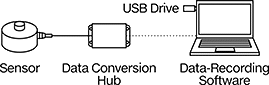 |
Wireless PC Connection Kit |
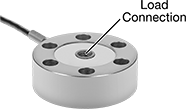 | 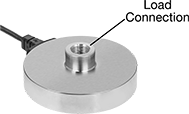 |
Threaded Through Hole | Threaded Standoff |
Round sensors have a low profile to fit in tight-clearance spaces.
Threaded Through Hole—Those with a threaded through hole are also known as pancake load cells. They can be bolted to surfaces in any orientation and are commonly used to measure clamping forces.
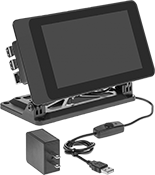
PC Connection Kits—PC connection kits link to a computer, tablet, or LCD display. All include a calibrated force sensor, a data conversion hub, and data-recording software. The conversion hub turns electrical signals from the sensor into usable force measurements. The software plots and analyzes measurements, so you can track high, low, and average values over time. It can also set off connected alarms or notify you when readings fall outside a set range. Export the data to Microsoft Excel and other analytical software such as MATLAB and LabVIEW. Wired PC connection kits come with a 6-ft. hub-to-PC USB cord.
PLC Connection Kits—PLC connection kits send an analog signal to your PLC to trigger actions such as diverting items that exceed a certain weight on a conveyor. They include a calibrated sensor and a data conversion hub. They’re not for use with LCD displays.
Wireless PC Connection Kits—Wireless PC connection kits transmit data over Wi-Fi to your computer from their conversion hub without a cord.
Enclosure Rating—IP rated sensors seal out dust.
PC Connection Kits | PLC Connection Kits | Wireless PC Connection Kits | |||||||||||||
|---|---|---|---|---|---|---|---|---|---|---|---|---|---|---|---|
Wt. Cap. | Accuracy | Wt. Measuring Increments | Thread Size | Dia. | Ht. | Sensor Material | Temp. Range, ° F | Each | Each | Each | |||||
Measures Compression and Tension (Not Legal-for-Trade) | |||||||||||||||
With 1 Threaded Through Hole | |||||||||||||||
| 550 lb.; 250 kg | ±4.4 oz., ±125 g | 0.01 lb., 0.01 kg | M10 × 1.5 mm | 2 15/16" | 1" | Alloy Steel | 0 to 140 | 3487N237 | 000000000 | 3487N252 | 000000000 | 6384N37 | 000000000 | ||
| 1,100 lb.; 500 kg | ±8.8 oz., ±250 g | 0.1 lb., 0.01 kg | M10 × 1.5 mm | 2 15/16" | 1" | Alloy Steel | 0 to 140 | 3487N238 | 00000000 | 3487N253 | 00000000 | 6384N39 | 00000000 | ||
| 2,200 lb.; 1,000 kg | ±1.1 lb., ±500 g | 0.1 lb., 0.01 kg | M12 × 1.75 mm | 3 9/16" | 1" | Alloy Steel | 0 to 140 | 3487N239 | 00000000 | 3487N254 | 00000000 | 6384N35 | 00000000 | ||
| 5,510 lb.; 2,500 kg | ±2.8 lb., ±1.25 kg | 0.1 lb., 0.1 kg | M12 × 1.75 mm | 3 9/16" | 1" | Alloy Steel | 0 to 140 | 3487N24 | 00000000 | 3487N255 | 00000000 | 6384N38 | 00000000 | ||
| 11,020 lb.; 5,000 kg | ±5.5 lb., ±2.5 kg | 1 lb., 0.1 kg | M24 × 3 mm | 5 1/2" | 1 3/4" | Alloy Steel | 0 to 140 | 3487N241 | 00000000 | 3487N256 | 00000000 | 6384N36 | 00000000 | ||
With 2 Threaded Standoffs | |||||||||||||||
| 25,000 lb.; 11,335 kg | ±12.5 lb., ±5.7 kg | 1 lb., 1 kg | 3/4"-16 | 4 3/4" | 3 1/16" | Alloy Steel | -40 to 175 | 6384N43 | 00000000 | ——— | 0 | ——— | 0 | ||
Measures Compression (Not Legal-for-Trade) | |||||||||||||||
With 1 Threaded Through Hole | |||||||||||||||
| 1,100 lb.; 500 kg | ±8.8 oz., ±250 g | 0.1 lb., 0.01 kg | M10 × 1.5 mm | 2 15/16" | 1" | Alloy Steel | 0 to 140 | 3487N228 | 00000000 | 3487N243 | 000000 | ——— | 0 | ||
| 2,200 lb.; 1,000 kg | ±1.1 lb., ±500 g | 0.1 lb., 0.01 kg | M12 × 1.75 mm | 3 9/16" | 1" | Alloy Steel | 0 to 140 | 3487N229 | 00000000 | 3487N244 | 000000 | ——— | 0 | ||
| 5,510 lb.; 2,500 kg | ±2.8 lb., ±1.25 kg | 0.1 lb., 0.1 kg | M12 × 1.75 mm | 3 9/16" | 1" | Alloy Steel | 0 to 140 | 3487N23 | 00000000 | 3487N245 | 000000 | ——— | 0 | ||
| 11,020 lb.; 5,000 kg | ±5.5 lb., ±2.5 kg | 1 lb., 0.1 kg | M24 × 3 mm | 5 1/2" | 1 3/4" | Alloy Steel | 0 to 140 | 3487N231 | 00000000 | 3487N246 | 000000 | 6384N31 | 00000000 | ||
With 2 Threaded Standoffs | |||||||||||||||
| 25,000 lb.; 11,335 kg | ±12.5 lb., ±5.7 kg | 1 lb., 1 kg | 3/4"-16 | 4 3/4" | 3 1/16" | Alloy Steel | -40 to 175 | 6384N42 | 00000000 | ——— | 0 | ——— | 0 | ||
Configurable Tension and Compression Force Sensors
Round
| 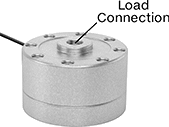 |
Threaded Through Hole | Threaded Standoff |
Round sensors have a low profile to fit in tight-clearance spaces.
Threaded Through Hole—Those with a threaded through hole are also known as pancake load cells. They can be bolted to surfaces in any orientation and are commonly used to measure clamping forces. They can be mounted in any orientation.
Threaded Standoff—Those with a threaded standoff have a threaded hole to connect to eye bolts, rod ends, and threaded rods. They’re commonly mounted upside-down between a tank and a leveling mount to weigh material in small tanks and silos.
Enclosure Rating—IP-rated sensors seal out dust.
Mounting Holes | |||||||||||||||
|---|---|---|---|---|---|---|---|---|---|---|---|---|---|---|---|
Wt. Cap. | Accuracy | Wt. Measuring Increments | Thread Size | Dia. | Ht. | Sensor Material | Temp. Range, ° F | Location | Fasteners Included | No. of | Diameter, mm | Each | |||
Measures Tension and Compression | |||||||||||||||
With 1 Threaded Through Hole | |||||||||||||||
| 1,100 lb.; 500 kg | ±8.8 oz., ±250 g | 0.1 lb., 0.01 kg | M10 × 1.5 mm | 2 15/16" | 1" | Alloy Steel | 0 to 140 | Top | No | 6 | 6.5 | 3487N223 | 0000000 | ||
| 2,200 lb.; 1,000 kg | ±1.1 lb., ±500 g | 0.1 lb., 0.01 kg | M12 × 1.75 mm | 3 9/16" | 1" | Alloy Steel | 0 to 140 | Top | No | 6 | 8.5 | 3487N224 | 000000 | ||
| 5,510 lb.; 2,500 kg | ±2.8 lb., ±1.25 kg | 0.1 lb., 0.1 kg | M12 × 1.75 mm | 3 9/16" | 1" | Alloy Steel | 0 to 140 | Top | No | 6 | 8.5 | 3487N225 | 000000 | ||
| 11,020 lb.; 5,000 kg | ±5.5 lb., ±2.5 kg | 1 lb., 0.1 kg | M24 × 3 mm | 5 1/2" | 1 3/4" | Alloy Steel | 0 to 140 | Top | No | 8 | 11 | 3487N226 | 000000 | ||
With 2 Threaded Standoffs | |||||||||||||||
| 25,000 lb.; 11,335 kg | ±12.5 lb., ±5.7 kg | 1 lb., 1 kg | 3/4"-16 | 4 3/4" | 3 1/16" | Alloy Steel | -40 to 175 | — | — | — | — | 3487N519 | 000000 | ||
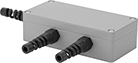 |
Connection hubs combine the measurements of multiple tension and compression force sensors together.
Ready-to-Use Tension and Compression Force Sensors
Round
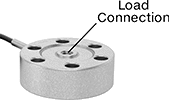 | 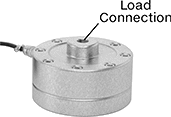 |
Threaded Through Hole | Threaded Standoff |
Threaded Standoff—Round sensors with threaded standoffs have a threaded hole to connect to eye bolts, rod ends, and threaded rods. They’re commonly mounted upside-down between a tank and a leveling mount to weight material in small tanks and silos.
Threaded Through Hole—Round sensors with a threaded through hole are also known as pancake load cells. They can be bolted to surfaces in any orientation and are commonly used to measure clamping forces.
Legal-for-Trade—Legal-for-trade sensors are NTEP approved for use with equipment that measures materials sold by weight.
Enclosure Rating—IP-rated sensors seal out dust.
Mounting Holes | |||||||||||||||
|---|---|---|---|---|---|---|---|---|---|---|---|---|---|---|---|
Wt. Cap. | Accuracy | Wt. Measuring Increments | Thread Size | Dia. | Ht. | Sensor Material | Temp. Range, ° F | Location | Fasteners Included | No. of | Diameter, mm | Each | |||
Measures Tension and Compression | |||||||||||||||
With 1 Threaded Through Hole | |||||||||||||||
| 550 lb.; 250 kg | ±4.4 oz., ±125 g | 0.01 lb., 0.01 kg | M10 × 1.5 mm | 2 15/16" | 1" | Alloy Steel | 0 to 140 | Top | No | 6 | 6.5 | 6131N25 | 0000000 | ||
With 2 Threaded Standoffs | |||||||||||||||
| 5,000 lb.; 2,265 kg | ±2.5 lb., ±1.13 kg | 0.1 lb., 0.1 kg | 1/2"-20 | 4 1/8" | 2 1/2" | Alloy Steel | -40 to 175 | — | — | — | — | 6131N16 | 00000000 | ||
| 10,000 lb.; 4,535 kg | ±5 lb., ±2.2 kg | 0.1 lb., 0.1 kg | 1/2"-20 | 4 1/8" | 2 1/2" | Alloy Steel | -40 to 175 | — | — | — | — | 6131N17 | 00000000 | ||
| 25,000 lb.; 11,335 kg | ±12.5 lb., ±5.7 kg | 1 lb., 1 kg | 3/4"-16 | 4 3/4" | 3 1/16" | Alloy Steel | -40 to 175 | — | — | — | — | 6131N18 | 00000000 | ||
|
Junction Boxes bring multiple sensors together to create a single system. They’re often used in platform or hopper scales when multiple sensors need to work together to give a total weight reading.
