We will reply to your message within an hour.
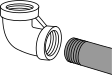
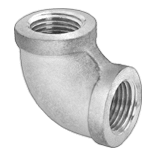
Use these corrosion-resistant fittings in a low-pressure pipe line.
Use these heavy duty, corrosion-resistant fittings in high-pressure flow applications.
Press these fittings onto stainless steel pipe using a crimping tool for a permanent, leak-tight connection that's faster than threading or welding and doesn't require heat.
Use these fittings for low-pressure applications in noncorrosive environments.
To prevent leaks in low-pressure lines, the male threads on these fittings have an acrylic sealant already applied for extra protection.
Crimp these fittings onto steel pipe to form a tightly sealed connection that’s faster than threading or welding and doesn’t require heat.
Distribute air or fluid to multiple locations from a single supply source with these manifolds. They are also known as headers.
Unlike other manifolds, which have an inlet on either end, these have one inlet on the opposite side from the outlets. This design allows air or fluid to follow a straight path, improving flow through your system. Also known as headers.
When you’re short on vertical space, these manifolds are a good fit—they have outlets on the side instead of on top, so they have a lower profile than rectangular manifolds. Use them to distribute air or fluid to five locations from a single supply source.
Mount these manifolds on the end of a hose line to distribute air, water, or hydraulic fluid to three locations from a single supply source.
With outlets on the side instead of on top, these manifolds have a lower profile than rectangular manifolds and fit well in cramped spaces. Use them to distribute air or fluid to three locations from a single supply source.
No sleeve is required to assemble these fittings, which makes for a faster, more convenient installation compared to 37° flared fittings. They are also known as refrigeration and SAE fittings.
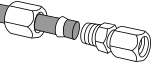
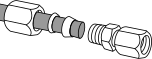
A nut with two sleeves (ferrules) gives these fittings extra gripping power. The sleeves bite into tubing as you tighten the nut, creating a strong seal.
These fittings have two sleeves for extra gripping power. They bite into steel tubing as you tighten the nut to form a strong seal.
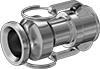
Couplings are metal, which has better durability than plastic cam-and-groove hose couplings. They consist of a plug and a socket that connect and disconnect quickly. Use them if you need frequent access to a line. To connect, insert the plug into the socket and push the levers down.
Connect your hose to a cam-and-groove vapor recovery valve.
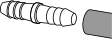
Made of stainless steel, these hose fittings are more durable than plastic barbed hose fittings and have excellent corrosion and chemical resistance. Slide the barbed end into hose and secure with a clamp.