






McMaster-Carr logo
    Filter by
    System of Measurement
    Input Voltage
    Industrial Info Snippet
    Switching Current
    Industrial Info Snippet
    Number of Circuits Controlled
    Number of Terminals
    Switch Designation
    Industrial Info Compare
    Electrical Connection
    Electrical Phase
    Operation Type
    U.S.–Mexico–Canada Agreement (USMCA) Qualifying
    Relay Type
    DFARS Specialty Metals
    Enclosure Rating
    Export Control Classification Number (ECCN)
    Industrial Info Snippet
    Mechanical Life Cycles
    UL File Number
    Enter e-mail addresses in the fields below
    Message
    Cancel
    Comments
    E-mail address (if you would like a response)
    4 Products

    Circuit Board Relays

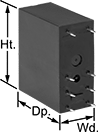
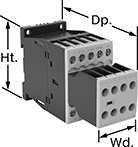
    Image of Product. 8 Terminals. Front orientation. Contains Annotated. Relays. Circuit Board Relays, Mechanical Operation.
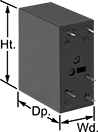
    Image of Product. 5 Terminals. Front orientation. Contains Annotated. Relays. Circuit Board Relays, Mechanical Operation.
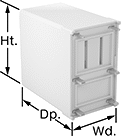
    Image of Product. 6 Terminals. Front orientation. Contains Annotated. Relays. Circuit Board Relays, Mechanical Operation.
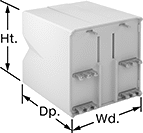
    Image of Product. 14 Terminals. Back orientation. Relays. Circuit Board Relays, Mechanical Operation.

    8 Terminals

    5 Terminals

    6 Terminals

    14 Terminals

    Smaller than relays with electrical wiring, these relays fit in compact devices. Mount them through holes on circuit boards with their solder pin terminals. Use them to control heaters, fans, and other high-power components from a low-power circuit.
    No. of
    Terminals
    Input
    Voltage
    Control Current,
    mA
    Switching Current
    @ Voltage
    Max. Switching
    Voltage, V AC
    Mechanical
    Life Cycles
    Ht.
    Wd.
    Dp.
    Pin
    Lg.
    Each
    Mechanical Operation
     
    1 Circuit Controlled with 1 Off or 1 On—SPDT
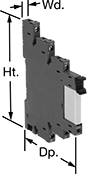
    560V DC36 amp @ 240V AC25010,000,0001.1"0.2"0.6"0.14"8262T2200000
     

    DIN-Rail Mount Interface Relays

    Isolate input and output circuits to prevent damage from voltage spikes, reduce signal interference, and amplify signal. These relays interface between your controller and components—they receive a signal from the controller to switch power on or off to the components. All have an LED indicator that shows you if your switch is actuated, so you know it’s connected and wired correctly. Use them to communicate signals to devices like motors or sensors. Mount them on 35 mm DIN rail (also known as DIN 3 rail).
    1 Circuit Controlled with 1 Off or 1 On—SPDT
    Image of Product. Front orientation. Contains Annotated. Interface Relays. DIN-Rail Mount Interface Relays, 1 Circuit Controlled, With Screw Terminals.

    With Screw

    Terminals

    Interface Relays
    Replacement
    Relays
    No. of
    Terminals
    Input
    Voltage
    Control Current,
    mA
    Switching Current
    @ Voltage
    Max. Switching
    Voltage, V AC
    Ht.
    Wd.
    Dp.
    Features
    Each
    Each
    With Screw Terminals
    5240V AC36 amp @ 240V AC2503.5"0.2"3"LED Indicator8262T160000008262T2200000
     

    Safety Relays

    Receive signals from safety monitoring relays or controllers to switch devices off and on because of a system failure. Also known as force-guided or mechanically linked contacts, the interlocking opposing contacts on these relays cannot be open or closed at the same time. To keep your system from receiving false switching signals, the interlocking opposing contact must remain open even if a contact welds closed.
    IP20 rated, they have recessed terminals that prevent fingers and other objects from touching live circuits. These relays have been tested to safety standards that can help you achieve your system's PL (performance level) and SIL (safety integrity level). Choose a relay with a PL and SIL rating to meet the needs of your system. Higher ratings indicate greater safety protection. As your system becomes more complex, you generally require a higher safety protection level. Mount them to 35mm DIN rail (also known as DIN 3 Rail).
    SIL 3, PLe, CAT IV, 600V Max. System Safety Rating—DIN-Rail and Surface Mount
    Image of Product. Front orientation. Contains Annotated. Safety Relays. Safety Relays, SIL 3, PLe, CAT IV, 600V Max. System Safety Rating—DIN-Rail and Surface Mount.
    Relays that meet SIL 3 are tested for applications with a probability of failure of 0.01% to 0.1% and are used for preventing fires, explosions, or toxic releases.
    Relays that meet CAT 4 withstand circuit surges in electrical applications up to 600V.
    Mirror Auxiliary Contacts—Relays with mirror auxiliary contacts have contacts that are normally closed and cannot be open at the same time as a normally open main contact.
    Nondetachable Auxiliary Contacts—Relays with nondetachable contacts have auxiliary contacts that won’t separate from the relay if there is shock or vibration.
    Self-Monitoring Circuitry—When a failure is detected, relays with self-monitoring circuitry signal the controller to remove power and prevent restarting until the issue is resolved.
    hp @
    Switching Voltage
    No. of
    Terminals
    Input Voltage,
    V DC
    Control Current,
    mA
    Switching Current
    @ Voltage
    Max. Switching
    Voltage, V AC
    Single Phase
    Three Phase
    Aux. Contact Switch
    Starting Position
    Ht.
    Wd.
    Dp.
    Features
    Each
    Screw-Terminal Wire Connection
     
    3 Circuits Controlled with 3 Off—3PST-NO
    1824318 amp @ 400V AC6002 hp @ 120V AC
    3 hp @ 240V AC
    5 hp @ 240V AC
    10 hp @ 480V AC
    15 hp @ 600V AC
    2 Off and 3 On3.4"1.8"5.5"Inspection Window, Interlocked Opposing Contacts, Mirror Auxiliary Contacts, Nondetachable Auxiliary Contacts, Recessed Terminals, Self-Monitoring Circuitry6242N180000000
    1824325 amp @ 400V AC6002 hp @ 120V AC
    5 hp @ 240V AC
    10 hp @ 240V AC
    15 hp @ 480V AC
    20 hp @ 600V AC
    2 Off and 3 On3.4"1.8"5.5"Inspection Window, Interlocked Opposing Contacts, Mirror Auxiliary Contacts, Nondetachable Auxiliary Contacts, Recessed Terminals, Self-Monitoring Circuitry6242N21000000
     
    back to top