McMaster-Carr logo
    Filter by
    System of Measurement
    Number of Circuits Controlled
    Switch Designation
    Industrial Info Compare
    Number of Terminals
    Mounting Location
    Switching Current
    Industrial Info Snippet
    Relay Type
    Horsepower @ Switching Voltage
    Socket Connection
    Mechanical Life Cycles
    Timing Adjustment Style
    Overall Timing
    Operation Type
    Wire Connection
    U.S.–Mexico–Canada Agreement (USMCA) Qualifying
    DFARS Specialty Metals
    Export Control Classification Number (ECCN)
    Industrial Info Snippet
    Enter e-mail addresses in the fields below
    Message
    Cancel
    Comments
    E-mail address (if you would like a response)
    5 Products

    Compact Spade-Terminal Relays

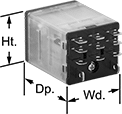
    Image of Product. 11-Terminal Relay. Front orientation. Contains Annotated. Relays. Compact Spade-Terminal Relays, 3 Circuits Controlled, 1.2" Wide, 1.6" Deep.
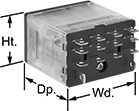
    Image of Product. 14-Terminal Relay. Front orientation. Contains Annotated. Relays. Compact Spade-Terminal Relays, 4 Circuits Controlled, 1.6" Deep.
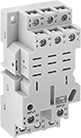
    Image of Product. 11-Terminal Relay Socket. Front orientation. Relay Sockets. Compact Spade-Terminal Relays.

    11-Terminal Relay

    14-Terminal Relay

    11-Terminal

    Relay Socket

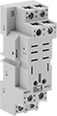
    Image of Product. 14-Terminal Relay Socket. Front orientation. Relay Sockets. Compact Spade-Terminal Relays.
    Image of Product. 8-Terminal Relay Socket. Front orientation. Relay Sockets. Compact Spade-Terminal Relays.

    14-Terminal

    Relay Socket

    8-Terminal

    Relay

    Socket

    Fit these relays where standard spade-terminal relays are too big. You can connect them three ways. Plug them into a socket (sold separately), connect them with quick-disconnect terminals, or solder wires directly to the terminals. An LED indicator shows you the status of the relay, so you know it’s connected and wired correctly.
    3 Circuits Controlled and 4 Circuits Controlled—Relays that control 2 or more circuits have a lockable test button, so you can test their function. When you press the button, the relay switches contacts. Use this button when checking a relay for proper function before installing it, or when investigating issues with wired relays.
    Sockets with Screw Terminals—Relay sockets mount directly on 35 mm DIN rail (also known as DIN 3 rail) for fast installation. You can also mount them to a flat surface using screws.
    Relays
    Sockets with
    Screw Terminals
    No. of
    Terminals
    Input
    Voltage
    Control Current,
    mA
    Switching Current
    @ Voltage
    Max. Switching
    Voltage, V AC
    hp @ Switching Voltage
    Ht.
    Wd.
    Dp.
    Quick-Disconnect
    Tab Wd.
    Features
    Each
    Each
    3 Circuits Controlled with 3 Off or 3 On—3PDT
     
    Relay-Socket Mount
    11240V AC615 amp @ 120V AC
    12 amp @ 24V DC
    3001/2 hp @ 120V AC
    1 hp @ 277V AC
    1.1"1.2"1.6"0.187"LED Indicator, Lockable Test Button, Mechanical Flag Indicator69585K7100000069585K2000000
     
    4 Circuits Controlled with 4 Off or 4 On—4PDT
     
    Relay-Socket Mount
    1424V DC615 amp @ 120V AC
    12 amp @ 24V DC
    3001/2 hp @ 120V AC
    1 hp @ 277V AC
    1.1"1.6"1.6"0.187"LED Indicator, Lockable Test Button, Mechanical Flag Indicator69585K960000069585K300000
     

    DIN-Rail Mount Multifunction Timer Relays

    Control multiple timing functions from your electrical cabinet—these timer relays mount to 35 mm DIN rail (also known as DIN 3 rail), which is the most commonly used size. UL Listed, C-UL Listed, or CE Marked, these relays meet American, Canadian, or European safety standards.
    Timer Relays with Delayed, Interval, Switch On, and Repeat Cycles
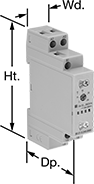
    Image of Product. Front orientation. Contains Annotated. Timer Relays. DIN-Rail Mount Multifunction Timer Relays, 1 Circuit Controlled.

    1 Circuit

    Controlled

    Timer relays with delayed, interval, switch-on, and repeat cycles have a broad range of applications. Use them to precisely control machines such as conveyors, lighting systems, and electric motors.
    Delayed Start (Delay on Make) Timer—This function allows you to set how long it takes for the relay to turn on after input voltage is applied. For example, a drill starts pumping lubricant immediately, but it does not start rotating until the set time has elapsed.
    Delayed Switch Off (Delay on Break) Timer—This function uses a switch instead of input voltage. When the switch is turned off, the relay remains on for a programmed amount of time before turning off. For example, a projector’s light is turned off with a switch, but its cooling fan continues to run for a set time.
    Delayed Switch-On with Delayed Switch-Off Timer—This function uses a switch instead of input voltage. It allows you to set how long the relay takes to turn on after a switch is turned on, and how long it will stay on after the switch is turned off. For example, a furnace turns on, but the fan doesn’t start pushing air through the vents until it has been heated. When the furnace turns off, the fan keeps blowing to circulate all the hot air.
    Delayed-Pulse Timer—This function uses input voltage to turn on the relay for a brief period after a preset time. For example, a light flashes a few seconds after a door closes.
    Interval Timer—This function uses input voltage to turn on the relay for a programmed amount of time. For example, when a part moving down a conveyor reaches a certain location, a cleaning spray comes on for a set time.
    Interval Switch-Off Timer—This function requires a switch to activate the relay, which stays off for the programmed amount of time. For example, lights in a storage room are turned on with a switch and stay on for a set time before turning off.
    Switch on (Single Shot) Timer—This function requires a switch to activate the relay, which stays on for the programmed amount of time. For example, lights in a storage room are turned on with a switch and stay on for a set time before turning off.
    Repeat-Cycle Timer—This function starts with an on cycle and then alternates between an on cycle and off cycle of equal durations until input voltage is removed. A common example would be a flashing light.
    Start-Off Repeat Cycle Timer—This function starts with an off cycle and alternates between an on cycle and off cycle of equal durations until input voltage is removed. A common example would be a flashing light.
    Switch Fixed On/Off Timer—This function requires a switch to activate the timing function instead of the input voltage (which is applied the entire time). It keeps the relay on whenever the switch is closed; it will only turn off if the switch is open.
    Timing
    Range
    No. of
    Terminals
    Input Voltage
    Control Current,
    mA
    Timer Relay Function
    No.
    of
    Overall
    Switching Current
    @ Voltage
    Max. Switching
    Voltage, V AC
    Ht.
    Wd.
    Dp.
    Each
    1 Circuit Controlled with 1 Off or 1 On—SPDT
    812V AC, 24V AC, 48V AC, 120V AC, 240V AC, 12V DC, 24V DC, 48V DC, 60V DC, 120V DC, 240V DC6Delayed Start (Delay on Make)
    Delayed Switch Off (Delay on Break)
    Delayed Switch-On with Delayed Switch-Off
    Delayed Pulse
    Interval
    Interval Switch-Off
    Switch on (Single Shot)
    Repeat Cycle
    Start-Off Repeat Cycle
    Switch Fixed On/Off
    80.1 sec. to 10 day8 amp @ 240V AC2504.1"0.7"2.6"6964K102000000
     
    back to top