




Filter by
Input Voltage

Switching Voltage
Switching Current
Mounting Location
Timer Function
Operation Type
Overall Timing


Timing Adjustment Style


Horsepower @ Switching Voltage
Switch Starting Position
Control Current


Socket Connection


Switch Action
Export Control Classification Number (ECCN)
DFARS Specialty Metals
DIN-Rail Mount Solid State Relays
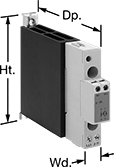 | 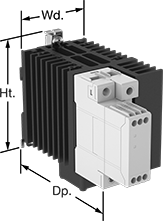 | 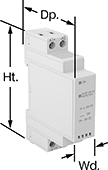 |
Relay with Integrated Heat Sink | Relay with Integrated Heat Sink and Fan | Relay |
Unlike mechanical relays, these solid state relays have no moving parts, so they require less maintenance and last longer, switch faster, and are quieter. They mount on 35 mm DIN rail (also known as DIN 3) for fast installation. An LED indicator lights up when these relays are connected, so you can quickly confirm that they’re wired correctly. IP20 rated, their terminals are recessed, so they prevent fingers and other objects from touching live circuits.
Integrated Heat Sink—Relays with an integrated heat sink disperse heat to increase the relay’s current rating.
Integrated Fan—Relays with an integrated fan are best for applications that generate more heat. The fan automatically turns on to provide additional cooling. When the temperature exceeds 176° F, an alarm sends a signal to an external device, such as a controller or indicating light.
No. of Terminals | Input Voltage | Control Current, mA | Switching Current @ Voltage (Load Type) | Max. Switching Voltage, V AC | hp @ Switching Voltage | Ht. | Wd. | Dp. | Features | Each | |||
|---|---|---|---|---|---|---|---|---|---|---|---|---|---|
1 Circuit Controlled with 1 Off—SPST-NO | |||||||||||||
Single Phase | |||||||||||||
| 4 | 24V AC, 90V AC, 120V AC, 240V AC, 24V DC, 48V DC, 60V DC, 120V DC, 275V AC | 12 | 5 amp @ 24V AC (Full) 10 amp @ 24V AC (Resistive) 10 amp @ 240V AC | 240 | — | 4.173" | 0.7" | 2.56" | Integrated Heat Sink, LED Indicator | 8299K34 | 000000 | ||
| 4 | 24V AC, 120V AC, 208V AC, 240V AC, 277V AC/24V DC, 48V DC, 60V DC, 120V DC | 13 | 20 amp @ 240V AC (Full) | 264 | 1/3 hp @ 115V AC 1 hp @ 230V AC | 4.33" | 0.7" | 3.447" | Integrated Heat Sink, LED Indicator | 4398N12 | 00000 | ||
| 4 | 24V AC, 120V AC, 208V AC, 240V AC, 277V AC/24V DC, 48V DC, 60V DC, 120V DC | 13 | 20 amp @ 600V AC (Full) | 660 | 1/3 hp @ 115V AC 1 hp @ 230V AC | 4.33" | 0.7" | 3.447" | Integrated Heat Sink, LED Indicator | 6323T41 | 00000 | ||
| 4 | 24V AC, 120V AC, 208V AC, 240V AC, 277V AC/24V DC, 48V DC, 60V DC, 120V DC | 13 | 30 amp @ 230V AC (Full) | 264 | 3/4 hp @ 115V AC 2 hp @ 230V AC | 4.33" | 0.89" | 4.917" | Integrated Heat Sink, LED Indicator | 7456K78 | 000000 | ||
| 4 | 24V AC, 120V AC, 208V AC, 240V AC, 277V AC/24V DC, 48V DC, 60V DC, 120V DC | 13 | 85 amp @ 600V AC (Full) | 660 | 2 hp @ 115V AC 5 hp @ 230V AC | 5.12" | 2.76" | 5.247" | Integrated Heat Sink, Integrated Fan, LED Indicator | 6323T81 | 000000 | ||
| 4 | 24V AC, 120V AC, 208V AC, 240V AC, 277V AC/24V DC, 48V DC, 60V DC, 120V DC | 22 | 30 amp @ 600V AC (Full) | 660 | 3/4 hp @ 115V AC 2 hp @ 230V AC | 4.33" | 0.89" | 4.917" | Integrated Heat Sink, LED Indicator | 6323T32 | 000000 | ||
| 4 | 24V AC, 120V AC, 208V AC, 240V AC, 277V AC/24V DC, 48V DC, 60V DC, 120V DC | 22 | 40 amp @ 600V AC (Full) | 660 | 1 hp @ 115V AC 3 hp @ 230V AC | 4.33" | 1.4" | 4.917" | Integrated Heat Sink, LED Indicator | 6323T34 | 000000 | ||
2 Circuits Controlled with 2 Off—DPST-NO | |||||||||||||
Three Phase | |||||||||||||
| 8 | 24V AC, 120V AC, 208V AC, 240V AC, 277V AC/24V DC, 48V DC, 60V DC, 120V DC | 2 | 25 amp @ 220V AC (Full) | 242 | 1 1/2 hp @ 115V AC 3 hp @ 230V AC | 4.33" | 2.13" | 3.427" | Integrated Heat Sink, LED Indicator | 7456K81 | 000000 | ||
| 8 | 24V AC, 120V AC, 208V AC, 240V AC, 277V AC/24V DC, 48V DC, 60V DC, 120V DC | 2 | 25 amp @ 600V AC (Full) | 660 | 5 hp @ 230V AC 10 hp @ 480V AC | 4.33" | 2.13" | 3.427" | Integrated Heat Sink, LED Indicator | 7456K82 | 000000 | ||
| 8 | 24V AC, 120V AC, 208V AC, 240V AC, 277V AC/24V DC, 48V DC, 60V DC, 120V DC | 2 | 40 amp @ 600V AC (Full) | 660 | 5 hp @ 230V AC 10 hp @ 480V AC | 4.33" | 2.84" | 4.66" | Integrated Heat Sink, LED Indicator | 6323T83 | 000000 | ||
| 15 | 24V AC, 120V AC, 208V AC, 240V AC, 277V AC/24V DC, 48V DC, 60V DC, 120V DC | 2 | 75 amp @ 600V AC (Full) | 660 | 10 hp @ 230V AC 20 hp @ 480V AC | 5.55" | 2.84" | 4.679" | Integrated Heat Sink, Integrated Fan, LED Indicator | 6323T85 | 000000 | ||
3 Circuits Controlled with 3 Off—3PST-NO | |||||||||||||
Three Phase | |||||||||||||
| 8 | 24V AC, 120V AC, 208V AC, 240V AC, 277V AC/24V DC, 48V DC, 60V DC, 120V DC | 2 | 20 amp @ 600V AC (Full) | 660 | 3 hp @ 230V AC 7 1/2 hp @ 480V AC | 4.33" | 2.1" | 3.427" | Integrated Heat Sink, LED Indicator | 6323T71 | 000000 | ||
| 8 | 24V AC, 120V AC, 208V AC, 240V AC, 277V AC/24V DC, 48V DC, 60V DC, 120V DC | 2 | 30 amp @ 600V AC (Full) | 660 | 5 hp @ 230V AC 10 hp @ 480V AC | 4.33" | 2.84" | 4.66" | Integrated Heat Sink, LED Indicator | 6323T87 | 000000 | ||
| 15 | 24V AC, 120V AC, 208V AC, 240V AC, 277V AC/24V DC, 48V DC, 60V DC, 120V DC | 2 | 40 amp @ 600V AC (Full) | 660 | 5 hp @ 230V AC 10 hp @ 480V AC | 5.31" | 2.13" | 3.739" | Integrated Heat Sink, Integrated Fan, LED Indicator | 6323T89 | 000000 | ||
| 15 | 24V AC, 120V AC, 208V AC, 240V AC, 277V AC/24V DC, 48V DC, 60V DC, 120V DC | 2 | 65 amp @ 600V AC (Full) | 660 | 10 hp @ 230V AC 20 hp @ 480V AC | 5.55" | 2.84" | 4.679" | Integrated Heat Sink, Integrated Fan, LED Indicator | 6323T92 | 000000 | ||
DIN-Rail Mount Multifunction Timer Relays
Timer Relays with Delayed, Interval, Switch On, and Repeat Cycles
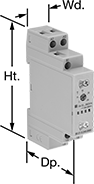 |
1 Circuit Controlled |
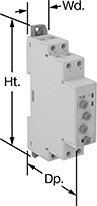 |
2 Circuits Controlled |
Timer relays with delayed, interval, switch-on, and repeat cycles have a broad range of applications. Use them to precisely control machines such as conveyors, lighting systems, and electric motors.
Delayed Start (Delay on Make) Timer—This function allows you to set how long it takes for the relay to turn on after input voltage is applied. For example, a drill starts pumping lubricant immediately, but it does not start rotating until the set time has elapsed.
Delayed Switch Off (Delay on Break) Timer—This function uses a switch instead of input voltage. When the switch is turned off, the relay remains on for a programmed amount of time before turning off. For example, a projector’s light is turned off with a switch, but its cooling fan continues to run for a set time.
Delayed Switch-On with Delayed Switch-Off Timer—This function uses a switch instead of input voltage. It allows you to set how long the relay takes to turn on after a switch is turned on, and how long it will stay on after the switch is turned off. For example, a furnace turns on, but the fan doesn’t start pushing air through the vents until it has been heated. When the furnace turns off, the fan keeps blowing to circulate all the hot air.
Delayed-Pulse Timer—This function uses input voltage to turn on the relay for a brief period after a preset time. For example, a light flashes a few seconds after a door closes.
Interval Timer—This function uses input voltage to turn on the relay for a programmed amount of time. For example, when a part moving down a conveyor reaches a certain location, a cleaning spray comes on for a set time.
Interval Switch-Off Timer—This function requires a switch to activate the relay, which stays off for the programmed amount of time. For example, lights in a storage room are turned on with a switch and stay on for a set time before turning off.
Switch on (Single Shot) Timer—This function requires a switch to activate the relay, which stays on for the programmed amount of time. For example, lights in a storage room are turned on with a switch and stay on for a set time before turning off.
Repeat-Cycle Timer—This function starts with an on cycle and then alternates between an on cycle and off cycle of equal durations until input voltage is removed. A common example would be a flashing light.
Start-Off Repeat Cycle Timer—This function starts with an off cycle and alternates between an on cycle and off cycle of equal durations until input voltage is removed. A common example would be a flashing light.
Switch Fixed On/Off Timer—This function requires a switch to activate the timing function instead of the input voltage (which is applied the entire time). It keeps the relay on whenever the switch is closed; it will only turn off if the switch is open.
Timing Range | ||||||||||||||
|---|---|---|---|---|---|---|---|---|---|---|---|---|---|---|
No. of Terminals | Input Voltage | Control Current, mA | Timer Relay Function | No. of | Overall | Switching Current @ Voltage | Max. Switching Voltage, V AC | Ht. | Wd. | Dp. | Each | |||
1 Circuit Controlled with 1 Off or 1 On—SPDT | ||||||||||||||
| 6 | 12V AC, 24V AC, 48V AC, 120V AC, 240V AC, 12V DC, 24V DC, 48V DC, 60V DC, 120V DC, 240V DC | 7 | Delayed Start (Delay on Make) Delayed Switch Off (Delay on Break) Delayed Switch-On with Delayed Switch-Off Interval Switch on (Single Shot) Repeat Cycle | 6 | 0.1 sec. to 24 hr. | 16 amp @ 240V AC | 250 | 3.5" | 0.7" | 2.4" | 6964K4 | 000000 | ||
| 8 | 12V AC, 24V AC, 48V AC, 120V AC, 240V AC, 12V DC, 24V DC, 48V DC, 60V DC, 120V DC, 240V DC | 6 | Delayed Start (Delay on Make) Delayed Switch Off (Delay on Break) Delayed Switch-On with Delayed Switch-Off Delayed Pulse Interval Interval Switch-Off Switch on (Single Shot) Repeat Cycle Start-Off Repeat Cycle Switch Fixed On/Off | 8 | 0.1 sec. to 10 day | 8 amp @ 240V AC | 250 | 4.1" | 0.7" | 2.6" | 6964K102 | 00000 | ||
2 Circuits Controlled with 2 Off or 2 On—DPDT | ||||||||||||||
| 8 | 12V AC, 24V AC, 48V AC, 120V AC, 240V AC, 12V DC, 24V DC, 48V DC, 60V DC, 120V DC, 240V DC | 7 | Delayed Start (Delay on Make) Delayed Switch Off (Delay on Break) Delayed Switch-On with Delayed Switch-Off Delayed Pulse Interval Interval Switch-Off Switch on (Single Shot) Repeat Cycle Start-Off Repeat Cycle Switch Fixed On/Off | 8 | 0.1 sec. to 10 day | 8 amp @ 240V AC | 250 | 4.1" | 0.7" | 2.6" | 6964K103 | 000000 | ||
Timer Relays with Asymmetrical Repeat Cycles
|
1 Circuit Controlled |
Use timer relays with asymmetrical repeat cycles when your repeat cycles have different on- and off-cycle durations.
Asymmetrical-Repeat-Cycle Timer—This function switches the relay on and alternates between different durations of on and off for as long as input voltage is applied. For example, a sprinkler system sprays in short bursts followed by longer rest periods, on and off until input voltage is removed.
Start-Off Asymmetrical Repeat Cycle Timer—This function switches the relay off and alternates between different durations of on and off for as long as input voltage is applied. For example, an irrigation system receives a signal and starts in the off state, allowing water to fill before switching on to start pumping.
Switch-On Asymmetrical Repeat Cycle Timer—This function switches the relay on and alternates between different durations of on and off for as long as input voltage is applied. It requires a switch to activate the timing function instead of the input voltage that’s being applied the entire time. You could use this function to turn on an electric motor for a short period and then turn it off for a longer rest period, repeating that pattern until the switch is turned off.
Switch-Off Asymmetrical Repeat Cycle Timer—This function switches the relay off and alternates between different durations of on and off for as long as input voltage is applied. It requires a switch to activate the timing function instead of input voltage that’s being applied the entire time. It could be used to turn on an electric motor for a short period and then turn it off for a longer rest period, repeating that pattern until the switch is turned off.
Timing Range | ||||||||||||||
|---|---|---|---|---|---|---|---|---|---|---|---|---|---|---|
No. of Terminals | Input Voltage | Control Current, mA | Timer Relay Function | No. of | Overall | Switching Current @ Voltage | Max. Switching Voltage, V AC | Ht. | Wd. | Dp. | Each | |||
1 Circuit Controlled with 1 Off or 1 On—SPDT | ||||||||||||||
| 6 | 12V AC, 24V AC, 48V AC, 120V AC, 240V AC, 12V DC, 24V DC, 48V DC, 60V DC, 120V DC, 240V DC | 7 | Asymmetrical Repeat Cycle Switch-On Asymmetrical Repeat Cycle | 6 | 0.1 sec. to 24 hr. | 16 amp @ 240V AC | 250 | 3.5" | 0.7" | 2.4" | 6964K17 | 000000 | ||
| 8 | 24V AC, 48V AC, 120V AC, 240V AC, 24V DC, 48V DC, 60V DC, 120V DC, 240V DC | 6.2 | Asymmetrical Repeat Cycle Start-Off Asymmetrical Repeat Cycle Switch-On Asymmetrical Repeat Cycle Switch-Off Asymmetrical Repeat Cycle | 8 | 0.05 sec. to 10 day | 16 amp @ 240V AC | 250 | 3.4" | 0.9" | 3.9" | 6964K101 | 00000 | ||
DIN-Rail Mount Solid State Interface Relays
1 Circuit Controlled with 1 Off—SPST-NO
 |  |
With Screw Terminals | With Spring-Clamp Terminals |
Interface Relays | Replacement Relays | ||||||||||||||
|---|---|---|---|---|---|---|---|---|---|---|---|---|---|---|---|
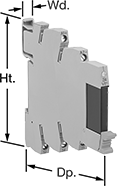
No. of Terminals | Input Voltage | Output Voltage, V DC | Control Current, mA | Switching Current @ Voltage | Max. Switching Voltage | Ht. | Wd. | Dp. | Features | Each | Each | ||||
With Screw Terminals | |||||||||||||||
| 4 | 120V AC, 120V DC | — | 5.5 | 2 amp @ 240V AC | 275V AC | 3.5" | 0.2" | 3" | LED Power Indicator | 4103N13 | 000000 | 8262T19 | 000000 | ||
| 4 | 120V AC, 120V DC | — | 5.5 | 6 amp @ 24V DC | 33V DC | 3.5" | 0.2" | 3" | LED Power Indicator | 4103N12 | 00000 | 8262T18 | 00000 | ||
| 5 | 24V AC, 48V AC, 60V AC, 120V AC, 240V AC, 24V DC, 48V DC, 60V DC, 120V DC, 240V DC | 3 to 48 | 19 | 100 mA @ 48V DC | 48V DC | 3.5" | 0.2" | 3.4" | LED Power Indicator | 7356K25 | 00000 | 4026N14 | 00000 | ||
| 5 | 24V AC, 48V AC, 120V AC, 240V AC, 24V DC, 48V DC, 60V DC, 120V DC, 240V DC | — | 18 | 5 amp @ 30V DC | 33V DC | 3.5" | 0.5" | 3.4" | LED Power Indicator | 8299K15 | 00000 | 4026N16 | 00000 | ||
With Spring-Clamp Terminals | |||||||||||||||
| 4 | 120V AC, 120V DC | — | 5.5 | 2 amp @ 240V AC | 275V AC | 3.7" | 0.2" | 3" | LED Power Indicator | 4103N101 | 00000 | 8262T19 | 00000 | ||
| 4 | 120V AC, 120V DC | — | 5.5 | 6 amp @ 24V DC | 33V DC | 3.7" | 0.2" | 3" | LED Power Indicator | 4103N102 | 00000 | 8262T18 | 00000 | ||
DIN-Rail Mount Interface Relays
1 Circuit Controlled with 1 Off or 1 On—SPDT
 |  |  |
With Screw Terminals | With Spring-Clamp Terminals | Relay with Fuse Holder (Sold Separately) |
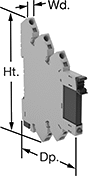
With Spring-Clamp Terminals—Relays with spring-clamp terminals connect and disconnect to wires without needing to turn screws. Because there is no screw, these connections have less risk of loosening over time than screw terminals, even when there is vibration.
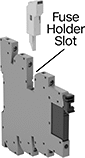
Fuse Holder Slot—Relays with a fuse holder slot give you the option for additional overload protection. If the current exceeds the fuse’s rating, the fuse will blow and break the circuit. This prevents the relay from overheating, breaking, or causing a fire. The fuse holder is sold separately. You can use these relays without the fuse holder as a standard interface relay.
Interface Relays | Replacement Relays | Fuse Holders | ||||||||||||||
|---|---|---|---|---|---|---|---|---|---|---|---|---|---|---|---|---|
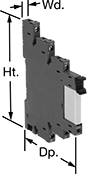
No. of Terminals | Input Voltage | Control Current, mA | Switching Current @ Voltage | Max. Switching Voltage, V AC | Ht. | Wd. | Dp. | Features | Each | Each | Each | |||||
With Screw Terminals | ||||||||||||||||
| 5 | 120V AC, 120V DC | 5 | 6 amp @ 240V AC | 250 | 3.5" | 0.2" | 3" | LED Indicator | 8262T12 | 000000 | 8262T22 | 00000 | ——— | 0 | ||
| 5 | 120V AC, 120V DC | 5 | 6 amp @ 240V AC | 250 | 3.7" | 0.2" | 3.5" | Fuse Holder Slot, LED Indicator | 4144N102 | 00000 | 8262T22 | 0000 | 4144N108 | 00000 | ||
With Spring-Clamp Terminals | ||||||||||||||||
| 5 | 120V AC, 120V DC | 5 | 6 amp @ 240V AC | 250 | 3.7" | 0.2" | 3" | LED Indicator | 4144N17 | 00000 | 8262T22 | 0000 | ——— | 0 | ||
| 5 | 120V AC, 120V DC | 5 | 6 amp @ 240V AC | 250 | 3.7" | 0.2" | 3.5" | Fuse Holder Slot, LED Indicator | 4144N104 | 00000 | 8262T22 | 0000 | 4144N108 | 0000 | ||
2 Circuits Controlled with 2 Off or 2 On—DPDT
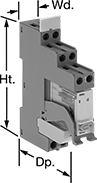 |
With Screw Terminals |
Interface Relays | Replacement Relays | ||||||||||||||
|---|---|---|---|---|---|---|---|---|---|---|---|---|---|---|---|
No. of Terminals | Input Voltage | Control Current, mA | Switching Current @ Voltage | Max. Switching Voltage, V AC | hp @ Switching Voltage | Ht. | Wd. | Dp. | Features | Each | Each | ||||
With Screw Terminals | |||||||||||||||
| 8 | 120V AC, 120V DC | 4.5 | 8 amp @ 240V AC | 250 | 1/2 hp @ 120V AC | 3.5" | 0.6" | 3" | LED Indicator | 4144N13 | 000000 | 4026N13 | 00000 | ||
Timer Relays
 |  |  |
Relays with 1 Circuit Controlled and Knob | Relays with 2 Circuits Controlled and Knob | Sockets |
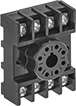
Turn machinery, such as paint and conveyor lines, on and off after a set period of time. These timer relays plug into relay sockets (sold separately) for fast installation and replacement.
Sockets—Relay sockets mount on 35 mm DIN rail (also known as DIN 3) or flat surfaces.
Timer Relays | Sockets | ||||||||||||||
|---|---|---|---|---|---|---|---|---|---|---|---|---|---|---|---|
Timing Range | Switching Current, amp | ||||||||||||||
No. of Terminals | Input Voltage | Control Current, mA | No. of | Overall | @ 240 V AC | @ 24 V DC | Max. Switching Voltage | hp @ Switching Voltage | Timing Adjustment Style | Each | Each | ||||
Delayed Start (Delay on Make) | |||||||||||||||
2 Circuits Controlled with 2 Off or 2 On—DPDT | |||||||||||||||
| 8 | 120V AC, 120V DC | 17 | 1 | 0.05 sec. to 1 sec. | 10 | 8 | 240V AC/30V DC | 1/3 hp @ 240V AC | Knob | 7268K21 | 000000 | 7122K19 | 00000 | ||
| 8 | 120V AC, 120V DC | 17 | 1 | 0.1 sec. to 10 sec. | 10 | 8 | 240V AC/30V DC | 1/3 hp @ 240V AC | Knob | 7268K23 | 00000 | 7122K19 | 0000 | ||
| 8 | 120V AC, 120V DC | 17 | 1 | 0.3 sec. to 30 sec. | 10 | 8 | 240V AC/30V DC | 1/3 hp @ 240V AC | Knob | 7268K24 | 00000 | 7122K19 | 0000 | ||
| 8 | 120V AC, 120V DC | 17 | 1 | 0.6 sec. to 60 sec. | 10 | 8 | 240V AC/30V DC | 1/3 hp @ 240V AC | Knob | 7268K25 | 00000 | 7122K19 | 0000 | ||
| 8 | 120V AC, 120V DC | 17 | 1 | 1.8 sec. to 180 sec. | 10 | 8 | 240V AC/30V DC | 1/3 hp @ 240V AC | Knob | 7268K26 | 00000 | 7122K19 | 0000 | ||
| 8 | 120V AC, 120V DC | 17 | 1 | 3 sec. to 300 sec. | 10 | 8 | 240V AC/30V DC | 1/3 hp @ 240V AC | Knob | 7268K51 | 00000 | 7122K19 | 0000 | ||
| 8 | 120V AC, 120V DC | 17 | 1 | 0.1 min. to 10 min. | 10 | 8 | 240V AC/30V DC | 1/3 hp @ 240V AC | Knob | 7268K52 | 00000 | 7122K19 | 0000 | ||
| 8 | 120V AC, 120V DC | 17 | 1 | 0.6 min. to 60 min. | 10 | 8 | 240V AC/30V DC | 1/3 hp @ 240V AC | Knob | 7268K54 | 00000 | 7122K19 | 0000 | ||
Delayed Switch Off (Delay on Break) | |||||||||||||||
2 Circuits Controlled with 2 Off or 2 On—DPDT | |||||||||||||||
| 11 | 120V AC, 120V DC | 17 | 1 | 0.05 sec. to 5 sec. | 10 | 8 | 240V AC/30V DC | 1/3 hp @ 240V AC | Knob | 7268K42 | 00000 | 7122K21 | 0000 | ||
| 11 | 120V AC, 120V DC | 17 | 1 | 0.1 sec. to 10 sec. | 10 | 8 | 240V AC/30V DC | 1/3 hp @ 240V AC | Knob | 7268K43 | 00000 | 7122K21 | 0000 | ||
| 11 | 120V AC, 120V DC | 17 | 1 | 0.3 sec. to 30 sec. | 10 | 8 | 240V AC/30V DC | 1/3 hp @ 240V AC | Knob | 7268K44 | 00000 | 7122K21 | 0000 | ||
| 11 | 120V AC, 120V DC | 17 | 1 | 0.6 sec. to 60 sec. | 10 | 8 | 240V AC/30V DC | 1/3 hp @ 240V AC | Knob | 7268K45 | 00000 | 7122K21 | 0000 | ||
| 11 | 120V AC, 120V DC | 17 | 1 | 1.2 sec. to 120 sec. | 10 | 8 | 240V AC/30V DC | 1/3 hp @ 240V AC | Knob | 7268K4 | 00000 | 7122K21 | 0000 | ||
| 11 | 120V AC, 120V DC | 17 | 1 | 1.8 sec. to 180 sec. | 10 | 8 | 240V AC/30V DC | 1/3 hp @ 240V AC | Knob | 7268K46 | 00000 | 7122K21 | 0000 | ||
| 11 | 120V AC, 120V DC | 17 | 1 | 3 sec. to 300 sec. | 10 | 8 | 240V AC/30V DC | 1/3 hp @ 240V AC | Knob | 7268K61 | 00000 | 7122K21 | 0000 | ||
| 11 | 120V AC, 120V DC | 17 | 1 | 0.1 min. to 10 min. | 10 | 8 | 240V AC/30V DC | 1/3 hp @ 240V AC | Knob | 7268K62 | 00000 | 7122K21 | 0000 | ||
| 11 | 120V AC, 120V DC | 17 | 1 | 0.6 min. to 60 min. | 10 | 8 | 240V AC/30V DC | 1/3 hp @ 240V AC | Knob | 7268K64 | 00000 | 7122K21 | 0000 | ||
Delayed Off | |||||||||||||||
2 Circuits Controlled with 2 Off or 2 On—DPDT | |||||||||||||||
| 8 | 120V AC, 120V DC | 20 | 8 | 0.05 sec. to 1,800 sec. | 10 | 8 | 240V AC/30V DC | 1/3 hp @ 240V AC | Knob | 7268K47 | 00000 | 7122K19 | 0000 | ||
Interval | |||||||||||||||
2 Circuits Controlled with 2 Off or 2 On—DPDT | |||||||||||||||
| 8 | 120V AC, 120V DC | 17 | 1 | 0.05 sec. to 5 sec. | 10 | 8 | 240V AC/30V DC | 1/3 hp @ 240V AC | Knob | 7630K31 | 00000 | 7122K19 | 0000 | ||
| 8 | 120V AC, 120V DC | 17 | 1 | 0.6 sec. to 60 sec. | 10 | 8 | 240V AC/30V DC | 1/3 hp @ 240V AC | Knob | 7630K32 | 00000 | 7122K19 | 0000 | ||
| 8 | 120V AC, 120V DC | 17 | 1 | 0.1 min. to 10 min. | 10 | 8 | 240V AC/30V DC | 1/3 hp @ 240V AC | Knob | 7630K33 | 00000 | 7122K19 | 0000 | ||
| 8 | 120V AC, 120V DC | 17 | 1 | 0.6 min. to 60 min. | 10 | 8 | 240V AC/30V DC | 1/3 hp @ 240V AC | Knob | 7630K34 | 00000 | 7122K19 | 0000 | ||
Repeat Cycle | |||||||||||||||
2 Circuits Controlled with 2 Off or 2 On—DPDT | |||||||||||||||
| 8 | 120V AC, 120V DC | 17 | 1 | 0.05 sec. to 5 sec. | 10 | 8 | 240V AC/30V DC | 1/3 hp @ 240V AC | Knob | 7630K11 | 000000 | 7122K19 | 0000 | ||
| 8 | 120V AC, 120V DC | 17 | 1 | 0.1 sec. to 10 sec. | 10 | 8 | 240V AC/30V DC | 1/3 hp @ 240V AC | Knob | 7630K12 | 000000 | 7122K19 | 0000 | ||
| 8 | 120V AC, 120V DC | 17 | 1 | 0.6 sec. to 60 sec. | 10 | 8 | 240V AC/30V DC | 1/3 hp @ 240V AC | Knob | 7630K14 | 000000 | 7122K19 | 0000 | ||
| 8 | 120V AC, 120V DC | 17 | 1 | 1.8 sec. to 180 sec. | 10 | 8 | 240V AC/30V DC | 1/3 hp @ 240V AC | Knob | 7630K16 | 000000 | 7122K19 | 0000 | ||
| 8 | 120V AC, 120V DC | 17 | 1 | 3 sec. to 300 sec. | 10 | 8 | 240V AC/30V DC | 1/3 hp @ 240V AC | Knob | 7630K17 | 000000 | 7122K19 | 0000 | ||
| 8 | 120V AC, 120V DC | 17 | 1 | 0.1 min. to 10 min. | 10 | 8 | 240V AC/30V DC | 1/3 hp @ 240V AC | Knob | 7630K18 | 000000 | 7122K19 | 0000 | ||
| 8 | 120V AC, 120V DC | 17 | 1 | 0.3 min. to 30 min. | 10 | 8 | 240V AC/30V DC | 1/3 hp @ 240V AC | Knob | 7630K23 | 000000 | 7122K19 | 0000 | ||
Switch on (Single Shot) | |||||||||||||||
1 Circuit Controlled with 1 Off or 1 On—SPDT | |||||||||||||||
| 8 | 120V AC, 120V DC | 17 | 1 | 0.1 sec. to 10 sec. | 10 | 8 | 240V AC/30V DC | 1/3 hp @ 240V AC | Knob | 7630K41 | 00000 | 7122K19 | 0000 | ||
| 8 | 120V AC, 120V DC | 17 | 1 | 0.6 sec. to 60 sec. | 10 | 8 | 240V AC/30V DC | 1/3 hp @ 240V AC | Knob | 7630K42 | 00000 | 7122K19 | 0000 | ||
Solid State DIN-Rail Mount Timer Relays
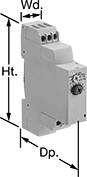 |
Mount these timer relays directly to 35 mm DIN rail (also known as DIN 3 rail) for fast installation. Unlike mechanical relays, they have no moving parts, so they require less maintenance and last longer, are quieter, and switch faster. After selecting a timing range, use the knob to adjust the trip time within the timing range.
Timing Range | |||||||||||||
|---|---|---|---|---|---|---|---|---|---|---|---|---|---|
No. of Terminals | Input Voltage | Control Current, mA | No. of | Overall | Switching Current @ Voltage | Max. Switching Voltage, V AC | Ht. | Wd. | Dp. | Each | |||
Delayed Start (Delay on Make) | |||||||||||||
1 Circuit Controlled with 1 Off—SPST-NO | |||||||||||||
| 6 | 24V AC, 48V AC, 120V AC, 240V AC, 24V DC, 48V DC, 60V DC, 120V DC, 240V DC | 7 | 7 | 0.1 sec. to 100 hr. | 0.7 amp @ 240V AC | 250 | 3 1/2" | 0.7" | 2.7" | 7801K51 | 000000 | ||
Hazardous Location Relays
 |  |
Screw Terminals | Spring-Clamp Terminals |
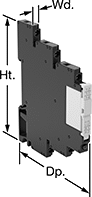
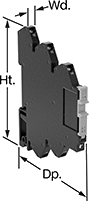
Sealed for safety, these relays are a good choice for hazardous locations where combustible or corrosive gases may be present.
Screw Terminals—Relays with screw terminals are considered interface relays, so they’re placed between your controller and components to isolate the input and output circuits. This means they protect your component from voltage spikes while amplifying the relay’s signal and reducing interference for reliable transmission. They are often used for switching applications, such as small motors and pilot lights. The included relay socket mounts on 35 mm DIN rail (also known as DIN 3 rail).
Spring-Clamp Terminals—Relays with spring-clamp terminals are considered interface relays, so they’re placed between your controller and components to isolate the input and output circuits. This means they protect your component from voltage spikes while amplifying the relay’s signal and reducing interference for reliable transmission. They are often used for switching applications, such as small motors and pilot lights. The included relay socket mounts on 35 mm DIN rail (also known as DIN 3 rail). Relays with spring-clamp terminals connect and disconnect to wires without needing to turn screws. With no screws to shake loose with vibration, the terminals hold tight over time.
No. of Terminals | Input Voltage | Control Current, mA | Switching Current @ Voltage | Max. Switching Voltage | Ht. | Wd. | Dp. | Enclosure Rating | Hazardous Location Rating | Each | |||
|---|---|---|---|---|---|---|---|---|---|---|---|---|---|
Screw Terminals | |||||||||||||
1 Circuit Controlled with 1 Off or 1 On—SPDT | |||||||||||||
| 5 | 120V AC, 120V DC | 3.5 | 6 amp @ 240V AC/30V DC | 400V AC/125V DC | 3.5" | 0.2" | 2.9" | IP20 | NEC Class I Division 2 Groups A, B, C, D | 4190N13 | 000000 | ||
| 5 | 120V AC, 120V DC | 3.5 | 16 amp @ 240V AC/24V DC | 400V AC/300V DC | 3.5" | 0.6" | 2.9" | IP20 | NEC Class I Division 2 Groups A, B, C, D | 4190N19 | 00000 | ||
2 Circuits Controlled with 2 Off or 2 On—DPDT | |||||||||||||
| 8 | 120V AC, 120V DC | 3.5 | 8 amp @ 240V AC/24V DC | 400V AC/300V DC | 3.5" | 0.6" | 2.9" | IP20 | NEC Class I Division 2 Groups A, B, C, D | 4190N21 | 00000 | ||
Spring-Clamp Terminals | |||||||||||||
1 Circuit Controlled with 1 Off or 1 On—SPDT | |||||||||||||
| 5 | 120V AC, 120V DC | 3.5 | 6 amp @ 240V AC/30V DC | 400V AC/125V DC | 2.9" | 0.2" | 3.7" | IP20 | NEC Class I Division 2 Groups A, B, C, D | 8163N13 | 00000 | ||
| 5 | 120V AC, 120V DC | 4 | 12 amp @ 240V AC/24V DC | 400V AC/300V DC | 2.9" | 0.6" | 3.7" | IP20 | NEC Class I Division 2 Groups A, B, C, D | 8163N16 | 00000 | ||
Safety Relays with Diagnostic Capabilities
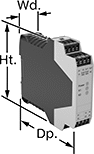 |
Relay |
Control and diagnose issues with safety-critical circuits. These relays have a microprocessor that monitors safety components, such as emergency stops and light curtains, and sends a signal to stop the operation if a failure is detected and restart when the issue is resolved. They also help with diagnostic tasks because of their feedback circuit, which allows basic relays to communicate their status back to the safety relay. These relays have a duplicate set of input and output signals, so they’ll still stop the controlled device if one of the inputs fails.
IP20 rated, they have recessed terminals which prevent fingers and other objects from touching live circuits. These relays have been tested to multiple safety standards and can help achieve PL, SIL, or CAT system ratings. They also meet ISO and IEC standards for machine safety.
Mount them to 35 mm DIN rail (also known as DIN 3 Rail) for fast installation.
No. of Terminals | Input Voltage | Switching Current @ Voltage | Max. Switching Voltage | Ht. | Wd. | Dp. | For Use With | Mounting Location | Max. System Safety Rating | Each | |||
|---|---|---|---|---|---|---|---|---|---|---|---|---|---|
2 Circuits Controlled | |||||||||||||
3 Safety Outputs with 2 Off and 1 Signal Output with 2 On | |||||||||||||
| 24 | 24V AC, 48V AC, 120V AC, 240V AC, 24V DC, 48V DC, 60V DC, 120V DC, 240V DC | 5 amp @ 240V AC 5 amp @ 24V DC | 250V AC, 250V DC | 4.42" | 0.9" | 4.5" | Emergency Stops | DIN Rail | PLe, SIL 3 | 6322N14 | 000000000 | ||
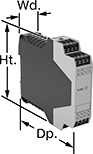 | 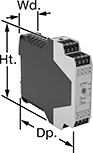 |
Auxiliary Contact Block | Auxiliary Contact Block with Time Delay |
No. of Terminals | Input Voltage, V DC | Switching Current @ Voltage | Max. Switching Voltage | Ht. | Wd. | Dp. | Features | Each | |||
|---|---|---|---|---|---|---|---|---|---|---|---|
5 Safety Outputs | |||||||||||
| 16 | 24 | 3 amp @ 240V AC 2.5 amp @ 24V DC | 250V AC, 250V DC | 3.9" | 0.9" | 4.5" | — | 6322N22 | 0000000 | ||
4 Delayed Safety Outputs | |||||||||||
| 16 | 24 | 3 amp @ 240V AC 3 amp @ 24V DC | 250V AC, 250V DC | 3.9" | 0.9" | 4.5" | Time Delay | 6322N18 | 000000 | ||
DIN-Rail Mount Touch-Safe Screw Terminal Relays
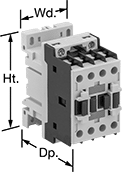 |
Quickly and safely mount these relays on 35 mm DIN rail (also known as DIN 3). IP20 rated, they have recessed terminals that prevent fingers and other objects from touching live circuits.
No. of Terminals | Input Voltage | Control Power, VA | Switching Current @ Voltage (Load Type) | Max. Switching Voltage, V AC | Horsepower @ Switching Voltage (Single Phase) | Ht. | Wd. | Dp. | Each | |||
|---|---|---|---|---|---|---|---|---|---|---|---|---|
2 Circuits Controlled with 2 Off—DPST-NO | ||||||||||||
| 6 | 120V AC, 120V DC | 2 | 25 amp @ 240V AC (Resistive) | 240 | 3/4 hp @ 120V AC 2 hp @ 240V AC | 3.5" | 0.7" | 2.4" | 6366N12 | 000000 | ||

High-Starting-Current DIN-Rail Mount Timer Relays
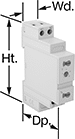 |
Reduce voltage fluctuations and stress on shafts and bearings when starting up three-phase motors. These timer relays start with motor contacts in a star configuration, then switch to a delta configuration after a set delay. Since star configuration takes less voltage to start than delta, these relays prevent voltage dips that often happen when a motor starts and are gentler on mechanical parts. Mount these relays directly to 35 mm DIN rail (also known as DIN 3 rail) for quick installation.
Timing Range | ||||||||||||||
|---|---|---|---|---|---|---|---|---|---|---|---|---|---|---|
No. of Terminals | Input Voltage | Control Current, mA | Timer Relay Function | No. of | Overall | Switching Current @ Voltage | Max. Switching Voltage, V AC | Ht. | Wd. | Dp. | Each | |||
2 Circuits Controlled with 2 Off—DPST-NO | ||||||||||||||
| 5 | 24V AC, 48V AC, 120V AC, 240V AC, 24V DC, 30V DC, 48V DC, 60V DC, 120V DC, 240V DC | 5 | Star-to-Delta | 6 | 0.1 sec. to 20 min. | 6 amp @ 12V AC to 250V AC, 240V AC | 250 | 3.4" | 0.7" | 2.4" | 8474N11 | 000000 | ||
Smart DIN-Rail Mount Multifunction Timer Relays
 |  |
1 Circuit Controlled | 2 Circuits Controlled |
No. of Terminals | Input Voltage | Control Power, W | Timer Relay Function | Overall Timing Range | Switching Current @ Voltage | Max. Switching Voltage, V AC | Ht. | Wd. | Dp. | Operating System Compatibility | Features | Each | |||
|---|---|---|---|---|---|---|---|---|---|---|---|---|---|---|---|
1 Circuit Controlled with 1 Off or 1 On—SPDT | |||||||||||||||
| 8 | 12V AC, 24V AC, 48V AC, 120V AC, 240V AC, 12V DC, 24V DC, 48V DC, 60V DC, 120V DC, 240V DC | 0.15 | Manual Switch Control Fixed On/Off Switch on (Single Shot) Delayed Start (Delay on Make) Delayed Switch Off (Delay on Break) Delayed Switch-On with Delayed Switch-Off Interval Repeat Cycle Asymmetrical Repeat Cycle Switch-On Asymmetrical Repeat Cycle | 0.1 sec. to 999 day | 8 amp @ 240V AC | 250 | 4.1" | 0.7" | 2.5" | Android 5.0 or Later, iOS 14.4 or Later | LED Indicator | 8491N12 | 000000 | ||
2 Circuits Controlled with 2 Off or 2 On—DPDT | |||||||||||||||
| 9 | 24V AC, 48V AC, 120V AC, 240V AC, 24V DC, 48V DC, 60V DC, 120V DC, 240V DC | 0.6 | Manual Switch Control Fixed On/Off Switch on (Single Shot) Delayed Start (Delay on Make) Delayed Switch Off (Delay on Break) Delayed Switch-On with Delayed Switch-Off Interval Repeat Cycle Asymmetrical Repeat Cycle Switch-On Asymmetrical Repeat Cycle Star-to-Delta | 0.1 sec. to 999 hr. | 8 amp @ 240V AC | 250 | 3.5" | 0.9" | 2.9" | Android 4.4 or Later, iOS 14.5 or Later | LED Indicator | 8491N11 | 00000 | ||
Solid State Versa-Mount Multifunction Timer Relays
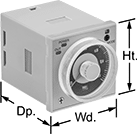 |
Install these relays in a panel cutout or plug them into a relay socket. Unlike mechanical relays, these solid state relays have no moving parts, so they require less maintenance and last longer, are quieter, and switch faster. They give you a variety of timing functions in one relay.
Sockets—Relay sockets (sold separately) mount to 35 mm DIN rail (also known as DIN 3 rail) for fast installation. They also mount to flat surfaces.
Timer Relays | Sockets | |||||||||||||||
|---|---|---|---|---|---|---|---|---|---|---|---|---|---|---|---|---|
Timing Range | ||||||||||||||||
No. of Terminals | Input Voltage | Control Current, mA | Timer Relay Function | No. of | Overall | Switching Current @ Voltage | Ht. | Wd. | Dp. | Features | Each | Each | ||||
2 Circuits Controlled with 2 Off or 2 On—DPDT | ||||||||||||||||
| 8 | 120V AC, 240V AC, 110V DC, 120V DC | 13 | Delayed Start (Delay on Make) Interval Switch on (Single Shot) Repeat Cycle | 4 | 0.05 sec. to 300 hr. | 5 amp @ 240V AC | 1.9" | 1.9" | 2.3" | Indicator Light | 69695K51 | 0000000 | 7122K19 | 00000 | ||
Solid State Surface-Mount Timer Relays
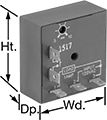 |
Attach these relays to a flat surface using the mounting hole. They have no moving parts, so compared to mechanical switches, they require less maintenance, last longer, and are quieter.
Delayed Start (Delay on Make)—Delayed start (delay on make) relays allow you to set how long it takes for the relay to turn on after input voltage is applied. For example, a drill starts pumping a lubricant immediately, but it does not start rotating until the set time has elapsed.
Potentiometer—Switches with a potentiometer (variable switch) allow you to adjust the delay within the range.
Timing Range | |||||||||||||
|---|---|---|---|---|---|---|---|---|---|---|---|---|---|
No. of Terminals | Input Voltage | Control Current, mA | No. of | Overall | Switching Current @ Voltage | Ht. | Wd. | Dp. | Features | Each | |||
Delayed Start (Delay on Make) | |||||||||||||
1 Circuit Controlled with 1 Off—SPST-NO | |||||||||||||
| 2 | 120V AC, 120V DC | 4 | 1 | 0.05 sec. to 1 sec. | 1 amp @ 120V AC | 2" | 2" | 0.89" | Potentiometer | 77055K25 | 0000000 | ||
| 2 | 120V AC, 120V DC | 4 | 1 | 0.25 sec. to 5 sec. | 1 amp @ 120V AC | 2" | 2" | 0.89" | Potentiometer | 77055K26 | 000000 | ||
| 2 | 120V AC, 120V DC | 4 | 1 | 0.5 sec. to 10 sec. | 1 amp @ 120V AC | 2" | 2" | 0.89" | Potentiometer | 77055K27 | 000000 | ||
| 2 | 120V AC, 120V DC | 4 | 1 | 3 sec. to 60 sec. | 1 amp @ 120V AC | 2" | 2" | 0.89" | Potentiometer | 77055K28 | 000000 | ||
| 2 | 120V AC, 120V DC | 4 | 1 | 15 sec. to 300 sec. | 1 amp @ 120V AC | 2" | 2" | 0.89" | Potentiometer | 77055K29 | 000000 | ||
| 2 | 120V AC, 120V DC | 4 | 1 | 30 sec. to 10 min. | 1 amp @ 120V AC | 2" | 2" | 0.89" | Potentiometer | 77055K31 | 000000 | ||
Spade-Terminal Relays
Relay-Socket Mount
 |  |
8 Terminals | Sockets with Screw Terminals |
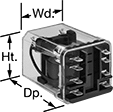
Relay-socket mount relays, also known as ice cube relays, offer three ways to connect. Plug them into a socket (sold separately), connect them with quick-disconnect terminals, or solder wires directly to the terminals.
Sockets with Screw Terminals—Relay sockets mount directly on 35 mm DIN rail (also known as DIN 3 rail) for fast installation. They can also mount to a flat surface.
Relays | Sockets with Screw Terminals | |||||||||||||
|---|---|---|---|---|---|---|---|---|---|---|---|---|---|---|
No. of Terminals | Input Voltage, V DC | Control Current, mA | Max. Switching Voltage, V AC | hp @ Switching Voltage | Ht. | Wd. | Dp. | Quick-Disconnect Tab Wd. | Each | Each | ||||
2 Circuits Controlled with 2 Off or 2 On—DPDT | ||||||||||||||
| 8 | 120 | 11 | 250 | 1/3 hp @ 120V AC 1/2 hp @ 240V AC | 1.4" | 1.5" | 1.9" | 0.187" | 7266K66 | 000000 | 7266K17 | 000000 | ||
Solid State Versa-Mount Timer Relays
 |
|
Sockets |
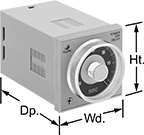
Mount these timer relays in a panel cutout or plug them into a relay socket for quick installation. Capable of fast switching, they are solid state and have no moving parts, so they require less maintenance, last longer, and are quieter than mechanical relays. Unlike standard relays that switch on and off immediately, timer relays delay before the circuit stops or starts.
Repeat Cycle—Relays with a repeat cycle alternate between an on cycle and off cycle of equal durations until input voltage is removed. A common example would be a flashing light.
Asymmetrical Repeat Cycle—Relays with an asymmetrical repeat cycle begin in an on state, then alternate between different durations of off and on for as long as input voltage is applied. For example, a heating system starts with an on period, then switches to an off period once the desired temperature is reached.
Start-Off Asymmetrical Repeat Cycle—Relays with a start-off asymmetrical repeat cycle begin in an off state, then alternate between different durations of on and off for as long as input voltage is applied. For example, an irrigation system receives a signal and starts in the off state, allowing water to fill before switching on to start pumping.
Sockets—Relay sockets (sold separately) mount to 35 mm DIN rail (also known as DIN 3 rail) or can be mounted to a flat surface.
Timer Relays | Sockets | |||||||||||||
|---|---|---|---|---|---|---|---|---|---|---|---|---|---|---|
Timing Range | ||||||||||||||
No. of Terminals | Input Voltage | Control Current, mA | No. of | Overall | Switching Current @ Voltage | Ht. | Wd. | Dp. | Each | Each | ||||
Repeat Cycle | ||||||||||||||
2 Circuits Controlled with 2 Off or 2 On—DPDT | ||||||||||||||
| 8 | 120V AC, 240V AC, 110V DC, 120V DC | 100 | 4 | 0.05 sec. to 300 hr. | 5 amp @ 240V AC | 1.9" | 1.9" | 3.3" | 69695K72 | 0000000 | 7122K19 | 00000 | ||
Asymmetrical Repeat Cycle | ||||||||||||||
2 Circuits Controlled with 2 Off or 2 On—DPDT | ||||||||||||||
| 8 | 120V AC, 240V AC, 110V DC, 120V DC | 41 | 4 | 0.05 sec. to 300 hr. | 5 amp @ 240V AC | 1.9" | 1.9" | 3.3" | 69695K113 | 000000 | 7122K19 | 0000 | ||
| 11 | 120V AC, 240V AC, 110V DC, 120V DC | 41 | 4 | 0.05 sec. to 300 hr. | 5 amp @ 240V AC | 1.9" | 1.9" | 3.3" | 8934N13 | 000000 | 7122K21 | 0000 | ||
Start-Off Asymmetrical Repeat Cycle | ||||||||||||||
2 Circuits Controlled with 2 Off or 2 On—DPDT | ||||||||||||||
| 8 | 120V AC, 240V AC, 110V DC, 120V DC | 41 | 4 | 0.05 sec. to 300 hr. | 5 amp @ 240V AC | 1.9" | 1.9" | 3.3" | 69695K111 | 000000 | 7122K19 | 0000 | ||
| 11 | 120V AC, 240V AC, 110V DC, 120V DC | 41 | 4 | 0.05 sec. to 300 hr. | 5 amp @ 240V AC | 1.9" | 1.9" | 3.3" | 8934N111 | 000000 | 7122K21 | 0000 | ||
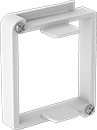 |
Mounting brackets are required to mount relays into a panel cutout.
Mounting Hole | |||||||||||
|---|---|---|---|---|---|---|---|---|---|---|---|
Material | Mounting Location | No. of | Ctr.-to-Ctr. | Dia., mm | Mounting Fasteners Included | Screw Size | Ht. | Wd. | Each | ||
| Polycarbonate | Panel | 2 | 3" | 5 | Yes | M5 | 2.28" | 1.89" | 6963K22 | 000000 | |
Multifunction Timer Relays
 | |
Relay Socket/Panel Mounting Location | Sockets |
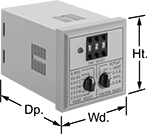
Get a variety of timing functions in a single relay. All relays plug into relay sockets (sold separately) for fast installation and replacement.
Panel Mount—Relay socket/panel mount relays require a mounting bracket (sold separately) to mount in a panel cutout.
Sockets—Relay sockets (sold separately) mount to 35 mm DIN rail (also known as DIN 3 rail) or can be mounted to a flat surface.
Timer Relays | Sockets | |||||||||||||||
|---|---|---|---|---|---|---|---|---|---|---|---|---|---|---|---|---|
Timing Range | ||||||||||||||||
No. of Terminals | Input Voltage | Control Current, mA | Timer Relay Function | No. of | Overall | Switching Current @ Voltage | Max. Switching Voltage, V AC | Ht. | Wd. | Dp. | Each | Each | ||||
2 Circuits Controlled with 2 Off or 2 On—DPDT | ||||||||||||||||
Relay-Socket/Panel Mount | ||||||||||||||||
| 11 | 24V AC, 48V AC, 120V AC, 240V AC, 24V DC, 48V DC, 60V DC, 120V DC, 240V DC | 104 | Delayed Start (Delay on Make) Interval Switch on (Single Shot) Delayed Switch Off (Delay on Break) Repeat Cycle | 6 | 0.05 sec. to 999 hr. | 10 amp @ 240V AC | 240 | 1.9" | 1.9" | 2.8" | 6964K3 | 0000000 | 7122K21 | 00000 | ||
|
Mounting Hole | |||||||||||
|---|---|---|---|---|---|---|---|---|---|---|---|
Material | Mounting Location | No. of | Ctr.-to-Ctr. | Dia., mm | Mounting Fasteners Included | Screw Size | Ht. | Wd. | Each | ||
| Polycarbonate | Panel | 2 | 3" | 5 | Yes | M5 | 2.28" | 1.89" | 6963K22 | 000000 | |
