Filter by
Shape
End Shape

Component

Color

System of Measurement
Material

Flexibility


Clarity


Performance
Heat-Shrink Tubing Type


U.S.–Mexico–Canada Agreement (USMCA) Qualifying
Export Control Classification Number (ECCN)

DFARS Specialty Metals

Tapered Heat-Shrink Tubing
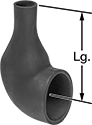 | 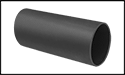 |
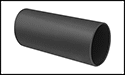
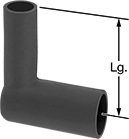
Style D (After Shrinking) | Style D and E (Before Shrinking) |
 |  |
Style E (Before Shrinking) | Style E (After Shrinking) |
A different shrink ratio on each end allows this tubing to fit over cable assemblies and wire harnesses with large connections, or around connectors with a 90° elbow. An adhesive lining melts when the tubing is heated and bonds to the underlying surface, creating a water-resistant seal. The tubing length listed is after shrinking; the length before shrinking is 20-25% shorter.
Lipped End—Lipped-end tubing has a ridge on the inside of one opening for better retention than nonlipped-end tubing. It’s often used with grooved adapters—upon shrinking, the lip grips onto the groove.
Dielectric Strength—Dielectric strength is the maximum voltage a material can handle before it starts to breakdown. The higher the dielectric strength of a material, the better it is for preventing electricity, heat, or signal from dissipating from wire and cable.
Tapered End | Non-Tapered End | ||||||||||||||||
|---|---|---|---|---|---|---|---|---|---|---|---|---|---|---|---|---|---|
Style | ID Before Shrinking | Min. ID After Shrinking | Shrink Ratio | ID Before Shrinking | Min. ID After Shrinking | Shrink Ratio | Min. Wall Thk. After Shrinking | Dielectric Strength, V/mil | Shrink Temp., ° F | Temp. Range, ° F | Color | End Style | Lg. | Each | |||
Polyolefin | |||||||||||||||||
| D | 1.25" | 0.28" | 4.5:1 | 1.25" | 0.75" | 1.7:1 | 0.09" | 200 | 250 | -65 to 275 | Black | Lipped | 1.4" | 6552N13 | 000000 | ||
| D | 1.25" | 0.28" | 4.5:1 | 1.25" | 0.75" | 1.7:1 | 0.09" | 200 | 250 | -65 to 275 | Black | Nonlipped | 1.4" | 6552N17 | 00000 | ||
| D | 1.5" | 0.33" | 4.5:1 | 1.5" | 0.75" | 2:1 | 0.1" | 200 | 250 | -65 to 275 | Black | Lipped | 1.7" | 6552N12 | 00000 | ||
| D | 1.5" | 0.33" | 4.5:1 | 1.5" | 0.75" | 2:1 | 0.1" | 200 | 250 | -65 to 275 | Black | Nonlipped | 1.7" | 6552N16 | 00000 | ||
| D | 1.75" | 0.38" | 4.6:1 | 1.75" | 1.1" | 1.6:1 | 0.13" | 200 | 250 | -65 to 275 | Black | Lipped | 2.1" | 6552N11 | 00000 | ||
| D | 1.75" | 0.38" | 4.6:1 | 1.75" | 1.1" | 1.6:1 | 0.13" | 200 | 250 | -65 to 275 | Black | Nonlipped | 2.1" | 6552N15 | 00000 | ||
| D | 2" | 0.62" | 3.2:1 | 2" | 1.6" | 1.3:1 | 0.13" | 200 | 250 | -65 to 275 | Black | Nonlipped | 3" | 6552N14 | 00000 | ||
| E | 3" | 0.86" | 3.5:1 | 3" | 1.41" | 2.1:1 | 0.18" | 200 | 250 | -65 to 275 | Black | Nonlipped | 5" | 6552N34 | 000000 | ||
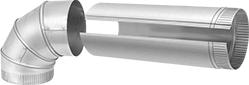
Standard Duct and Fittings
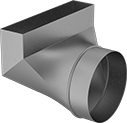
Oval Duct and Fittings