Filter by
System of Measurement
Thread Size


Material
Fastener Strength Grade/Class
Thread Spacing


Threading


Thread Direction

Thread Type
Nut Type


Specifications Met
Component

Finish


Tensile Strength
Hardness
DFARS Specialty Metals
Export Control Classification Number (ECCN)
Sold As
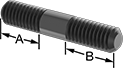
Threaded Rods
Medium-Strength Steel
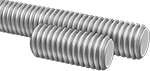 |
With tensile strengths from 110,000 psi to 125,000 psi, these rods are strong enough for most industrial applications, such as anchoring machinery and connecting pipe flanges. They are about twice as strong as low-strength steel rods. To avoid stripped threads during installation, make sure your nuts are also medium-strength steel.
Zinc-Plated Steel—The most common choice for areas with occasional exposure to moisture.
Steel—Best for dry environments since moisture will cause these rods to rust.
Lg. | Tensile Strength, psi | Fastener Strength Grade/Class | Hardness | Specs. Met | Each | |||
|---|---|---|---|---|---|---|---|---|
Zinc-Plated Steel | ||||||||
M30 × 3.5 mm | ||||||||
| 1 m | 110,000 | Class 8.8 | Rockwell C20 | DIN 975 | 99067A278 | 0000000 | ||
Steel | ||||||||
M30 × 3.5 mm | ||||||||
| 300 mm | 125,000 | ASTM Grade B7 | Rockwell C35 | ASTM A193, DIN 976 | 93325A325 | 00000 | ||
| 300 mm | 110,000 | Class 8.8 | Rockwell C20 | DIN 976 | 99055A251 | 00000 | ||
| 500 mm | 125,000 | ASTM Grade B7 | Rockwell C35 | ASTM A193, DIN 976 | 93675A515 | 000000 | ||
| 500 mm | 110,000 | Class 8.8 | Rockwell C20 | DIN 976 | 99055A359 | 000000 | ||
| 1 m | 125,000 | ASTM Grade B7 | Rockwell C35 | ASTM A193, DIN 976 | 93325A300 | 000000 | ||
| 1 m | 110,000 | Class 8.8 | Rockwell C20 | DIN 975 | 99055A160 | 000000 | ||
| 2 m | 125,000 | ASTM Grade B7 | Rockwell C35 | ASTM A193, DIN 976 | 93325A315 | 000000 | ||
M30 × 2 mm | ||||||||
| 300 mm | 125,000 | ASTM Grade B7 | Rockwell C35 | ASTM A193, DIN 975 | 95245A183 | 000000 | ||
| 1 m | 125,000 | ASTM Grade B7 | Rockwell C35 | ASTM A193, DIN 975 | 95245A184 | 000000 | ||
M30 × 1.5 mm | ||||||||
| 1 m | 125,000 | ASTM Grade B7 | Rockwell C35 | ASTM A193, DIN 976 | 95245A159 | 000000 | ||
High-Strength Steel
|
With a tensile strength of 150,000 psi, these rods are strong enough to stabilize steel frameworks and structural supports, such as I-beams. They are about 25% stronger than medium-strength steel rods. To avoid stripped threads during installation, make sure your nuts are also high-strength steel.
Steel—Best for dry environments since moisture will cause these rods to rust.
Lg. | Tensile Strength, psi | Fastener Strength Grade/Class | Hardness | Specs. Met | Each | |||
|---|---|---|---|---|---|---|---|---|
Steel | ||||||||
M30 × 3.5 mm | ||||||||
| 100 mm | 150,000 | Class 10.9 | Rockwell C32 | DIN 976 | 1078N93 | 000000 | ||
| 150 mm | 150,000 | Class 10.9 | Rockwell C32 | DIN 976 | 1078N94 | 00000 | ||
| 200 mm | 150,000 | Class 10.9 | Rockwell C32 | DIN 976 | 1078N95 | 00000 | ||
| 300 mm | 150,000 | Class 10.9 | Rockwell C32 | DIN 976 | 1078N96 | 00000 | ||
| 500 mm | 150,000 | Class 10.9 | Rockwell C32 | DIN 976 | 1078N97 | 000000 | ||
| 1 m | 150,000 | Class 10.9 | Rockwell C32 | DIN 976 | 1078N23 | 000000 | ||
| 2 m | 150,000 | Class 10.9 | Rockwell C32 | DIN 976 | 1078N98 | 000000 | ||
Extreme-Strength Steel
|
Our strongest threaded rods have a tensile strength of 170,000 psi to hold up in your most demanding high-stress applications. They're about 20% stronger than high-strength steel rods. To avoid stripped threads during installation, make sure your nuts are also extreme-strength steel.
Steel—Best for dry environments since moisture will cause these rods to rust.
Lg. | Tensile Strength, psi | Fastener Strength Grade/Class | Hardness | Specs. Met | Each | |||
|---|---|---|---|---|---|---|---|---|
Steel | ||||||||
M30 × 3.5 mm | ||||||||
| 100 mm | 170,000 | Class 12.9 | Rockwell C39 | DIN 976 | 1077N598 | 000000 | ||
| 150 mm | 170,000 | Class 12.9 | Rockwell C39 | DIN 976 | 1077N612 | 00000 | ||
| 200 mm | 170,000 | Class 12.9 | Rockwell C39 | DIN 976 | 1077N623 | 00000 | ||
| 300 mm | 170,000 | Class 12.9 | Rockwell C39 | DIN 976 | 1077N633 | 000000 | ||
| 500 mm | 170,000 | Class 12.9 | Rockwell C39 | DIN 976 | 1077N646 | 000000 | ||
| 1 m | 170,000 | Class 12.9 | Rockwell C39 | DIN 976 | 1077N18 | 000000 | ||
| 2 m | 170,000 | Class 12.9 | Rockwell C39 | DIN 976 | 1077N661 | 000000 | ||
Low-Strength Steel
|
Lg. | Tensile Strength, psi | Hardness | Specs. Met | Pkg. Qty. | Pkg. | |||
|---|---|---|---|---|---|---|---|---|
Zinc-Plated Steel | ||||||||
M30 × 3.5 mm | ||||||||
| 300 mm | 50,000 | Rockwell B49 | DIN 976 | 1 | 94595A249 | 000000 | ||
| 1 m | 50,000 | Rockwell B49 | DIN 976 | 1 | 93000A624 | 00000 | ||
Steel | ||||||||
M30 × 3.5 mm | ||||||||
| 300 mm | 50,000 | Rockwell B49 | DIN 976 | 1 | 98861A230 | 00000 | ||
| 1 m | 50,000 | Rockwell B49 | DIN 976 | 1 | 98861A170 | 00000 | ||
M30 × 2 mm | ||||||||
| 300 mm | 50,000 | Rockwell B49 | DIN 976 | 1 | 98861A616 | 00000 | ||
| 1 m | 50,000 | Rockwell B49 | DIN 976 | 1 | 98861A577 | 000000 | ||
M30 × 1.5 mm | ||||||||
| 1 m | 50,000 | Rockwell B49 | DIN 976 | 1 | 98861A576 | 000000 | ||
Stainless Steel
|
More corrosion resistant than steel rods and comparable in strength to low-strength steel.
18-8 Stainless Steel—The choice for wet and outdoor environments, these rods resist rust. However, they won't hold up to the harsh chemicals that 316 stainless steel can.
Highly Corrosion-Resistant 316 Stainless Steel—Superior to 18-8 stainless steel, these rods won't degrade when exposed to harsh weather, salt water, and most chemicals.
Lg. | Tensile Strength, psi | Fastener Strength Grade/Class | Hardness | Specs. Met | Pkg. Qty. | Pkg. | |||
|---|---|---|---|---|---|---|---|---|---|
18-8 Stainless Steel | |||||||||
M30 × 3.5 mm | |||||||||
| 300 mm | 70,000 | — | Not Rated | DIN 976 | 1 | 90024A314 | 0000000 | ||
| 500 mm | 70,000 | — | Not Rated | DIN 976 | 1 | 90024A490 | 000000 | ||
| 1 m | 70,000 | — | Not Rated | DIN 976 | 1 | 90024A315 | 000000 | ||
| 2 m | 70,000 | — | Not Rated | DIN 976 | 1 | 90024A316 | 000000 | ||
Highly Corrosion-Resistant 316 Stainless Steel | |||||||||
M30 × 3.5 mm | |||||||||
| 300 mm | 70,000 | — | Not Rated | DIN 976 | 1 | 94185A593 | 000000 | ||
| 1 m | 75,000 | ASTM Grade B8M | Not Rated | ASTM A193, DIN 976 | 1 | 94185A594 | 000000 | ||
| 2 m | 75,000 | — | Not Rated | DIN 976 | 1 | 94185A595 | 000000 | ||
Fast-Travel Ball Screws and Nuts
 | 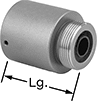 |
Ball Nuts, Externally Threaded Nut, Style B |
Multiple thread channels (also known as thread starts) create faster linear travel than ball screws with a single thread start. Internal ball bearings provide smooth low-friction travel in applications that require high speeds, accurate positioning, and repeatable movement. To ensure compatibility, select components that have the same thread size and number of thread starts. Ball nuts are furnished with a tube to keep ball bearings in place. Do not remove the tube until you are ready to install the nuts onto the screws.
Externally Threaded Ball Nuts—Right-Hand Threaded
|
Style B |
Carbon Steel—Carbon steel ball screws and nuts are case hardened, so they resist wear better than standard carbon steel. However, they are less corrosion resistant than black-oxide alloy steel screws and nuts.
Travel Distance per Turn—Travel distance per turn, also known as screw lead, is the distance a ball nut moves with one revolution of the ball screw.
Style | Thread Size | Lg., mm | Dia., mm | No. of Thread Starts | Travel Distance per Turn, mm | External Thread Size | Hardness | Dynamic Thrust Load Cap., lb. | Max. Backlash, mm | Temp. Range, ° F | Each | |||
|---|---|---|---|---|---|---|---|---|---|---|---|---|---|---|
Carbon Steel | ||||||||||||||
| B | M16 | 50 | 39 | 4 | 16 | M30 | Rockwell C56 | 1,500 | 0.04 | 32 to 150 | 4566N302 | 0000000 | ||
Coupling Nuts
Medium-Strength Steel
 |
These Grade 5 or Class 8 nuts are about twice as strong as low-strength steel coupling nuts. Use them with threaded rods that have a comparable strength rating to avoid stripping threads during installation.
Zinc-Plated Steel—A step up from plain steel, the zinc plating withstands occasional exposure to moisture.
Black-Oxide Steel—A dark, matte coating creates a finished look. Nuts offer minimal corrosion resistance, so they're best for dry environments.
Each | ||||||||||||
|---|---|---|---|---|---|---|---|---|---|---|---|---|
Thread Size | Lg., mm | Wd., mm | Fastener Strength Grade/Class | Threading | Specs. Met | Certificate Type | 1-9 | 10-49 | 50-Up | |||
Zinc-Plated Steel | ||||||||||||
| M30 × 3.5 mm | 90 | 46 | Class 8 | Fully Threaded | DIN 6334 | — | 90009A228 | 000000 | 000000 | 000000 | ||
Black-Oxide Steel | ||||||||||||
| M30 × 3.5 mm | 90 | 46 | Class 8 | Fully Threaded | ASME B18.2.2, DIN 6334 | Material Certificate | 90082A125 | 00000 | 00000 | 00000 | ||
High-Strength Steel
|
Rated Grade 8 or Class 10, these are about 25% stronger than medium-strength steel coupling nuts. Use them with threaded rods that have a comparable strength rating to avoid stripping threads during installation.
Zinc-Plated Steel—A step up from plain steel, the zinc plating withstands occasional exposure to moisture.
Steel—Best for dry environments since moisture will cause these nuts to rust.
Corrosion-Resistant Stainless Steel
|
18-8 Stainless Steel—The choice for wet and outdoor environments, these nuts resist rust. However, they won't hold up to the harsh chemicals that 316 stainless steel can.
%20--%3e%3cg%3e%3cg%20id='Layer_1'%3e%3cpath%20class='cls-1'%20d='M68,27.2c-14.6,0-26.4,11.7-26.4,26.3,0,7,2.8,13.7,7.7,18.7v44.8l18.8-16.1,18.7,16.1v-44.9c10.3-10.3,10.3-27,0-37.3-5-4.9-11.7-7.7-18.7-7.7h0ZM81.3,105l-13.2-11.4-13.2,11.4v-28.7c8.2,4.8,18.3,4.8,26.5,0v28.7ZM76.2,70.8c-5.2,2.5-11.2,2.5-16.4,0-9.5-4.5-13.5-15.9-9-25.4,4.5-9.5,15.9-13.5,25.4-9,9.5,4.5,13.5,15.9,9,25.4-1.9,4-5.1,7.1-9,9Z'/%3e%3cpath%20class='cls-2'%20d='M5.8,95.5c-1.2,0-2.1-1-2.1-2.1,0,0,0,0,0,0V29.4h20.9c2.1,0,3.8-1.7,3.8-3.8V3.7c.2,0,.4,0,.5,0h37.5c1.2,0,2.1,1,2.1,2.1v18.6c1.2,0,2.5.1,3.7.3V5.8C72.2,2.6,69.6,0,66.4,0H28.9c-1.5,0-3,.6-4.1,1.7h-.1c0,.1-23,23.2-23,23.2-1.1,1.1-1.7,2.6-1.7,4.1v64.3c0,3.2,2.6,5.8,5.8,5.8h41.7v-3.7H5.8ZM24.7,7.1v18.7H6L24.7,7.1Z'/%3e%3c/g%3e%3c/g%3e%3c/svg%3e)
Certificates with a traceable lot number are available for these products. Download certificates from ORDER HISTORY after your order ships.
Each | |||||||||||
|---|---|---|---|---|---|---|---|---|---|---|---|
Thread Size | Lg., mm | Wd., mm | Threading | Specs. Met | Certificate Type | 1-9 | 10-49 | 50-Up | |||
18-8 Stainless Steel | |||||||||||
| M30 × 3.5 mm | 90 | 46 | Fully Threaded | ASME B18.2.2, DIN 6334 | Material Certificate | 93590A316 | 000000 | 000000 | 000000 | ||
Threaded on Both Ends Setup Studs