

Filter by
Roller Chain Trade Number


Chain Style


Roller Chain Type


System of Measurement

Chain Pitch Type
Performance
Length
Roller Width
Working Load
Chain Standard
Roller Diameter
Export Control Classification Number (ECCN)

DFARS Specialty Metals
Finish
Roller Chain and Links
 |  |
Chain | Connecting Links |
 |  |
Adding Links | Adding-and-Connecting Links |
 |
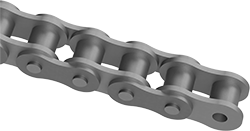
Pair this chain with sprockets to transmit power between rotating shafts. Like the chain on a bike, the side plates have a figure-eight shape that grips the sprockets without slipping.
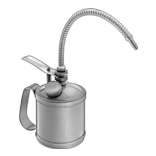
Lubrication is key to smooth operation and long chain life. Routinely apply oil by hand or install an oil dispenser for continuous lubrication.
Corrosion-Resistant 304 Stainless Steel—Won't corrode from frequent washdowns and mild chemicals, including ammonia often found in cleaning solutions.
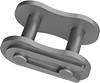
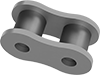
Connecting Link—Use a single link to join both ends of your chain. Start by removing the spring clip or cotter pin from the link’s side plate. Then, slide the link pins into the mating rollers at each end of your chain and snap the clip back on. Also known as master links.
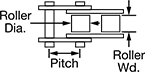
Adding Link—Attach with a connecting link to extend the length of your chain. Each link adds a length equal to the chain’s pitch. Also known as roller
links.
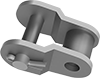
Adding-and-Connecting Link—An all-in-one link for adding and connecting. It adds a half-pitch length at the roller end, allowing finer length adjustments than full-pitch links. The pin end connects to your chain—except for trade number 25, which requires a separate connecting link. Remove
the side plate to install. Also known as half links and offset links.
Deep-Channel Roller Chain Guides
 |
Guide |
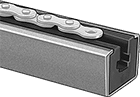
Also known as captured guides, deep-channel guides prevent chain from slipping off track. Use them to minimize friction, reduce noise, and prolong the life of your roller chain. They can be cut to the exact length you need.
Flanged Frame—Guides with flanged frame allow easy mounting. Stainless steel frames are more corrosion resistant than steel frames.
Overall | |||||||||||
|---|---|---|---|---|---|---|---|---|---|---|---|
For Roller Chain Trade No. | Ht. | Wd. | Channel Dp. | Mounting Fasteners Included | Mounting Hole Dia. | Max. Temp., ° F | Choose a Length, ft. | Per Ft. | |||
For Single-Strand ANSI Roller Chain | |||||||||||
Polyethylene with 304 Stainless Steel Frame | |||||||||||
| 60 | 1.13" | 1.18" | 0.82" | — | — | 175 | 1, 2, 3, 4, 5, 6, 7, 8 | 93095K25 | 000000 | ||
Polyethylene with 304 Stainless Steel Flanged Frame | |||||||||||
| 60 | 0.98" | 2.09" | 0.81" | No | 5/16" | 175 | 1, 3, 4, 6, 8 | 93095K39 | 000000 | ||
Floating Roller Chain Tensioners
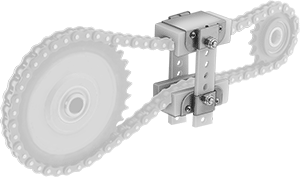 |
Mount these tensioners directly onto your chain drive. They have adjustable straps that take up slack and apply constant tension. Because they engage with the side plates instead of the rollers, they increase the life of your roller chain.
UHMW Polyethylene—UHMW polyethylene tensioners are stronger and more durable than PTFE tensioners.
PTFE—PTFE tensioners handle temperatures up to 450° F, more than twice as high as UHMW and titanium models.
Titanium—Titanium tensioners stand up to harsh and dirty environments. They're stronger and more durable than plastic tensioners. And with a low coefficient of friction, they work with chain that has little or no lubrication.
Overall | |||||||||||
|---|---|---|---|---|---|---|---|---|---|---|---|
For Roller Chain Trade No. | For Strand Type | Ht. | Wd. | Dp. | Housing Material | Strap Material | Max. Temp., ° F | Each | |||
For ANSI Chain | |||||||||||
UHMW Polyethylene | |||||||||||
| 60, 35-2, 40-2, 35-3 | Single, Double, Triple | 12" | 4" | 3 1/8" | 304 Stainless Steel | HDPE | 180 | 5973K5 | 0000000 | ||
PTFE | |||||||||||
| 60, 35-2, 40-2, 35-3 | Single, Double, Triple | 12" | 4" | 3 1/8" | 304 Stainless Steel | Galvanized Steel | 450 | 5973K214 | 000000 | ||
Titanium | |||||||||||
| 60, 35-2, 40-2, 35-3 | Single, Double, Triple | 12" | 4" | 3 1/8" | 304 Stainless Steel | HDPE | 180 | 5973K228 | 000000 | ||
