


Filter by
Product Family
Number of Teeth


Component


Speed Ratio

Hub Type

Tooth Profile


Pulley Type


Shaft Mount Type

REACH

DFARS Specialty Metals
Export Control Classification Number (ECCN)
RoHS
Timing Belt Pulleys
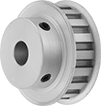 |
Finished Bore |
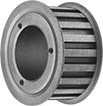 |
Bushing Bore |
 |
Keep your drive system in sync. Trapezoidal teeth mesh with matching belts to synchronize motion. With the original tooth profile, these pulleys handle enough torque for most applications. If you need high torque or precise starts and stops, consider curved tooth profiles, such as GT and HTD pulleys.
Iron—Strong but best for dry environments since moisture will cause them to rust.
Corrosion-Resistant Aluminum—Won't rust in wet environments and one-third the weight of steel and iron. However, aluminum pulleys are not as strong as iron and steel.
Finished Bore—Mount these pulleys onto the shaft and secure with a set screw—no machining required.
Bushing Bore—Quickly swap or service parts in tight spaces—no press-fitting or special tools required. Mount a bushing (sold separately) on your shaft and slide the pulley over it. As you tighten the included set screws, the bushing grips the shaft and draws it into the pulley, creating a final hold that is more secure than with set screws alone.
For Bushing | ||||||||||||
|---|---|---|---|---|---|---|---|---|---|---|---|---|
For Max. Belt Wd. | Pitch | No. of Teeth | Bore Type | For Shaft Dia., mm | Type | Trade No. | Pitch Dia. | Hub Type | Each | |||
For MXL Trade Size | ||||||||||||
Corrosion-Resistant Aluminum | ||||||||||||
| 6 mm | 0.080" | 120 | Finished | 10 | — | — | 77.6 mm | Standard | 1375K168 | 000000 | ||
| 9 mm | 0.080" | 120 | Finished | 10 | — | — | 77.6 mm | Standard | 1375K169 | 00000 | ||
For H Trade Size | ||||||||||||
Iron | ||||||||||||
| 1" | 0.500" | 120 | Bushing | — | Quick Disconnect (QD) | SF | 19.099" | — | 6495K525 | 000000 | ||
| 1 1/2" | 0.500" | 120 | Bushing | — | Quick Disconnect (QD) | SF | 19.099" | — | 6495K625 | 000000 | ||
| 2" | 0.500" | 120 | Bushing | — | Quick Disconnect (QD) | E | 19.099" | — | 6495K825 | 000000 | ||
 |
Quick-Disconnect Bushing |
Bushing | |||||
|---|---|---|---|---|---|
Type | Trade No. | For Shaft Dia. | Each | ||
| Quick Disconnect (QD) | SF | 1/2" | 6086K614 | 000000 | |
| Quick Disconnect (QD) | SF | 5/8" | 6086K615 | 00000 | |
| Quick Disconnect (QD) | SF | 3/4" | 6086K616 | 00000 | |
| Quick Disconnect (QD) | SF | 7/8" | 6086K617 | 00000 | |
| Quick Disconnect (QD) | SF | 1" | 6086K619 | 00000 | |
| Quick Disconnect (QD) | SF | 1 1/8" | 6086K622 | 00000 | |
| Quick Disconnect (QD) | SF | 1 3/16" | 6086K623 | 00000 | |
| Quick Disconnect (QD) | SF | 1 1/4" | 6086K624 | 00000 | |
| Quick Disconnect (QD) | SF | 1 3/8" | 6086K625 | 00000 | |
| Quick Disconnect (QD) | SF | 1 7/16" | 6086K626 | 00000 | |
| Quick Disconnect (QD) | SF | 1 1/2" | 6086K627 | 00000 | |
| Quick Disconnect (QD) | SF | 1 5/8" | 6086K628 | 00000 | |
| Quick Disconnect (QD) | SF | 1 11/16" | 6086K629 | 00000 | |
| Quick Disconnect (QD) | SF | 1 3/4" | 6086K631 | 00000 | |
| Quick Disconnect (QD) | SF | 1 7/8" | 6086K632 | 00000 | |
| Quick Disconnect (QD) | SF | 1 15/16" | 6086K633 | 00000 | |
| Quick Disconnect (QD) | SF | 2" | 6086K634 | 00000 | |
| Quick Disconnect (QD) | SF | 2 1/8" | 6086K635 | 00000 | |
| Quick Disconnect (QD) | SF | 2 3/16" | 6086K636 | 00000 | |
| Quick Disconnect (QD) | SF | 2 1/4" | 6086K637 | 00000 | |
| Quick Disconnect (QD) | SF | 2 3/8" | 6086K864 | 00000 | |
| Quick Disconnect (QD) | SF | 2 7/16" | 6086K865 | 00000 | |
| Quick Disconnect (QD) | SF | 2 1/2" | 6086K638 | 00000 | |
| Quick Disconnect (QD) | SF | 2 5/8" | 6086K866 | 00000 | |
| Quick Disconnect (QD) | SF | 2 3/4" | 6086K867 | 00000 | |
| Quick Disconnect (QD) | SF | 2 15/16" | 6086K639 | 00000 | |
| Quick Disconnect (QD) | SF | 30 mm | 2344K75 | 00000 | |
| Quick Disconnect (QD) | SF | 35 mm | 2344K62 | 00000 | |
| Quick Disconnect (QD) | SF | 40 mm | 2344K64 | 00000 | |
| Quick Disconnect (QD) | SF | 50 mm | 2344K67 | 00000 | |
| Quick Disconnect (QD) | SF | 55 mm | 2344K68 | 00000 | |
| Quick Disconnect (QD) | SF | 60 mm | 2344K69 | 00000 | |
| Quick Disconnect (QD) | E | 35 mm | 2344K82 | 000000 | |
| Quick Disconnect (QD) | E | 65 mm | 2344K92 | 000000 | |
| Quick Disconnect (QD) | E | 75 mm | 2344K94 | 000000 | |
Metal Worms and Worm Gears
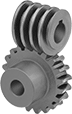 |
Worm and Gear Sold Separately |
Worm gears use screw threads to make large reductions to shaft speed while transmitting motion at a right angle. They transmit motion from worm to gear and cannot be reversed. For gears and worms to mesh correctly, they must have the same pressure angle, pitch/module, number of thread starts, and thread direction. These worms are compatible with plastic worm gears.
Gears
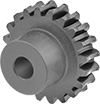 |  |  |
Cast Iron—Cast iron gears are strong and durable.
Speed Ratio—Speed ratio is the ratio by which output shaft speed is reduced. As speed decreases, torque increases.
Hub | |||||||||||||||||||
|---|---|---|---|---|---|---|---|---|---|---|---|---|---|---|---|---|---|---|---|
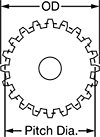
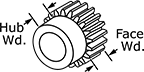
Gear Module | Speed Ratio | No. of Teeth | Pressure Angle | Gear Pitch Dia., mm | For No. of Thread Starts | OD, mm | Face Wd., mm | Overall Wd., mm | For Shaft Dia., mm | Dia., mm | Wd., mm | Material | For Thread Direction | Tooth Heat Treatment | Tooth Mechanical Finish | Each | |||
Round Bore—Cast Iron | |||||||||||||||||||
| 1 | 120:1 | 120 | 20° | 120 | 1 | 123 | 10 | 20 | 10 | 40 | 10 | Cast Iron | Right Hand | Not Hardened | Unfinished | 57545K786 | 000000 | ||
Precision High-Torque GT Timing Belt Pulleys
 |
Finished Bore |
 |
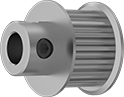
When precise synchronization is crucial, these pulleys minimize play (backlash). They’re often found in 3D printers, where accurate positioning is essential. Their curved teeth fit snugly with matching belts. Compared to pulleys with standard trapezoidal teeth, these pulleys transmit about three times more torque and run at higher speeds. All are compatible with Gates PowerGrip GT, 2GT, GT2, GT3, and GT4 series.
Corrosion-Resistant Aluminum—Won't rust in wet environments and one-third the weight of steel and iron. However, aluminum pulleys are not as strong as iron and steel.
Finished Bore—Mount these pulleys onto the shaft and secure with a set screw—no machining required.
Metal Spur Gears
Gears
 |
20° Pressure Angle Round Bore |
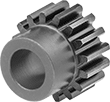
20° Pressure Angle—The current industry standard, these 20° pressure angle spur gears have thicker, stronger teeth than 14½° pressure angle gears.
Stainless Steel—Stainless steel gears resist rust in damp and wet environments, so they're commonly used in food-processing plants and other areas with frequent cleaning.
Hub, mm | ||||||||||||||
|---|---|---|---|---|---|---|---|---|---|---|---|---|---|---|
Gear Module | No. of Teeth | Gear Pitch Dia., mm | OD, mm | Face Wd., mm | Dia. | Wd. | Bore Type | For Shaft Dia., mm | Tooth Heat Treatment | Material | Each | |||
20° Pressure Angle | ||||||||||||||
Stainless Steel | ||||||||||||||
| 1 | 120 | 120 | 122 | 10 | 60 | 10 | Round Bore | 12 | Not Hardened | 303 Stainless Steel | 2664N535 | 0000000 | ||
Gear Racks
 |
20° Pressure Angle—Rectangular |
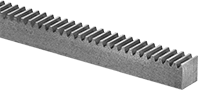
These racks match with spur gears to convert rotary motion to linear motion. For components to mesh correctly, they must have the same pressure angle and pitch/module.
Stainless Steel—Stainless steel gear racks resist rust in damp and wet environments, so they're commonly used in food-processing plants and other areas with frequent cleaning.
Hardened—Gear racks with hardened teeth have better wear resistance than racks with teeth that are not hardened.
Gear Module | Lg., mm | Pitch Ht., mm | Ht., mm | Face Wd., mm | Tooth Heat Treatment | Material | Each | |||
|---|---|---|---|---|---|---|---|---|---|---|
20° Pressure Angle—Rectangular | ||||||||||
Stainless Steel | ||||||||||
| 1 | 500 | 11 | 12 | 10 | Hardened | 304 Stainless Steel | 2485N232 | 0000000 | ||
Plastic Timing Belt Pulleys
 | |
Naturally rust resistant and lightweight, these plastic pulleys are ideal for machines that require frequent washdowns. Trapezoidal teeth, the original tooth profile, mesh with matching belts to transmit power without slipping.
Plain Bore—Do it your way—machine the bore to your exact shaft size or add a set screw or keyway.
For Max. Belt Wd., mm | Pitch | No. of Teeth | Bore Type | For Shaft Dia., mm | Pitch Dia., mm | No. of Flanges | Hub Type | Each | |||
|---|---|---|---|---|---|---|---|---|---|---|---|
For MXL Trade Size | |||||||||||
Polycarbonate | |||||||||||
| 6 | 0.080" | 120 | Plain | 8 | 77.6 | 2 | Standard | 7717N96 | 000000 | ||
