


Filter by
System of Measurement
Shaft Diameter


OD

Chain Type


Width
Overall Width
Component

Material
Chain Standard


RoHS

Export Control Classification Number (ECCN)
DFARS Specialty Metals
Sprockets
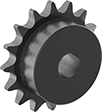 |
Plain Bore |
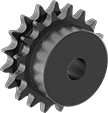 |
For Double Strand |
For Roller Chain | ||||||||||
|---|---|---|---|---|---|---|---|---|---|---|
Trade No. | Std. | Pitch | No. of Teeth | OD, mm | Bore Type | For Shaft Dia. | Each | |||
For Single Strand | ||||||||||
Steel | ||||||||||
| 05B | ISO | 8 mm | 13 | 37 | Plain | 8 mm to 20 mm | 2302K84 | 000000 | ||
| 05B | ISO | 8 mm | 17 | 48 | Plain | 8 mm to 20 mm | 2302K58 | 00000 | ||
| 06B | ISO | 3/8" | 15 | 51 | Plain | 10 mm to 20 mm | 2302K4 | 00000 | ||
| 08B | ISO | 1/2" | 10 | 47 | Plain | 10 mm to 20 mm | 2302K105 | 00000 | ||
For Double Strand | ||||||||||
Steel | ||||||||||
| 06B-2 | ISO | 3/8" | 15 | 51 | Plain | 10 mm to 20 mm | 3571N104 | 00000 | ||
| 06B-2 | ISO | 3/8" | 16 | 54 | Plain | 12 mm to 20 mm | 3571N105 | 00000 | ||
| 08B-2 | ISO | 1/2" | 26 | 113 | Plain | 20 mm to 56 mm | 3571N15 | 000000 | ||
| 08B-2 | ISO | 1/2" | 30 | 129 | Plain | 20 mm to 64 mm | 3571N154 | 000000 | ||
| 08B-2 | ISO | 1/2" | 36 | 153 | Plain | 20 mm to 73 mm | 3571N157 | 000000 | ||
| 08B-2 | ISO | 1/2" | 38 | 161 | Plain | 20 mm to 73 mm | 3571N158 | 000000 | ||
| 08B-2 | ISO | 1/2" | 42 | 177 | Plain | 20 mm to 73 mm | 3571N16 | 000000 | ||
| 12B-2 | ISO | 3/4" | 17 | 115 | Plain | 20 mm to 54 mm | 3571N211 | 000000 | ||
| 12B-2 | ISO | 3/4" | 19 | 127 | Plain | 20 mm to 62 mm | 3571N213 | 000000 | ||
Idler Sprockets
For Single Strand
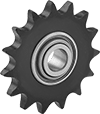 |
Ball Bearing |
For Roller Chain | ||||||||||
|---|---|---|---|---|---|---|---|---|---|---|
Trade No. | Std. | Pitch | No. of Teeth | For Shaft Dia., mm | OD, mm | Bearing Material | Each | |||
Ball Bearing | ||||||||||
Steel | ||||||||||
| 16B | ISO | 1" | 12 | 20 | 109 | Steel | 4182N2 | 0000000 | ||
Taper-Lock Bushings
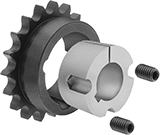 |
Mount these hubless bushings flush into your sprocket or pulley for a slim profile with no protruding screws. They are for use with taper-lock sprockets of the same bushing trade number. As you tighten the included set screws, the bushing grips the shaft and pulls it into your sprocket or pulley.
Keyway, mm | ||||||||||
|---|---|---|---|---|---|---|---|---|---|---|
For Shaft Dia., mm | Overall Wd., mm | Wd. | Dp. | Taper | Fastener Tightening Torque, in·lbf | Includes | Each | |||
Steel | ||||||||||
Bushing Trade Number 1008 | ||||||||||
| 20 | 22 | 6 | 2.8 | 8° | 55 | Set Screws | 57095K426 | 000000 | ||
Bushing Trade Number 1108 | ||||||||||
| 20 | 22 | 6 | 2.8 | 8° | 55 | Set Screws | 57095K438 | 00000 | ||
Bushing Trade Number 1210 | ||||||||||
| 20 | 25 | 6 | 2.8 | 8° | 175 | Set Screws | 57095K452 | 00000 | ||
Bushing Trade Number 1610 | ||||||||||
| 20 | 25 | 6 | 2.8 | 8° | 175 | Set Screws | 57095K494 | 00000 | ||
Bushing Trade Number 1615 | ||||||||||
| 20 | 38 | 6 | 2.8 | 8° | 175 | Set Screws | 57095K526 | 00000 | ||
Bushing Trade Number 2012 | ||||||||||
| 20 | 32 | 6 | 2.8 | 8° | 280 | Set Screws | 57095K548 | 00000 | ||
Metal Ratchet Gears and Pawls
 |
Gears and Pawls (Sold Separately) |
Gears
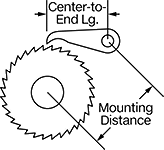 | 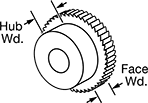 |
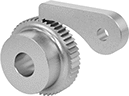
Compared to nylon gears, these metal ratchet gears are better for high-load, high-speed, and heavy duty applications. Used to prevent unwanted motion in jacks, tie downs, clutches, and winches, ratchet gears have sloped teeth that allow motion in one direction and prevent it in the other.
Hardened—Gears with hardened teeth are more wear resistant than gears with teeth that are not hardened.
Hub, mm | |||||||||||||
|---|---|---|---|---|---|---|---|---|---|---|---|---|---|
Face Wd., mm | No. of Teeth | OD, mm | For Shaft Dia., mm | Mounting Distance, mm | Material | Tooth Heat Treatment | Overall Wd., mm | Dia. | Wd. | Each | |||
Round Bore | |||||||||||||
| 20 | 40 | 120 | 20 | 85.2 | 1045 Carbon Steel | Hardened | 20 | — | — | 6283K85 | 0000000 | ||
| 20 | 50 | 150 | 20 | 95.5 | 1045 Carbon Steel | Hardened | 20 | — | — | 6283K86 | 000000 | ||
| 25 | 30 | 120 | 20 | 95.7 | 1045 Carbon Steel | Hardened | 25 | — | — | 6283K88 | 000000 | ||
| 25 | 50 | 200 | 20 | 122.4 | 1045 Carbon Steel | Hardened | 43 | 100 | 18 | 6283K121 | 000000 | ||
Metal Miter Gears
 |  |
Gears Sold Separately | Keyed Bore with Set Screw |
 | 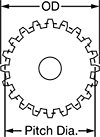 |
For 90° Shaft Angle |
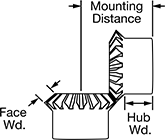
With straight, conically shaped teeth and a 1:1 speed ratio, miter gears connect two shafts at an angle without changing shaft speed or torque. They're more efficient than spiral miter gears because they create less friction.
For two gears to mesh correctly, they must have the same pressure angle, shaft angle, pitch/module, and number of teeth.
1045 Carbon Steel—Carbon steel gears have hard, strong, and wear-resistant teeth. They’re best for heavy duty and high-torque applications, such as lifting equipment. However, these gears will rust when exposed to moisture or corrosive chemicals. Some gears have hardened teeth for additional wear resistance; gears with teeth that are not hardened can be hardened to fit your application.
Hub, mm | Keyway, mm | ||||||||||||||||||
|---|---|---|---|---|---|---|---|---|---|---|---|---|---|---|---|---|---|---|---|
Gear Module | No. of Teeth | For Shaft Angle | Pressure Angle | Gear Pitch Dia., mm | OD, mm | Face Wd., mm | Overall Wd., mm | For Shaft Dia., mm | Mounting Distance, mm | Tooth Heat Treatment | Dia. | Wd. | Wd. | Dp. | Set Screw Thread Size | Each | |||
Keyed Bore with Set Screw | |||||||||||||||||||
1045 Carbon Steel | |||||||||||||||||||
| 2 | 30 | 90° | 20° | 60 | 62.8 | 12 | 29.4 | 20 | 50 | Hardened | 45 | 12.5 | 6 | 2.8 | M6 | 2600N6 | 000000 | ||
GT Timing Belt Idler Pulleys
 |
Toothed |
 |
Toothed | |||||||||
|---|---|---|---|---|---|---|---|---|---|
For Max. Belt Wd., mm | Pitch, mm | For Shaft Dia., mm | OD, mm | Bearing Type | No. of Teeth | Each | |||
For 8MGT Trade Size | |||||||||
Iron | |||||||||
| 20 | 8 | 20 | 90 | Roller | 32 | 7769N21 | 0000000 | ||
Metal Bevel Gears
 |
Gears Sold Separately |
 |
Large Gears |
Large Gears | ||||||||
|---|---|---|---|---|---|---|---|---|
Face Wd., mm | Gear Module | Pressure Angle | Speed Ratio | Material | For Shaft Dia., mm | Each | ||
| 20 | 2.5 | 20° | 5:1 | 1045 Carbon Steel | 20 | 2515N355 | 0000000 | |
Split-Tapered Bushings
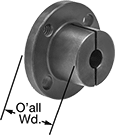 |
Steel |
Keyway, mm | |||||||||
|---|---|---|---|---|---|---|---|---|---|
For Shaft Dia., mm | Overall Wd. | Wd. | Dp. | Taper | Fastener Tightening Torque, in·lbf | Each | |||
Steel | |||||||||
Bushing Trade Number H with Clamping Screws | |||||||||
| 20 | 1 1/4" | 6 | 3 | 3° | 95 | 9859T718 | 000000 | ||
Flanged Screw-Clamp Bushings
 |  |
A mounting flange prevents movement during tightening. These bushings are good for shock loads. When you tighten the included screws, the bushing's inner sleeve contracts onto the shaft and the outer sleeve expands to hold your sprocket, pulley, or gear. They can be mounted on shafts with or without keyways.
For Shaft Dia., mm | OD, mm | Overall Wd., mm | Max. Torque, in·lbf | Fastener Tightening Torque, in·lbf | Includes | Each | |||
|---|---|---|---|---|---|---|---|---|---|
Steel | |||||||||
| 20 | 38 | 30 | 1,800 | 90 | Clamping Screws | 1058K74 | 0000000 | ||
Corrosion-Resistant Flanged Screw-Clamp Bushings
 |  |
Made from stainless steel or plated with nickel, these bushings resist corrosion. A mounting flange prevents movement during tightening. As screw-clamp bushings, they're good for shock loads. When you tighten the clamping screws, the bushing's inner sleeve tightens onto the shaft and the outer sleeve expands to hold your sprocket, pulley, or gear.
Nickel-Plated Steel—Nickel-plated steel bushings have good corrosion resistance in wet environments. However, the plating may begin to flake with long-term use.
Stainless Steel—Stainless steel bushings have excellent corrosion resistance and can withstand prolonged exposure to moisture.
Quick-Grip Screw-Clamp Bushings

Quick-Grip Flanged Hydraulic Bushings


