
McMaster-Carr logo
    Filter by
    System of Measurement
    Shaft Diameter
    Roller Chain Trade Number
    Number of Teeth
    Bore Type
    Shaft Type
    Component
    Strand Type
    For Shaft Angle
    U.S.–Mexico–Canada Agreement (USMCA) Qualifying
    DFARS Specialty Metals
    Export Control Classification Number (ECCN)
    Industrial Info Snippet
    Pressure Angle
    Chain Type
    Gear Pitch Diameter
    Industrial Info Snippet
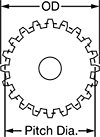
    Attribute Image
    Shaft Mount Type
    Chain Standard
    Enter e-mail addresses in the fields below
    Message
    Cancel
    Comments
    E-mail address (if you would like a response)
    7 Products

    Sprockets

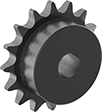
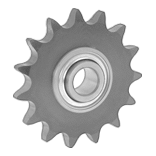
    Image of Product. Plain Bore. Front orientation. Drive Sprockets. Sprockets, For Single Strand, Plain Bore.

    Plain Bore

    Sprocket teeth mesh with your roller chain to smoothly transmit power. These U.S.-made sprockets have machined teeth for a more precise fit than flame-cut or punched teeth, allowing them to glide in and out of the chain to reduce wear and extend chain life.
    Steel—Steel is strong, but best for dry environments since moisture will cause it to rust.
    Corrosion-Resistant 18-8 Stainless Steel—Won't corrode from frequent washdowns and mild chemicals, including ammonia often found in cleaning solutions.
    Plain Bore—Plain bore sprockets give you options—machine a custom bore, weld, or press-fit them in place. They're sized to the minimum shaft diameter listed and are machinable up to the maximum.
    For
    Roller Chain
    Trade
    No.
    Std.
    Pitch
    No. of
    Teeth
    OD
    Bore
    Type
    For Shaft
    Dia.
    Each
    For Single Strand
     
    Steel
    25ANSI1/4"131 3/16"Plain1/4" to 7/16"6793K5000000
     
    Corrosion-Resistant 18-8 Stainless Steel
    25ANSI1/4"131 3/16"Plain1/4" to 7/16"6799K500000
     

    Plastic Sprockets

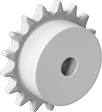
    Image of Product. Front orientation. Drive Sprockets. Plastic Sprockets.
    Quiet-running, lightweight, and naturally rust resistant. Choose these sprockets for noise-sensitive areas, designs with weight constraints, and machines that require frequent washdowns. Their teeth mesh with your roller chain to smoothly transmit power. All are made in the U.S.
    Plain Bore—Plain bore sprockets give you options—machine a custom bore, weld, or press-fit them in place. They're sized to the minimum shaft diameter listed and are machinable up to the maximum.
    For
    Roller Chain
    Trade
    No.
    Std.
    Pitch
    No. of
    Teeth
    OD
    Bore
    Type
    For Shaft
    Dia.
    Each
    For Single Strand
    25ANSI1/4"131 3/16"Plain1/4" to 7/16"60425K186000000
    35ANSI3/8"101 3/8"Plain3/8" to 7/16"60425K17200000
     

    Light Duty Sleeve Bushings

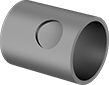
    Image of Product. Front orientation. Pulley and Sprocket Bushings. Light Duty Sleeve Bushings.
    Reduce the ID of sprockets, pulleys, and gears in low-torque applications. Bushings have a hole for a set screw.
    For Shaft
    Dia.
    OD
    Overall
    Wd.
    Set Screw
    Hole Dia.
    Each
    Steel
    7/16"1/2"1 1/8"3/8"6420K15000000
     

    Metal Miter Gears

    Image of System. Gears Sold Separately. Front orientation. Miter Gears. Metal Miter Gears.
    Image of Product. Front orientation. Miter Gears. Metal Miter Gears, Round Bore.

    Gears Sold

    Separately

    Round Bore

    Image of Attribute. For 90° Shaft Angle. Front orientation. Contains Annotated. Metal Miter Gears, For 90° Shaft Angle.
    Image of Attribute. Front orientation. Contains Annotated.

    For 90° Shaft Angle

    With straight, conically shaped teeth and a 1:1 speed ratio, miter gears connect two shafts at an angle without changing shaft speed or torque. They're more efficient than spiral miter gears because they create less friction.
    For two gears to mesh correctly, they must have the same pressure angle, shaft angle, pitch/module, and number of teeth.
    1144 Carbon Steel—Carbon steel gears have hard, strong, and wear-resistant teeth. They’re best for heavy duty and high-torque applications, such as lifting equipment. However, these gears will rust when exposed to moisture or corrosive chemicals. Some gears have hardened teeth for additional wear resistance; gears with teeth that are not hardened can be hardened to fit your application.
    Hub
    Gear
    Pitch
    No. of
    Teeth
    For Shaft
    Angle
    Pressure
    Angle
    Gear Pitch
    Dia.
    OD
    Face
    Wd.
    Overall
    Wd.
    For Shaft
    Dia.
    Mounting
    Distance
    Tooth Heat
    Treatment
    Dia.
    Wd.
    Each
    Round Bore
     
    1144 Carbon Steel
    16
    2090°20°1 1/4"1.34"0.27"0.844"7/16"1.25"Not Hardened1"0.5"6529K13000000
     

    Metal Bevel Gears

    Image of System. Gears Sold Separately. Front orientation. Bevel Gears. Metal Bevel Gears.

    Gears Sold

    Separately

    Image of Product. Front orientation. Bevel Gears. Metal Bevel Gears, Small Gears.

    Small Gears

    Bevel gears provide right-angle speed reduction. They're a type of miter gear installed so that one gear is smaller than the other to achieve speed ratios ranging from 3:2 to 5:1. All are made of carbon steel for good strength.
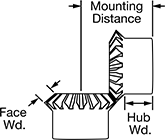
    A complete set consists of a large gear and a small gear, also known as a pinion (sold separately). For the gears to mesh correctly, they must have the same face width, pitch or module, and pressure angle.
    Speed Ratio—The ratio by which shaft speed is reduced when transferring motion from the smaller to the larger gear. To increase shaft speed, transfer motion from the larger to the smaller gear. Changing shaft speed also changes torque: as speed decreases, torque increases. To achieve the speed ratio listed, match it across a set of compatible gears.
    Small Gears
    Face
    Wd.
    Gear
    Pitch
    Pressure
    Angle
    Speed
    Ratio
    Material
    For Shaft
    Dia.
    Each
    0.42"16
    20°3:11144 Carbon Steel
    7/16"2515N16000000
    back to top