


Filter by
Housing Material

System of Measurement
Maximum Flow Rate
Priming Type
Maximum Pressure
Maximum Temperature
For Motor Power Source
Power Source

Gear Material
Intake Connection Port

U.S.–Mexico–Canada Agreement (USMCA) Qualifying
DFARS Specialty Metals
Export Control Classification Number (ECCN)
Constant-Flow-Rate Gear Pumps without Motor for Chemicals
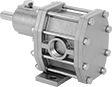 |
With a 316 stainless steel housing and stainless steel gears, these gear pumps are often used to dispense chemicals such as ethylene glycol, isopropyl alcohol, and nitric acid. Use an electric motor with a coupling and belt/pulley drive. They produce a smooth flow of liquid. All are self-priming, which means they create a suction force to draw liquid upward and fill the pump chamber. Do not use with solids.
Required hp, hp | Intake (NPT) | Discharge (NPT) | Overall | Shaft | |||||||||||||||||||
|---|---|---|---|---|---|---|---|---|---|---|---|---|---|---|---|---|---|---|---|---|---|---|---|
Max. Flow Rate @ 25 psi, gpm | Max. Flow Rate | Max. ft. of Head, ft. | Max. Pressure, psi | Max. Viscosity, cP | Temp. Range, ° F | @ 25 psi | @ 100 psi | Pipe Size | Connection | Gender | Pipe Size | Connection | Gender | Lg. | Wd. | Ht. | Dia. | Lg. | Ctr.-to-Base Lg. | Each | |||
For 1,800 rpm Maximum Motor Speed | |||||||||||||||||||||||
| 4.3 | 4 gpm | 346.3 | 150 | 20,000 | -50 to 450 | 1/4 | 3/4 | 1/2 | Threaded | Female | 1/2 | Threaded | Female | 6 1/4" | 3" | 3 3/4" | 1/2" | 1 1/4" | 2 5/8" | 43095K47 | 000000000 | ||
| 10.2 | 10 gpm | 346.3 | 150 | 20,000 | -50 to 450 | 1/2 | 1 1/2 | 3/4 | Threaded | Female | 3/4 | Threaded | Female | 7 1/2" | 3 3/8" | 4 3/8" | 5/8" | 1 3/4" | 3" | 43095K52 | 00000000 | ||
High-Pressure Constant-Flow-Rate Rotary Vane Pumps without Motor for Water
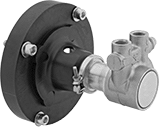 |
Commonly called rotary vane pumps, they have a built-in bypass relief valve to prevent pressure buildup. Attach an electric motor with a speed reducer or a belt pulley to alter the pump speed. Use a NEMA 56C frame motor. Pumps are gravity fed and require an elevated liquid source to fully fill the pump before turning on. Do not run dry or use with solids. They meet NSF/ANSI 61 safety standards for use with drinking water systems.
303 Stainless Steel Housing—Pumps with a 303 stainless steel housing are more corrosion resistant than pumps with a brass housing.
Intake | Discharge | Overall | Shaft | |||||||||||||||||||
|---|---|---|---|---|---|---|---|---|---|---|---|---|---|---|---|---|---|---|---|---|---|---|
Max. Flow Rate, gpm | Max. ft. of Head, ft. | Max. Pressure, psi | Max. Viscosity | For Motor Power Source | Req. Power, hp | Pipe Size | Thread Type | Gender | Pipe Size | Thread Type | Gender | Lg. | Wd. | Ht. | Lg. | Wd. | Dp. | Ctr.-to-Base Lg. | Each | |||
303 Stainless Steel Housing | ||||||||||||||||||||||
| 2.3 | 554 | 240 | Not Rated | Electric | 1/2 | 3/8 | NPT | Female | 3/8 | NPT | Female | 7" | 7" | 6" | 7/16" | 1/4" | 3/8" | 3" | 82395K76 | 0000000 | ||
| 4.3 | 554 | 240 | Not Rated | Electric | 3/4 | 1/2 | NPT | Female | 1/2 | NPT | Female | 7" | 7" | 6" | 7/16" | 1/4" | 3/8" | 3" | 82395K77 | 000000 | ||
| 5.4 | 554 | 240 | Not Rated | Electric | 1 | 1/2 | NPT | Female | 1/2 | NPT | Female | 7" | 7" | 6" | 7/16" | 1/4" | 3/8" | 3" | 82395K78 | 000000 | ||
Air-Powered Constant-Flow-Rate Piston Pumps
 |
Commonly called piston pumps, these are often used in high-pressure applications, such as hydrostatic testing of pipelines, tanks, and valves. Flow and outlet liquid pressure can be controlled by varying the air pressure. To calculate discharge liquid pressure, multiply the air pressure by the ratio shown in the table. Pumps are self-priming, which means they create a suction force to draw liquid upward to fill the pump chamber.
Note: Pumps must be filled with liquid before use. They need a constant flow of liquid and cannot run dry.
Flow Rate, gpm | Air Pressure, psi | Overall | |||||||||||||||
|---|---|---|---|---|---|---|---|---|---|---|---|---|---|---|---|---|---|
@ 0 psi | @ 3,000 psi | Max. ft. of Head, ft. | Max. Discharge Pressure, psi | Max. Viscosity, cP | Min. | Max. | Air Consumption, scfm | Air Connection (NPT) | Intake Pipe Connection (NPT) | Discharge Pipe Connection (NPT) | Lg. | Wd. | Ht. | Each | |||
86:1 Discharge Liquid to Inlet Air Pressure Ratio | |||||||||||||||||
| 0.19 | 0.17 | 28,764 | 12,470 | 100 | 15 | 145 | 20 | 1/4 Female | 3/8 Female | 1/4 Female | 4 5/8" | 4" | 9" | 6770K43 | 000000000 | ||
28:1 Discharge Liquid to Inlet Air Pressure Ratio | |||||||||||||||||
| 0.58 | 0.13 | 9,365 | 4,060 | 100 | 15 | 145 | 20 | 1/4 Female | 3/8 Female | 1/4 Female | 4 5/8" | 4" | 9" | 6770K41 | 00000000 | ||
11:1 Discharge Liquid to Inlet Air Pressure Ratio | |||||||||||||||||
| 4.76 | — | 3,679 | 1,595 | 100 | 15 | 145 | 45 | 1/2 Female | 1 Female | 1/2 Female | 10 3/4" | 9 1/2" | 10 3/8" | 6770K28 | 00000000 | ||
