

Filter by


System of Measurement
Mounting Location

DIN Rail Height
DIN Rail Trade Size

Fuse Overall Diameter
Wire Connection

Electrical Connection
Color

Grounding


Current per Circuit
Fuse Overall Length
Circuit Status Indicator Type
CSA File Number
DFARS Specialty Metals
Manufacturer Model Number
REACH

U.S.–Mexico–Canada Agreement (USMCA) Qualifying
Export Control Classification Number (ECCN)
RoHS
Modular DIN-Rail Mount Terminal Blocks
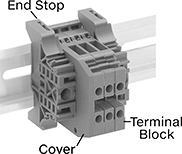 |
Mix and match these terminal blocks to get the exact number of circuits you need in a single setup. Add blocks for thermocouples, fuses, and grounding wire as needed. The blocks clip side by side onto DIN rail in control panels, creating tidy rows of circuits that you can identify and access on the spot.
The screw-clamp terminals flatten your wire so it stays put when vibrated or pulled. If you need to change wiring frequently without adjusting a screw, consider a quick-connect terminal block with spring-clamp or lever-clamp terminals.
Fuse Terminal Blocks with Screw-Clamp Terminals
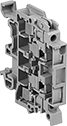 |
Install a fuse in the built-in fuse holder so excess current doesn't damage your equipment. If the current exceeds the limit, the fuse will blow and cut power to connected components.
Blown Fuse Indicator—A light goes on when the fuse blows, so you can spot an overloaded circuit without cutting power or touching equipment.
Covers—Snap onto the exposed side of a terminal block to prevent accidental contact with a live wire.
End Stops—Mount at the end of a group of terminal blocks so they don't slide when vibrated or bumped.
Bar Jumpers—Metal poles create an electrical connection between blocks, so you can connect multiple components with a single wire. Blocks must be the same width for the jumpers to fit. Cut jumpers to size with a hacksaw or high-force wire cutter. Add covers so jumpers don't touch the screws on the outermost blocks.
Insulation—Terminal blocks with insulated jumpers maintain their IP20 rating to prevent shocks and short circuits. Blocks with noninsulated jumpers lose their IP20 rating for touch protection because the jumpers introduce exposed metal to the circuit.
Terminal Blocks | Covers | End Stops | Bar Jumpers | |||||||||||||||||||||
|---|---|---|---|---|---|---|---|---|---|---|---|---|---|---|---|---|---|---|---|---|---|---|---|---|
For Fuse | Each | |||||||||||||||||||||||
No. of Circuits | No. of Terminals per Circuit | For Wire Ga. | Wd., mm | Ht., mm | Overall Dia., mm | Overall Lg., mm | Type | Circuit Status Indicator Type | Blown Fuse Indicator Voltage, V AC | For DIN Rail Trade Size | Enclosure Rating | Color | 1-24 | 25-Up | Each | Each | Insulation | Each | ||||||
300V AC/300V DC—6.3 amp per Circuit | ||||||||||||||||||||||||
| 2 1 (Ground) | 2 1 (Ground) | 20 to 12 | 8 | 99 | 5 | 20 | Ceramic, Glass | Blown Fuse | 110 230 | 3 | IP20 | Gray | 7641K865 | 000000 | 000000 | 7641K765 | 00000 | 7641K757 | 00000 | Noninsulated | 7641K16 | 000000 | ||
 |  |  |
Blank | Numbered for Horizontal Rails | Numbered for Vertical Rails |
Each | |||||||||
|---|---|---|---|---|---|---|---|---|---|
For No. of Circuits | For Terminal Block Wd., mm | Number Range | Markers per Card | Color | 1-24 | 25-Up | |||
Blank | |||||||||
| 1, 2 | 8, 10, 12, 13, 16, 22 | — | 100 | White | 7641K981 | 00000 | 00000 | ||
Numbered for Horizontal Rails | |||||||||
| 1, 2 | 8, 10, 12, 13, 16, 22 | 1 to 100 | 100 | White | 7641K991 | 0000 | 0000 | ||
| 1, 2 | 8, 10, 12, 13, 16, 22 | 101 to 200 | 100 | White | 7641K992 | 0000 | 0000 | ||
Numbered for Vertical Rails | |||||||||
| 1, 2 | 8, 10, 12, 13, 16, 22 | 1 to 100 | 100 | White | 7641K993 | 0000 | 0000 | ||
| 1, 2 | 8, 10, 12, 13, 16, 22 | 101 to 200 | 100 | White | 7641K994 | 0000 | 0000 | ||
