


Filter by
Thread Size


Length
Threading


Fastener Strength Grade/Class
Thread Direction


Performance
Specifications Met

DFARS Specialty Metals
Hardness
Component


Sold As


Threaded Rods
Medium-Strength Steel
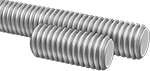 |
Lg. | Tensile Strength, psi | Fastener Strength Grade/Class | Hardness | Specs. Met | Each | |||
|---|---|---|---|---|---|---|---|---|
Zinc-Yellow-Chromate-Plated Steel | ||||||||
M14 × 2 mm | ||||||||
| 1 m | 125,000 | ASTM Grade B7 | Rockwell C35 | ASTM A193, DIN 976 | 98942A118 | 000000 | ||
| 2 m | 125,000 | ASTM Grade B7 | Rockwell C35 | ASTM A193, DIN 976 | 98942A218 | 00000 | ||
Zinc-Plated Steel | ||||||||
M14 × 2 mm | ||||||||
| 1 m | 110,000 | Class 8.8 | Rockwell C20 | DIN 975 | 99067A257 | 00000 | ||
Black-Oxide Steel | ||||||||
M14 × 2 mm | ||||||||
| 1 m | 125,000 | ASTM Grade B7 | Rockwell C35 | ASTM A193, DIN 976 | 98942A305 | 00000 | ||
Steel | ||||||||
M14 × 1.5 mm | ||||||||
| 150 mm | 125,000 | ASTM Grade B7 | Rockwell C35 | ASTM A193, DIN 976 | 95245A236 | 00000 | ||
| 300 mm | 125,000 | ASTM Grade B7 | Rockwell C35 | ASTM A193, DIN 976 | 95245A117 | 00000 | ||
| 1 m | 125,000 | ASTM Grade B7 | Rockwell C35 | ASTM A193, DIN 975 | 95245A203 | 000000 | ||
M14 × 2 mm | ||||||||
| 50 mm | 125,000 | ASTM Grade B7 | Rockwell C35 | ASTM A193, DIN 976 | 93325A433 | 0000 | ||
| 100 mm | 125,000 | ASTM Grade B7 | Rockwell C35 | ASTM A193, DIN 976 | 93325A434 | 00000 | ||
| 300 mm | 125,000 | ASTM Grade B7 | Rockwell C35 | ASTM A193, DIN 976 | 93325A340 | 00000 | ||
| 500 mm | 125,000 | ASTM Grade B7 | Rockwell C35 | ASTM A193, DIN 976 | 93325A435 | 00000 | ||
| 1 m | 125,000 | ASTM Grade B7 | Rockwell C35 | ASTM A193, DIN 976 | 93325A210 | 00000 | ||
| 2 m | 125,000 | ASTM Grade B7 | Rockwell C35 | ASTM A193, DIN 976 | 93325A110 | 00000 | ||
High-Strength Steel
|
With a tensile strength of 150,000 psi, these rods are strong enough to stabilize steel frameworks and structural supports, such as I-beams. They are about 25% stronger than medium-strength steel rods. To avoid stripped threads during installation, make sure your nuts are also high-strength steel.
Steel—Best for dry environments since moisture will cause these rods to rust.
Lg. | Tensile Strength, psi | Fastener Strength Grade/Class | Hardness | Specs. Met | Each | |||
|---|---|---|---|---|---|---|---|---|
Steel | ||||||||
M14 × 2 mm | ||||||||
| 50 mm | 150,000 | Class 10.9 | Rockwell C32 | DIN 976 | 1078N49 | 000000 | ||
| 100 mm | 150,000 | Class 10.9 | Rockwell C32 | DIN 976 | 1078N51 | 00000 | ||
| 150 mm | 150,000 | Class 10.9 | Rockwell C32 | DIN 976 | 1078N52 | 00000 | ||
| 200 mm | 150,000 | Class 10.9 | Rockwell C32 | DIN 976 | 1078N53 | 00000 | ||
| 300 mm | 150,000 | Class 10.9 | Rockwell C32 | DIN 976 | 1078N54 | 00000 | ||
| 500 mm | 150,000 | Class 10.9 | Rockwell C32 | DIN 976 | 1078N55 | 00000 | ||
| 1 m | 150,000 | Class 10.9 | Rockwell C32 | DIN 976 | 1078N15 | 00000 | ||
Extreme-Strength Steel
|
Our strongest threaded rods have a tensile strength of 170,000 psi to hold up in your most demanding high-stress applications. They're about 20% stronger than high-strength steel rods. To avoid stripped threads during installation, make sure your nuts are also extreme-strength steel.
Steel—Best for dry environments since moisture will cause these rods to rust.
Lg. | Tensile Strength, psi | Fastener Strength Grade/Class | Hardness | Specs. Met | Each | |||
|---|---|---|---|---|---|---|---|---|
Steel | ||||||||
M14 × 2 mm | ||||||||
| 50 mm | 170,000 | Class 12.9 | Rockwell C39 | DIN 976 | 1077N353 | 000000 | ||
| 100 mm | 170,000 | Class 12.9 | Rockwell C39 | DIN 976 | 1077N36 | 00000 | ||
| 150 mm | 170,000 | Class 12.9 | Rockwell C39 | DIN 976 | 1077N39 | 00000 | ||
| 200 mm | 170,000 | Class 12.9 | Rockwell C39 | DIN 976 | 1077N398 | 00000 | ||
| 300 mm | 170,000 | Class 12.9 | Rockwell C39 | DIN 976 | 1077N449 | 00000 | ||
| 500 mm | 170,000 | Class 12.9 | Rockwell C39 | DIN 976 | 1077N45 | 00000 | ||
| 1 m | 170,000 | Class 12.9 | Rockwell C39 | DIN 976 | 1077N451 | 000000 | ||
Low-Strength Steel
|
Lg. | Tensile Strength, psi | Hardness | Specs. Met | Pkg. Qty. | Pkg. | |||
|---|---|---|---|---|---|---|---|---|
Zinc-Plated Steel | ||||||||
M14 × 2 mm | ||||||||
| 300 mm | 50,000 | Rockwell B49 | DIN 976 | 1 | 94595A225 | 000000 | ||
| 1 m | 50,000 | Rockwell B49 | — | 1 | 93000A519 | 00000 | ||
| 2 m | 50,000 | Rockwell B49 | — | 1 | 93000A576 | 00000 | ||
Steel | ||||||||
M14 × 1.5 mm | ||||||||
| 150 mm | 50,000 | Rockwell B49 | DIN 976 | 1 | 98861A606 | 00000 | ||
| 300 mm | 50,000 | Rockwell B49 | DIN 976 | 1 | 98861A550 | 00000 | ||
| 1 m | 50,000 | Rockwell B49 | DIN 975 | 1 | 98861A336 | 00000 | ||
M14 × 2 mm | ||||||||
| 1 m | 50,000 | Rockwell B49 | — | 1 | 98861A110 | 00000 | ||
Stainless Steel
Threaded on Both Ends Setup Studs
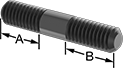
Ball Screws and Nuts
 | 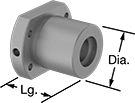 |
Ball Nuts Flange Nut Style C |
Internal ball bearings provide smooth low-friction travel in applications that require high speeds, accurate positioning, and repeatable movement. Also known as single-start ball screws and nuts, they have a single thread that runs the length of the screw. They operate with more torque than fast-travel ball screws and nuts. To ensure compatibility, select components that have the same thread direction and size. Ball nuts are furnished with a tube to keep ball bearings in place. Do not remove the tube until you are ready to install the nuts onto the screws.
Ball Screws—Right-Hand Threaded
 |  |
Travel Distance per Turn—Travel distance per turn, also known as screw lead, is the distance a ball nut moves with one revolution of the ball screw.
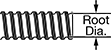
Root Diameter—Root diameter indicates the diameter the ball screw will be after machining away the threads.
Thread Size | Lg., mm | No. of Thread Starts | Travel Distance per Turn, mm | Accuracy for Travel Distance per Turn | Root Dia., mm | Hardness | Tensile Strength, psi | Temp. Range, ° F | Each | |||
|---|---|---|---|---|---|---|---|---|---|---|---|---|
Carbon Steel | ||||||||||||
| M14 | 500 | 1 | 4 | ±0.210 mm/300 mm | 11.5 | Rockwell C58 | 21,000 | 5 to 175 | 6624K69 | 000000 | ||
| M14 | 1,000 | 1 | 4 | ±0.210 mm/300 mm | 11.5 | Rockwell C58 | 21,000 | 5 to 175 | 6624K71 | 000000 | ||
Platform Ball Nuts—Right-Hand Threaded
 |
Travel Distance per Turn—Travel distance per turn, also known as screw lead, is the distance a ball nut moves with one revolution of the ball screw.
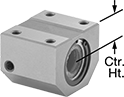
Thread Size | Lg., mm | Wd., mm | Ht., mm | Ctr. Ht., mm | No. of Thread Starts | Travel Distance per Turn, mm | Hardness | Dynamic Thrust Load Cap., lb. | Max. Backlash, mm | Temp. Range, ° F | Each | |||
|---|---|---|---|---|---|---|---|---|---|---|---|---|---|---|
Alloy Steel | ||||||||||||||
| M14 | 35 | 34 | 30 | 13 | 1 | 4 | Rockwell C58 | 1,200 | 0.1 | 5 to 175 | 6624K73 | 0000000 | ||
Flange Ball Nuts—Right-Hand Threaded
|
Style C |
Travel Distance per Turn—Travel distance per turn, also known as screw lead, is the distance a ball nut moves with one revolution of the ball screw.
Flange, mm | ||||||||||||||||
|---|---|---|---|---|---|---|---|---|---|---|---|---|---|---|---|---|
Style | Thread Size | Lg., mm | Dia., mm | Wd. | Ht. | Thk. | No. of Thread Starts | Travel Distance per Turn, mm | Hardness | Dynamic Thrust Load Cap., lb. | Max. Backlash, mm | Temp. Range, ° F | Each | |||
Alloy Steel | ||||||||||||||||
| C | M14 | 40 | 31 | 50 | 37 | 10 | 1 | 4 | Rockwell C58 | 1,200 | 0.1 | 5 to 175 | 6624K72 | 0000000 | ||
Left-Hand Threaded Rods
 |
Low-Strength Steel
Lg., m | Tensile Strength, psi | Hardness | Specs. Met | Each | |||
|---|---|---|---|---|---|---|---|
Steel | |||||||
M14 × 2 mm | |||||||
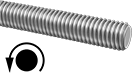
| 1 | 50,000 | Rockwell B49 | DIN 976 | 98817A401 | 000000 | ||
Connecting Rods
Coupling Nuts
Low-Strength Steel
 |
Each | ||||||||||
|---|---|---|---|---|---|---|---|---|---|---|
Thread Size | Lg., mm | Wd., mm | Threading | Specs. Met | 1-9 | 10-49 | 50-Up | |||
Zinc-Plated Steel | ||||||||||
| M14 × 2 mm | 42 | 22 | Fully Threaded | DIN 6334 | 93355A370 | 00000 | 00000 | 00000 | ||
Medium-Strength Steel
|
These Grade 5 or Class 8 nuts are about twice as strong as low-strength steel coupling nuts. Use them with threaded rods that have a comparable strength rating to avoid stripping threads during installation.
Zinc-Plated Steel—A step up from plain steel, the zinc plating withstands occasional exposure to moisture.
Black-Oxide Steel—A dark, matte coating creates a finished look. Nuts offer minimal corrosion resistance, so they're best for dry environments.
Corrosion-Resistant Stainless Steel
|
Each | ||||||||||
|---|---|---|---|---|---|---|---|---|---|---|
Thread Size | Lg., mm | Wd., mm | Threading | Specs. Met | 1-9 | 10-49 | 50-Up | |||
18-8 Stainless Steel | ||||||||||
| M14 × 2 mm | 42 | 22 | Fully Threaded | ASME B18.2.2, DIN 6334 | 93590A311 | 000000 | 000000 | 000000 | ||
Black-Oxide 18-8 Stainless Steel | ||||||||||
| M14 × 2 mm | 42 | 22 | Fully Threaded | ASME B18.2.2, DIN 6334 | 93590A327 | 00000 | 00000 | 00000 | ||
Highly Corrosion-Resistant 316 Stainless Steel | ||||||||||
| M14 × 2 mm | 42 | 22 | Fully Threaded | DIN 6334 | 90111A341 | 00000 | 00000 | 00000 | ||
Round Coupling Nuts
Turnbuckle-Style Connecting Rods

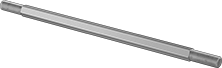
Internally Threaded Inline Ball Joint Linkages
Ball Joint Linkages
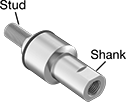 | 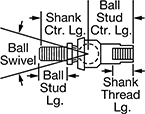 |
Shank | Ball Stud | Right-Hand Threaded Ball Stud | |||||||||||
|---|---|---|---|---|---|---|---|---|---|---|---|---|---|
Thread Size | Ctr. Lg., mm | Thread Lg., mm | Thread Size | Ctr. Lg., mm | Lg., mm | Max. Ball Swivel | Static Radial Load Cap. | Material | Lubrication | Each | |||
Right-Hand Shank Thread | |||||||||||||
| M14 × 1.5 mm | 45 | 25 | M14 × 1.5 mm | 58 | 22 | 17° | Not Rated | Zinc | Lubricated | 8412K23 | 000000 | ||
| M14 × 2 mm | 45 | 25 | M14 × 2 mm | 64 | 28 | 17° | Not Rated | Zinc | Lubricated | 8412K24 | 00000 | ||
Internally Threaded Turnbuckle-Style Connecting Rods

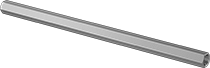
Extreme-Pressure Iron and Steel Threaded Pipe Fittings
Straight Connectors
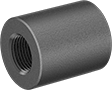 |
Female, Threaded Fitting Connection |
Thread Size | Body Shape | Material | Max. Pressure @ Temp. | Each | |||
|---|---|---|---|---|---|---|---|
Metric Female | |||||||
| M14 × 1.5 mm | Hex | Zinc-Plated Steel | 4,500 psi @ 72° F | 4936K981 | 000000 | ||
Straight Adapters
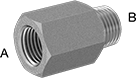 |
Female x Male |
Zinc-Plated Steel—Zinc-plated steel fittings have better corrosion resistance than plain steel fittings.
Straight Adapters with Gasket
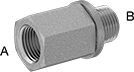 | 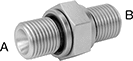 |
Female x Male | Male x Male |
Zinc-Plated Steel—Zinc-plated steel fittings have better corrosion resistance than plain steel fittings.
Pipe Size (A) | Thread Size (B) | Dash Size (A) | Body Shape | Material | Max. Pressure @ Temp. | Gasket Material | Each | |||
|---|---|---|---|---|---|---|---|---|---|---|
NPT Female × Metric Male | ||||||||||
| 1/4 | M14 × 1.5 mm | 04 | Hex | Zinc-Plated Steel | 4,500 psi @ 72° F | Buna-N | 4936K155 | 00000 | ||
NPT Male × Metric Male | ||||||||||
| 1/4 | M14 × 1.5 mm | 04 | Hex | Zinc-Plated Steel | 6,000 psi @ 72° F | Buna-N | 4936K767 | 00000 | ||
BSPP Male × Metric Male | ||||||||||
| 1/4 | M14 × 1.5 mm | 04 | Hex | Zinc-Plated Steel | 6,000 psi @ 72° F | Buna-N | 4936K751 | 00000 | ||
| 3/8 | M14 × 1.5 mm | 06 | Hex | Zinc-Plated Steel | 5,500 psi @ 72° F | Buna-N | 4936K753 | 00000 | ||

Internally Threaded Lubrication-Free Ball Joint Rod Ends
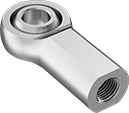 |  |
Ball Joint Rod End |
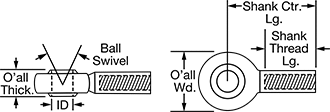
Shank | |||||||||||||
|---|---|---|---|---|---|---|---|---|---|---|---|---|---|
Thread Size | Ctr. Lg., mm | Thread Lg., mm | ID, mm | Max. Ball Swivel | Overall Wd., mm | Overall Thk., mm | Static Radial Load Cap., lb. | Material | Choose a Shank Thread Direction | Each | |||
Ball Joints | |||||||||||||
| M14 × 1.5 mm | 57 | 27 | 14 | 21° | 35 | 19 | 16,100 | Zinc-Plated Chrome-Moly Steel | Right Hand, Left Hand | 2458K91 | 000000 | ||
| M14 × 2 mm | 57 | 27 | 14 | 21° | 35 | 19 | 16,100 | Zinc-Plated Chrome-Moly Steel | Right Hand, Left Hand | 2458K89 | 00000 | ||
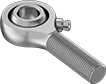
Ball Joint Rod Ends with Grease Fitting
 | 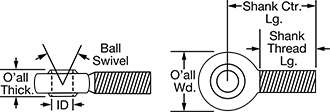 |
Shank | |||||||||||||
|---|---|---|---|---|---|---|---|---|---|---|---|---|---|
Thread Size | Ctr. Lg., mm | Thread Lg., mm | ID, mm | Max. Ball Swivel | Overall Wd., mm | Overall Thk., mm | Static Radial Load Cap., lb. | Material | Choose a Shank Thread Direction | Each | |||
Ball Joints with Grease Fitting | |||||||||||||
| M14 × 2 mm | 60 | 36 | 14 | 30° | 34.8 | 19 | 7,900 | Carbon Steel | Right Hand, Left Hand | 4444T13 | 000000 | ||
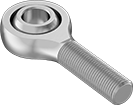
Ball Joint Rod Ends
 | |
Shank | |||||||||||||
|---|---|---|---|---|---|---|---|---|---|---|---|---|---|
Thread Size | Ctr. Lg., mm | Thread Lg., mm | ID, mm | Max. Ball Swivel | Overall Wd., mm | Overall Thk., mm | Static Radial Load Cap., lb. | Material | Choose a Shank Thread Direction | Each | |||
Ball Joints | |||||||||||||
| M14 × 1.5 mm | 60 | 36 | 14 | 49° | 35 | 19 | 6,700 | Zinc-Plated Carbon Steel | Right Hand | 60645K113 | 000000 | ||
| M14 × 2 mm | 60 | 36 | 14 | 30° | 35 | 19 | 7,900 | Zinc-Plated Carbon Steel | Right Hand, Left Hand | 60645K983 | 00000 | ||
Lubrication-Free Ball Joint Rod Ends
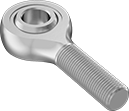 | |
Shank | |||||||||||||
|---|---|---|---|---|---|---|---|---|---|---|---|---|---|
Thread Size | Ctr. Lg., mm | Thread Lg., mm | ID, mm | Max. Ball Swivel | Overall Wd., mm | Overall Thk., mm | Static Radial Load Cap., lb. | Material | Choose a Shank Thread Direction | Each | |||
Ball Joints | |||||||||||||
| M14 × 1.5 mm | 60 | 36 | 14 | 21° | 35 | 19 | 16,100 | Zinc-Plated Alloy Steel | Right Hand, Left Hand | 2458K449 | 000000 | ||
| M14 × 2 mm | 60 | 36 | 14 | 21° | 35 | 19 | 16,100 | Zinc-Plated Alloy Steel | Right Hand, Left Hand | 2458K451 | 00000 | ||
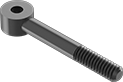
Partially Threaded Rod End Bolts
 |
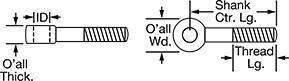 |
Create pivoting connections in applications that require high shear strength—the partially threaded shank of these rod end bolts withstands more side force than a fully threaded shank. Also known as swing bolts and eyebolts, they are used to create hinges, turnbuckles, and tie downs. Unlike ball joint rod ends, these rod end bolts are made from a single piece of metal, so they wear down more slowly and have a more controlled swing. However, because they do not have a moving ball joint, they do not compensate for angular misalignment. Made from steel, they are stronger and more wear resistant than stainless steel rod end bolts, but they are not as corrosion resistant.
Black-Oxide Carbon Steel—Rod end bolts with a black-oxide finish have a dark, matte coating that keeps the steel from rusting in dry environments.
DIN 444—Rod end bolts that meet DIN 444 adhere to international dimensional standards, ensuring they are compatible with other parts and tools.
Extreme-Pressure Stainless Steel Threaded Pipe Fittings
Straight Adapters with Gasket
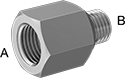 | 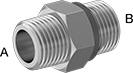 |
Female x Male | Male x Male |
UN/UNF (SAE Straight) Thread—Also known as O-ring boss threads.
316 Stainless Steel—Fittings are the most corrosion resistant. They stand up to wet environments, just like 304 stainless steel fittings, but unlike 304 stainless steel, they will not corrode from salt water, chlorine solutions, and chemicals.
Thread Size | Dash Size | 316 Stainless Steel | |||||||||
|---|---|---|---|---|---|---|---|---|---|---|---|
Pipe Size (A) | (A) | (B) | (A) | (B) | Body Shape | Gasket Material | Max. Pressure @ Temp. | Each | |||
NPT Female × Metric Male | |||||||||||
| 1/4 | — | M14 × 1.5 mm | 04 | — | Hex | Buna-N | 5,000 psi @ 72° F | 4822T394 | 000000 | ||
BSPP Male × Metric Male | |||||||||||
| 1/4 | — | M14 × 1.5 mm | 04 | — | Hex | Buna-N | 5,000 psi @ 72° F | 4822T167 | 00000 | ||
UN/UNF (SAE Straight) Female × Metric Male | |||||||||||
| — | 9/16"-18 | M14 × 1.5 mm | 06 | — | Hex | Buna-N | 5,000 psi @ 72° F | 51205K783 | 00000 | ||
Metric Female × UN/UNF (SAE Straight) Male | |||||||||||
| — | M14 × 1.5 mm | 9/16"-18 | — | 06 | Hex | Buna-N | 6,000 psi @ 72° F | 51205K763 | 00000 | ||
High-Pressure Brass and Bronze Threaded Pipe Fittings
Straight Adapters with Gasket
 |
Female x Male |
NPTF Thread—NPTF (Dryseal) threads are compatible with NPT threads.
Fluoroelastomer—These gaskets resist a wide range of chemicals, including benzene, butyl alcohol, and ethylene glycol.
Corrosion-Resistant Ball Joint Rod Ends
 | |
Shank | |||||||||||||
|---|---|---|---|---|---|---|---|---|---|---|---|---|---|
Thread Size | Ctr. Lg., mm | Thread Lg., mm | ID, mm | Max. Ball Swivel | Overall Wd., mm | Overall Thk., mm | Static Radial Load Cap., lb. | Material | Choose a Shank Thread Direction | Each | |||
Ball Joints | |||||||||||||
| M14 × 2 mm | 60 | 36 | 14 | 30° | 35 | 19 | 5,300 | 303 Stainless Steel | Right Hand, Left Hand | 2988K16 | 000000 | ||
Easy-Adjust Clevis Rod Ends
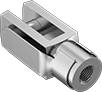 |  |  |
Clevis Rod End |
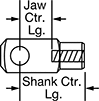
Make quick adjustments to these rod ends by inserting and releasing the clevis pins without the need to bend them into place. Also called yoke-end linkages, they support pivoting movement along one axis when threaded onto shafts, rods, valve pistons, and other assemblies. All are zinc-plated steel for moderate corrosion resistance.
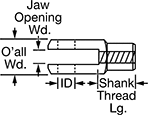
Shank | ||||||||||||||
|---|---|---|---|---|---|---|---|---|---|---|---|---|---|---|
Thread Size | Ctr. Lg., mm | Thread Lg., mm | ID, mm | Jaw Opening Wd., mm | Overall Wd., mm | Jaw Ctr. Lg., mm | Tensile Strength, psi | Includes | Shank Thread Direction | Specs. Met | Each | |||
Zinc-Plated Carbon Steel | ||||||||||||||
| M14 × 2 mm | 56 | 28 | 14 | 14 | 27 | 28 | 60,000 | Snap-On Spring Clevis Pin | Right Hand | DIN 71752 | 2448K54 | 000000 | ||
High-Load Ball Joint Rod Ends
 | |
These steel rod ends handle loads that are at least 25% higher than other comparably sized rod ends. PTFE allows smooth rotation and eliminates the need for lubrication.
Nylon/PTFE Insert—Rod ends with Nylon/PTFE insert have a durable, self-sealing insert that reduces wear.
Shank | |||||||||||||
|---|---|---|---|---|---|---|---|---|---|---|---|---|---|
Thread Size | Ctr. Lg., mm | Thread Lg., mm | ID, mm | Max. Ball Swivel | Overall Wd., mm | Overall Thk., mm | Static Radial Load Cap., lb. | Material | Choose a Shank Thread Direction | Each | |||
Ball Joints | |||||||||||||
Nylon/PTFE Insert | |||||||||||||
| M14 × 2 mm | 60 | 36 | 14 | 21° | 35 | 19 | 20,300 | Alloy Steel | Right Hand, Left Hand | 60745K97 | 000000 | ||
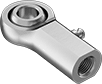
Internally Threaded Ball Joint Rod Ends with Grease Fitting
 | |
Shank | |||||||||||||
|---|---|---|---|---|---|---|---|---|---|---|---|---|---|
Thread Size | Ctr. Lg., mm | Thread Lg., mm | ID, mm | Max. Ball Swivel | Overall Wd., mm | Overall Thk., mm | Static Radial Load Cap., lb. | Material | Choose a Shank Thread Direction | Each | |||
Ball Joints with Grease Fitting | |||||||||||||
| M14 × 2 mm | 57 | 27 | 14 | 30° | 34.8 | 19 | 7,900 | Carbon Steel | Right Hand, Left Hand | 6536N5 | 000000 | ||
Internally Threaded Corrosion-Resistant Ball Joint Rod Ends
 | |
Shank | |||||||||||||
|---|---|---|---|---|---|---|---|---|---|---|---|---|---|
Thread Size | Ctr. Lg., mm | Thread Lg., mm | ID, mm | Max. Ball Swivel | Overall Wd., mm | Overall Thk., mm | Static Radial Load Cap., lb. | Material | Choose a Shank Thread Direction | Each | |||
Ball Joints | |||||||||||||
| M14 × 2 mm | 57 | 27 | 14 | 30° | 35 | 19 | 5,300 | 303 Stainless Steel | Right Hand, Left Hand | 2988K36 | 000000 | ||
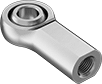
Internally Threaded High-Load Ball Joint Rod Ends
 | |
Shank | |||||||||||||
|---|---|---|---|---|---|---|---|---|---|---|---|---|---|
Thread Size | Ctr. Lg., mm | Thread Lg., mm | ID, mm | Max. Ball Swivel | Overall Wd., mm | Overall Thk., mm | Static Radial Load Cap., lb. | Material | Choose a Shank Thread Direction | Each | |||
Ball Joints | |||||||||||||
Nylon/PTFE Insert | |||||||||||||
| M14 × 2 mm | 57 | 27 | 14 | 21° | 35 | 19 | 20,300 | Chrome-Moly Steel | Right Hand, Left Hand | 4483T93 | 000000 | ||
Long-Life Ball Joint Rod Ends
 | |
Seals keep out dirt and an oil-embedded polyester foam insert slowly releases lubricant for a long life. You can remove the insert to add more oil if it starts to run dry. These rod ends have an eyelet and a ball that swivels to support angular misalignment. Made of zinc-plated steel, they have moderate corrosion resistance.
Shank | |||||||||||||
|---|---|---|---|---|---|---|---|---|---|---|---|---|---|
Thread Size | Ctr. Lg., mm | Thread Lg., mm | ID, mm | Max. Ball Swivel | Overall Wd., mm | Overall Thk., mm | Static Radial Load Cap., lb. | Material | Choose a Shank Thread Direction | Each | |||
Ball Joints | |||||||||||||
| M14 × 1.5 mm | 60 | 36 | 14 | 21° | 34.8 | 21 | 6,700 | Zinc-Plated Carbon Steel | Right Hand, Left Hand | 5884N33 | 000000 | ||
| M14 × 2 mm | 60 | 36 | 14 | 30° | 34.8 | 21 | 7,900 | Zinc-Plated Carbon Steel | Right Hand, Left Hand | 5884N34 | 00000 | ||
