We will reply to your message within an hour.
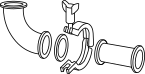
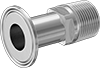
The smooth finish inside these stainless steel quick-clamp fittings makes it easy to remove product residue.
Use these fittings in an air vacuum system to avoid the hassle of brazing and welding. Insert two fittings into a clamp and tighten to form a secure seal in steel tubing.
Metal hose fittings have better durability than plastic barbed hose fittings.
Low-profile barbs and a longer first barb allow for a smoother, easier installation than other barbed fittings. Slide the barbed end into hose and secure with a clamp.
Metal cam-and-groove couplings have better durability than plastic cam-and-groove couplings.
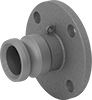
Couplings are metal, which has better durability than plastic cam-and-groove hose couplings. They consist of a plug and a socket that connect and disconnect quickly. Use them if you need frequent access to a line. To connect, insert the plug into the socket and push the levers down.
Access your line without twisting the hose—these unions separate into three pieces.
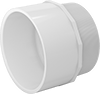
Connect these fittings to Schedule 40 plastic pipe—they are the industry standard for residential and commercial low-pressure plumbing and water supply applications. They are plastic for good corrosion resistance.
Watch water flow through your line. These fittings are compatible with Schedule 40 pipe, the industry standard for residential and commercial low-pressure plumbing and water supply.
Connect this pipe to standard-wall plastic pipe fittings for a variety of residential and commercial low-pressure plumbing and water supply applications.
See inside your line with this clear pipe, which works in a variety of residential and commercial low-pressure plumbing and water supply applications.
Connect these fittings to Schedule 80 pipe. With thicker, stronger walls than standard-wall fittings, they can handle heavy duty supply applications, such as water processing, wastewater treatment, and irrigation.
Connect to thick-wall plastic pipe fittings for use in heavy duty industrial plumbing and water supply applications, such as water processing, waste water treatment, and irrigation. Pipe can handle pressures up to 900 psi.
See what’s flowing through your line with this clear pipe. Since it’s Schedule 80, this pipe has thicker, stronger walls than standard-wall pipe, so you can use it for heavy duty industrial plumbing and water supply applications, such as water processing, waste water treatment, and irrigation.
Connect to CPVC pipe for use in high-temperature plumbing and water supply applications.
Connect to CPVC pipe fittings for use in high-temperature plumbing and water supply applications up to 170° or 200° F.
With thinner walls than Schedule 40 fittings, these are lighter in weight and have more space on the inside for high-flow applications, such as underground gravity-flow sewer and storm drainage lines. They are also known as SDR 35 fittings.
Butt-weld fittings allow for a smooth, flush connection that provides maximum flow.
Also known as Schedule 10 fittings, these are thin, lightweight, and corrosion resistant.
To make installing and maintaining systems easy, these connectors come with clamps that form a strong seal on pipe and fittings once tightened.
Slip these joints over your pipe ends and tighten the band clamps for a secure hold.
These joints weld to unthreaded pipe or another butt-weld fitting for a leak-resistant permanent connection.
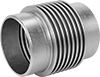
These all-metal expansion joints can handle high temperatures up to 800° F.
These expansion joints have a double-bulb design for extra movement and vibration absorption.
The flanged ends on these expansion joints rotate for easy bolt hole alignment during installation.
Connect different pipe sizes in your line while adding a point of flexibility between them. These expansion joints absorb movement between two connected pipes to reduce stress, vibration, and noise.
The PTFE body on these expansion joints has a super-smooth surface that stands up to corrosive chemicals.
The EPDM lining in these joints meets NSF/ANSI 61 standard for use with drinking water.