We will reply to your message within an hour.
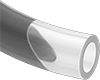
This general purpose tubing is the industry standard for air and water applications.
Thick walls give this tubing excellent abrasion resistance.
Protect sensitive equipment with this tubing—it is specially formulated to reduce the buildup of static electricity.
Multiple colors allow you to color-code your line for easy identification.
A braid reinforcement gives this tubing excellent strength in high-pressure applications up to 250 psi.
This multiple-line tubing holds together on its own, so there's no need for cable ties or tape.
Static electricity will not build up in this tubing, so you can use it near sensitive equipment.
Keep your work site safe and clutter free–this coiled tubing extends when you need it and retracts out of the way when you don't.
Designed for use in welding applications, this tubing has multiple layers of material and is specially formulated to self-extinguish.
This general purpose tubing has hard walls, yet is flexible enough for gradual bends. It has excellent strength and durability.
Excellent strength and durability allow this tubing to handle high-pressure air and water applications up to 950 psi.
Keep your work area tidy with this coiled tubing that extends when you need it and retracts out of the way when you don’t.
Run chemicals through this tubing at temperatures between -100° F and 500° F.
Ultraviolet light won’t cause this tubing to degrade or deteriorate.
You don’t have to worry about this tubing cracking due to stress or impact—even over a wide range of temperatures.
Hard walls give this tubing excellent strength in high-pressure and vacuum applications.
This durable tubing has the best abrasion and wear resistance of all our hard tubing for chemicals.
Keep your work site safe and clutter free—this coiled tubing extends when you need it and retracts out of the way when you don't.
Use this general purpose tubing with a variety of chemicals.
With excellent resistance to abrasion and tearing, this tubing can hold up in rugged environments.
An internal reinforcement gives this tubing the strength to handle high-pressure applications up to 350 psi.
Typically used in applications requiring movement, such as metering (peristaltic) pumps and robotics, this tubing can handle repeated bending and flexing.
Lighter than other plastic and rubber tubing, but extremely tough, this tubing stands up to the wear and tear of daily use.
Strong, hard walls give this tubing extra support in high-pressure and vacuum applications.
Strong, yet pliable, this tubing is good for gradual bends and can handle repeated flexing.
Designed for high-purity processes, this tubing is made without plasticizers like DEHP that can contaminate the fluid passing through it.
Designed for high-purity applications, this hard tubing is cleaned and bagged to prevent dirt and moisture from contaminating the inside. It is free of plasticizers like DEHP, so it won’t impart tastes or odors to the fluid running through it.
This tubing has hard walls like copper tubing, but is lighter in weight and easier to install. It connects to fittings with no heat or soldering required. Tubing meets NSF/ANSI Standard 61 for drinking water.
Made of nickel-plated brass, these tube fittings resist corrosion better than plain brass fittings. The male threaded ends connect to NPT, NPTF, BSPP, BSPT, and other universal threads, so you don’t have to bother matching exact thread types.
Make lightweight connections without the hassle of matching the exact thread type—these fittings connect to NPT, NPTF, BSPP, BSPT, and other universal threads.
Often used in outdoor, damp, and washdown environments, these 316 stainless steel fittings will not corrode from water, salt, or chemicals. The male threaded ends mate with NPT, NPTF, BSPT, BSPP, and other universal threads, so you won’t have to worry about matching exact threads when you’re on the job.
Made of nickel-plated brass, these fittings have better corrosion resistance than unplated brass fittings.
A 316 stainless steel body gives these fittings the best corrosion resistance of all our metal push-to-connect tube fittings.
These fittings won’t absorb moisture, so they’re good for water and high-humidity air applications.
The threads on these fittings mate with NPT, NPTF, BSPT, and BSPP threads.
Connect air brake lines with fittings that won’t crack in sub-zero temperatures. They meet Department of Transportation FMVSS 571 safety standards, so they’re often used in commercial trucks and trailers.
Designed for use in welding applications, these fittings are flame retardant.
An all-metal body and built-in tube support or dual seals allow these fittings to handle the highest pressure ratings of all our push-to-connect tube fittings.
Ball bearings allow these fittings to rotate 360°, even after they are tightened. They have a special seal that reduces friction to allow for continuous rotation.
Made of EPDM, the gasket on these fittings stands up to the hot water found in heat exchangers and cooling systems. These fittings have stainless steel pipe threads, which are more durable than the plastic pipe threads found on other push-to-connect tube fittings.
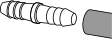
Tube supports slip inside tubing to prevent the walls from collapsing.
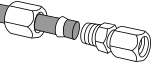
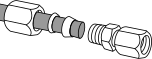
A single sleeve (ferrule) compresses the tubing as you tighten the nut on these fittings, creating a strong seal. They are brass for good corrosion resistance.
Use these sleeves with brass compression nuts and fittings to create a seal on plastic and rubber tubing.
Use these O-rings with brass compression tube fittings that have BSPP male threads. They create a seal on the BSPP male threads to guard against leaks.
Made of brass, these fittings resist corrosion from water and are more durable than plastic and aluminum fittings.
Aluminum fittings have good corrosion resistance, but are lighter in weight than brass.
The nickel plating on these fittings provides better corrosion resistance than unplated brass fittings.
Color-code fittings for easy identification. These aluminum fittings have good corrosion resistance, but are lighter in weight than brass.
Made of stainless steel, these fittings have better corrosion resistance than brass fittings.
You don't need a clamp to secure these fittings to tubing. They have a nut on the barbed end that tightens to hold the tubing in place.
Lighter in weight than their metal counterparts, these quick-disconnect couplings are made of acetal plastic. They are moisture resistant, so they won’t absorb water and lose strength, even in high-humidity environments.
Don’t get your lines crossed—use one of these couplings to quickly connect or disconnect multiple tubes at once.
Not only are these chrome-plated brass couplings corrosion resistant, they’re also durable enough to handle pressures up to 250 psi and can be used with vacuum.
Create custom couplings to save space and snake around obstructions. These couplings let you swap in different ends to change the connection size, type, and orientation to fit your specific setup.
Prevent mixing the wrong high-pressure lines—these couplings are designed to only connect with a plug or socket of the same color.
A built-in shut-off valve stops the flow when you separate these couplings, so air or water won’t leak from your line. Made of nylon, these couplings are lightweight and have good impact and abrasion resistance.
These plastic compression fittings meet NSF/ANSI Standard 51 for food contact.
Use these nuts and sleeves with compression fittings for food and beverage to create a seal on plastic tubing.
These quick-disconnect couplings meet NSF/ANSI 169 for food equipment.
These quick-disconnect couplings mate with a sanitary stainless steel quick-clamp fitting for use in dairy lines.
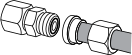
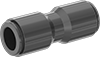
Also known as instant fittings, these chemical-resistant plastic fittings connect to tubing with a push. An internal gripping ring holds the tubing tight.
Fittings are 316 stainless steel, which has excellent chemical resistance and is more durable than plastic.
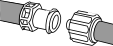
Quick-disconnect couplings consist of a plug and a socket that join with a latch so you can easily connect and disconnect your line.
Fittings can withstand temperatures up to 200° F.
Use these nuts with brass compression fittings to create a seal on plastic tubing. They meet NSF/ANSI 61 for use with drinking water.
Also known as instant fittings, they connect to tubing with a push, and an internal gripping ring and O-ring hold the tubing tight. Use in applications up to 140 psi.
Use these fittings at pressures up to 9,700 psi. Also known as instrumentation fittings, they are made to tight tolerances for use in high-precision applications. They are compatible with Swagelok®, Let-Lok, and Parker A-Lok fittings.
Couple these sleeves with Yor-Lok nuts and fittings to create an extra-strong seal on stainless steel tubing.
A single sleeve (ferrule) bites into tubing as you tighten the nut, creating a strong seal. The nut and sleeve are included.
The flat face of the fitting connects to a tube adapter so you can slide the tubing and fitting sideways to disconnect in cramped spaces. They are also known zero-clearance fittings.
The sleeve in these fittings is rubber instead of metal, so it cushions the tubing and absorbs vibration while creating a tight seal.
A single sleeve (ferrule) bites into tubing as you tighten the nut, creating a strong seal.
Use these sleeves with compression nuts and fittings, sometimes called bite fittings, to create a strong seal on steel tubing. They are also known as ferrules.
Use these nuts with compression sleeves and fittings, also known as bite fittings, to create a strong seal on steel tubing.
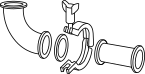
Use these fittings in an air vacuum system to avoid the hassle of brazing and welding. Insert two fittings into a clamp and tighten to form a secure seal in steel tubing.
A tube adapter sits flush against the flat face of the fitting so you can slide the steel tubing and fitting sideways to disconnect in cramped spaces. Also known as zero-clearance fittings.
Yarn reinforcement gives this hose good strength under pressure.
Attach push-on barbed fittings to this hose for use in low-pressure hydraulic applications. No clamps are needed to secure fittings to the hose; the more you pull on the fittings, the tighter the hose will grip.
Although only half the weight, this hose resists wear and tear 240 times better than our standard rubber hydraulic hose.
Prevent electrical shock and damage to equipment while moving hydraulic fluid near high voltages.
Hose has good oil-resistance, so it won’t deteriorate or become brittle when exposed to grease and lubricants.
Metal hose fittings have better durability than plastic barbed hose fittings.
Eliminate sharp bends at the end of your air and water hose—these fittings have a built-in kink absorber.
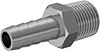
Fittings are metal for better durability than plastic barbed hose fittings. They have sharper barbs than standard barbed hose fittings to grip push-on hose without the need for clamps or ferrules. The more you pull on the fittings, the tighter the hose will grip.
Low-profile barbs and a longer first barb allow for a smoother, easier installation than other barbed fittings. Slide the barbed end into hose and secure with a clamp.
The industry standard for quick-disconnect couplings, these are also known as industrial interchange couplings. Compatible with Industrial-shape plugs and sockets.
Made of acetal, these couplings are lighter in weight than metal quick-disconnect couplings. Compatible with Plastic-shape plugs and sockets.
Compatible with ARO-shape plugs and sockets.
Compatible with Schrader-shape plugs and sockets.
Also known as automotive couplings. Compatible with Tru-Flate-shape plugs and sockets.
Plugs and sockets are color coded by shape so you can't mix hose lines. Only plugs and sockets of the same color will fit together.
Couplings have an identical claw-style head that connects to another twist-claw hose coupling with a quarter twist.
Couplings have a spring-loaded locking sleeve that automatically locks into place to prevent accidental disconnection. The identical claw-style head connects to another spring-lock twist-claw hose coupling with a quarter twist.
Also known as Thor couplings, these have two locking points to give you twice the gripping power of standard grip-lock couplings. They consist of a plug and a socket that connect with a quarter twist.
Fittings have sharp barbs that grip push-on hose with no clamps or ferrules required. The more you pull on the fittings, the tighter the hose will grip. Use in low-pressure hydraulic applications up to 350 psi.
Use these couplings at pressures up to 5,000 psi. They consist of a plug and socket that connect and disconnect quickly. Use them if you need frequent access to a line. They are compatible with International Standard ISO B-shape plugs and sockets.
Use these couplings at pressures up to 3,000 psi. They consist of a plug and socket that connect and disconnect quickly. Use them if you need frequent access to a line. They are compatible with Pioneer-shape plugs and sockets.
Use these couplings at pressures up to 5,000 psi. They consist of a plug and socket that connect and disconnect quickly. Use them if you need frequent access to a line. They are compatible with International Standard ISO A-shape plugs and sockets.
Made of stainless steel, these hose fittings are more durable than plastic barbed hose fittings and have excellent corrosion and chemical resistance. Slide the barbed end into hose and secure with a clamp.
These couplings are compatible with International Standard ISO Series B-shape plugs and sockets. They are FDA compliant, so they’re suitable for food and beverage applications and won’t impart tastes or odors to the product. They consist of a plug and a socket that connect and disconnect quickly so you can frequently access your line. Use at pressures up to 220 psi.
Use these barbed fittings in low-pressure steam applications up to 150 psi. Slide the barbed end into hose and secure with a clamp.
Couplings consist of a plug and a socket that connect quickly. Use them if you need frequent access to a line. They are designed for low-pressure steam applications up to 300 psi.
Also known as ground-joint couplings and boss couplings, these fittings are designed for high-pressure steam applications up to 600 psi. Insert the barbed end of the fitting into hose, then position the interlocking clamp over the hose and bolt into place. The clamp firmly grips your hose as it locks into the ring of the barbed end, creating a leak-tight seal.
Connect to thick-wall plastic pipe fittings for use in heavy duty industrial plumbing and water supply applications, such as water processing, waste water treatment, and irrigation. Pipe can handle pressures up to 900 psi.
See what’s flowing through your line with this clear pipe. Since it’s Schedule 80, this pipe has thicker, stronger walls than standard-wall pipe, so you can use it for heavy duty industrial plumbing and water supply applications, such as water processing, waste water treatment, and irrigation.
Connect these fittings to Schedule 80 pipe. With thicker, stronger walls than standard-wall fittings, they can handle heavy duty supply applications, such as water processing, wastewater treatment, and irrigation.
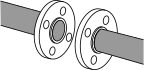
Bolt two same-size flanges together with a gasket to create an access point within a line. They are also known as Pressure Class 150 flanges. They have thick, strong walls to handle heavy duty industrial plumbing and water supply applications, such as water processing, waste water treatment, and irrigation.
Connect to CPVC pipe fittings for use in high-temperature plumbing and water supply applications up to 170° or 200° F.
Connect to CPVC pipe for use in high-temperature plumbing and water supply applications.
Bolt two same-size flanges together with a gasket to create an access point within a line. They are also known as Pressure Class 150 flanges. Use in high-temperature plumbing and water supply applications up to 200° F.