
McMaster-Carr logo
    Filter by
    Number of Teeth
    System of Measurement
    Strand Type
    Pitch
    Shaft Type
    Bore Type
    Component
    Material
    Sprocket Type
    Chain Standard
    Chain Type
    Tooth Heat Treatment
    U.S.–Mexico–Canada Agreement (USMCA) Qualifying
    DFARS Specialty Metals
    Export Control Classification Number (ECCN)
    Industrial Info Snippet
    Overall Width
    Shaft Mount Type
    Heat Treatment
    Enter e-mail addresses in the fields below
    Message
    Cancel
    Comments
    E-mail address (if you would like a response)
    15 Products

    Sprockets

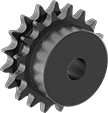
    Image of Product. Front orientation. Drive Sprockets. Sprockets, For Double Strand.

    For Double Strand

    Sprocket teeth mesh with your roller chain to smoothly transmit power. These U.S.-made sprockets have machined teeth for a more precise fit than flame-cut or punched teeth, allowing them to glide in and out of the chain to reduce wear and extend chain life.
    Wear-Resistant Steel with Hardened Teeth—These sprockets have teeth that are hardened from the tip to the base so they withstand chain contact and wear evenly. That means fewer broken teeth and a longer lifespan than sprockets with unhardened or tip-hardened teeth. Steel is best for dry environments since moisture will cause it to rust.
    Plain Bore—Plain bore sprockets give you options—machine a custom bore, weld, or press-fit them in place. They're sized to the minimum shaft diameter listed and are machinable up to the maximum.
    For
    Roller Chain
    Trade
    No.
    Std.
    Pitch
    No. of
    Teeth
    OD
    Bore
    Type
    For Shaft Dia.
    Each
    For Double Strand
     
    Wear-Resistant Steel with Hardened Teeth
    35-2ANSI3/8"121 5/8"Plain1/2" to 9/16"2784K1000000
    35-2ANSI3/8"131 3/4"Plain1/2" to 11/16"2784K200000
    35-2ANSI3/8"141 7/8"Plain1/2" to 7/8"2784K300000
    35-2ANSI3/8"152"Plain1/2" to 15/16"2784K400000
    35-2ANSI3/8"162 1/8"Plain1/2" to 15/16"2784K500000
    35-2ANSI3/8"172 1/4"Plain1/2" to 1 1/16"2784K600000
    35-2ANSI3/8"182 3/8"Plain1/2" to 1 3/16"2784K700000
    35-2ANSI3/8"192 1/2"Plain1/2" to 1 5/16"2784K800000
    35-2ANSI3/8"202 9/16"Plain3/4" to 1 5/16"2784K900000
     

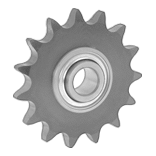
    Idler Sprockets

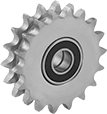
    Maintain constant tension on your roller chain to reduce wear and vibration. These sprockets press against the chain to take up slack and rotate freely on bearings to keep the chain moving smoothly. They’re often paired with roller chain tensioners.
    For Double Strand
    Image of Product. Front orientation. Idler Sprockets. For Double Strand, Ball Bearing.

    Ball Bearing

    Ball Bearing—Smoother than smooth—the balls inside these bearings roll nearly friction-free to handle high speeds. All are sealed to keep lubricant in and dust out.
    Steel—Steel is strong, but best for dry environments since moisture will cause it to rust.
    For
    Roller Chain
    Trade
    No.
    Std.
    Pitch
    No. of
    Teeth
    For Shaft
    Dia.
    OD
    Bearing
    Material
    Each
    Ball Bearing
     
    Steel
    35-2ANSI3/8"191/2"2 1/2"Steel6260K1000000
    35-2ANSI3/8"195/8"2 1/2"Steel6260K200000
     

    Roller Chain and Links

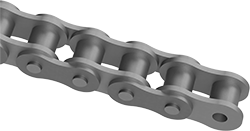
    Image of Product. Front orientation. Roller Chain and Links. Roller Chain and Links, Chain.
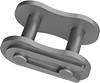
    Image of Product. Front orientation. Roller Chain and Links. Roller Chain and Links, Connecting Links.

    Chain

    Connecting Links

    Image of Product. Front orientation. Roller Chain and Links. Roller Chain and Links, Adding Links.
    Image of Product. Front orientation. Roller Chain and Links. Roller Chain and Links, Adding-and-Connecting Links.

    Adding Links

    Adding-and-Connecting

    Links

    Image of Attribute. Front orientation. Contains Annotated.
    Pair this chain with sprockets to transmit power between rotating shafts. Like the chain on a bike, the side plates have a figure-eight shape that grips the sprockets without slipping.
    Lubrication is key to smooth operation and long chain life. Routinely apply oil by hand or install an oil dispenser for continuous lubrication.
    Steel—The go-to for roller chain, steel is strong and economical. While proper lubrication helps prevent rusting, it’s not as corrosion resistant as coated or stainless steel.
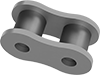
    Connecting Link—Use a single link to join both ends of your chain. Start by removing the spring clip or cotter pin from the link’s side plate. Then, slide the link pins into the mating rollers at each end of your chain and snap the clip back on. Also known as master links.
    Adding Link—Attach with a connecting link to extend the length of your chain. Each link adds a length equal to the chain’s pitch. Also known as roller links.
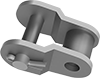
    Adding-and-Connecting Link—An all-in-one link for adding and connecting. It adds a half-pitch length at the roller end, allowing finer length adjustments than full-pitch links. The pin end connects to your chain—except for trade number 25, which requires a separate connecting link. Remove the side plate to install. Also known as half links and offset links.
    Chain
    Connecting Links
    Adding Links
    Adding-and-Connecting
    Links
    Roller
    Chain
    Trade
    No.
    Std.
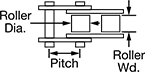
    Pitch
    Roller
    Dia.
    Roller
    Wd.
    Working
    Load, lb.
    Per
    Ft.
    Each
    Each
    Each
    Double Strand
     
    Steel
    35-2ANSI3/8"0.200"3/16"8106261K7110000006261K221000006261K103000006261K84100000
     
    back to top